Wednesday, January 28, 2009

Copyright Information


Copyright in the works of Franceso Karel Samethini is vested in Elisabeth Samethini of Sydney, NSW, Australia.


The following text and images may be reproduced by permission only: (1) All text from the Author's Preface through the end of Chapter 27; (2) the contents of Appendix A, and; (3) All photos and images designated as "Frank Samethini Collection" or "Han Samethini Collection". However, there is one exception to the latter: the photograph of Han Samethini at Chungkai POW camp, which has long been available through other sources (e.g., the Australian War Memorial).

We encourage links from other Internet sites to this one.

For permissions, comments or questions please send e-mail to kalhorn@sbcglobal.net

Tuesday, January 20, 2009

Contents

Photo Source: Thailand-Burma Railway Centre

Foreword to the Blog Version of The Sky Looked Down
Author's Preface
The Song of the Railroad
1. Bondi
2. Surabaya
3. Encounter
4. The Darkening Sky
5. The Unspeakable Days
6. Destination Railroad
7. Andre
8. The River
9. Hairbreadth Escape
10. Railroad
11. Bridge on the Kwai
12. Chungkai
13. More of Chungkai
14. Who is the Thief?
15. Tamuang
16. At Sea
17. Nightmare Journey
18. Nippon
19. Ministry
20. Quake
21. Toyama
22. The End of the Road
23. Manila
24. Peace?
25. The Letter
26. The Road Back
27. Lisa and Mary-Em

Appendix A: Lisa's Story
Appendix B: Sources on the Burma Railway and Japanese Prison Camps
Appendix C: Music and Songs

Title Photo Source: "The River Kwai", photos.igougo.com

Foreword to the Blog Version of The Sky Looked Down

Cover of the leather-bound manuscript of The Sky Looked Down
Source: Frank Samethini Collection


Francesco Karel Samethini (1915-2000) was born in Bondowoso, East Java, in the Netherlands East Indies. He and his younger brother Henri (Han) grew up on a sugar plantation managed by their father. After receiving primary schooling in the East Indies, the boys were sent to Holland for secondary schooling. They returned to Java in the early 1930s. Han became a musician and band leader. Frank pursued a business career, and by the end of the decade he was working in the Surabaya office of a steamship line agent.

Frank tells his story from this starting point, the threshold of the 1940s in the bustling port city of Surabaya. Here he spent happy nights on the town, fell in love with his future bride Lisa, and dreamed of blissful years to come with a wife and family. Here he was called to arms by Queen and Country, and here he was taken captive, a prisoner of war, by the Empire of Japan.

Until 2009, Samethini's vivid, intensely personal POW memoir was known only to his family. He began writing in the mid 1960s at Bondi Beach, Sydney, but did not complete the work until 1992. In December of that year Frank had five leather-bound copies printed, giving one to his wife Elisabeth (Lisa), and the others to his four daughters. This blog version of The Sky Looked Down, based on the manuscript, makes the story available to a broader readership for the first time. Illustrations and footnotes have been added.

An immense debt of gratitude is owed to Frank's family, in particular Elisabeth and daughters Mary-emma and Christine, for lending a copy of the manuscript and providing several photos from the family collection. This project would have been impossible without their help and steady encouragement.

- R.K.

Author's Preface

Photo Source: Frank Samethini Collection

The sky looked down on a young Dutchman in the East Indies in the Nineteen Forties. He was enjoying a life of ease and security from which he was suddenly hurled into the abyss of war. This book is not merely a narrative of happenings but a dramatisation of actual events as they took place, sharply outlining the emotional effects on himself and, as observed by him, on others. It is a moving picture of how he met the girl who changed his life in the tumultuous days of preparing for war, the brief wedding ceremony and, shortly afterwards, the outbreak of hostilities with Japan. The unconditional surrender, separation from his family, and transport to Changi and the infamous Burma Railroad.

It also records two examples, never published before, of the perfidy of a former fortress commander and the dual personality of an officer of a famous regiment. It tells of the young man's solitary nightly excursions across the river in the jungle of Thailand, and the hairbreadth escape from detection and death. More than anything else it shows that, in spite of the general privation and back-breaking work under the tropical sun and monsoonal rain, attacks of dysentery and malaria, there was the ever prevailing spirit and sense of humour breaking through.

It was an inexplicable spirit of faith in the ultimate victory over an inhumanly cruel enemy and filth and disease, bringing him and his small group of friends moments of quiet contentment and friendly jest amidst all the squalor and misery.

Then there was the dangerous sea voyage with the torpedo attack and the sweltering heat in the lower hold. The arrival at Japan, followed by more hard labour and the great earthquake lasting six days. The hell of American air force bombardment and finally the atomic blasts at Hiroshima and Nagasaki ending the war.

The long trail, delayed by stopovers at rest camps, began back to the Indies and his beloved Lisa.

Frank Samethini, 1992

The Song of the Railroad

Photo Source: photos.igougo.com

THE SONG OF THE RAILROAD
by Frank Samethini

Twinline of steel, winding through hills, plains and steaming jungle,
resting on a thousand sleepers, the bodies of the perished.

Each dawn the rising red ball of sun
Brings a new day of hunger and pain.
Worn out before the struggle's begun,
Why should we resist further in vain?
Why all this harrowing, insane strife
In what little there is left of life?

In the hot, quivering air a whisper, soft but nudging, pulling.
Listen not to that voice, pay no heed!
"Think, think of those at home, those you love."
Don't submit to this devilish creed.
For, true as there's a heaven above,
If you harden yourself, do not bend,
You might conquer it all in the end.
Pain, gnawing pain in legs and shoulders.
Dig! Dig! Lift that spade, move those boulders.
Beware! Creeping shadow of man, gun,
Watching us under the searing sun.
There! The snarl and the sickening crack
Of rifle butt on a comrade's back.

"Lie down, little brother. Lay yourself down to sleep."
Man, blood dripping from his fingernails,
Tumbles down. "I can no more!" he wails.
Pulled upright he is by Nippon scum.
The judo smack, bursting his eardrum,
Knocks him down and he lies there prostrate
While we're looking on in helpless hate.

"Lie down, little brother. There'll be no more to weep."
Hatred rising in a silent cry
Urges you to fight on, not to die.
But you can dig no more. Rest's needed,
Just for a moment. But, oh my God!
His boot kicks your groin - the flaming pain
Shoots from your belly, knots in your brain.

"Come, listen to me. Hear my sigh riding on the wind."
Rain, in sudden, chilling, lashing squall
Weakens the structure - it starts to fall!
The heavy weight at once snaps the rope,
Half the bridge is plunging down the slope.
Flee, you slaves, run, god-forsaken dogs!
Save yourselves from the thundering logs.

"Heed my whisper. Sink down and give in, my little friend."
A broken rail clangs, the deafening blow
Splintering bone, spattering his brain
On green, wet leaves trembling in the rain.
His costly blood drips on muddy ground.
Again, anger surging without a sound
And the voice, though you're free from its spell.

"Lie down, little brother. Lay yourself down where he fell."
Once more that pitiful bundle, still
Lying between the leaves where he died,
Has shocked you into an iron will
To battle and claw, to kick and bite.
To grit the teeth and stiffen the soul.
To hell with them, damn the enemy!
We'll hang on for that ultimate goal,
To live and reach the Day of Victory.

And so they went, day by day, week by week, month by month, to the bridge on the River Kwai. With sullen stubbornness, unyielding to impossible odds, struggling on to perish or to do the formidable, building the bridge for the twinline of steel. Winding through hills, plains and steaming jungle, two hundred and fifty miles long, resting on sleepers, resting on the memory of the perished, worked to death on the Burma Railroad.

1. Bondi

Bondi Beach
Sydney, New South Wales
Photo Source: postcardsfromaus.blogspot.com

The sky. Deep, all encompassing, blazing in the noonday sun. White clouds drift lazily towards the thin line of horizon. The beach, only yesterday sweeping down from the promenade in a wide arc of spotless white sand, is now thickly studded with people. A multitude sprawled in almost complete nudeness permissible for the occasion, exploited with profound dedication. Young womanhood in cleft, freckled tautness, bared to an inch from the last remaining punctuation of female anatomy, is languidly reclining within easy hand span of their escorts, fur-chested, sunglassed males in pouched briefs. Further down on the beach mums and dads, with blotches of sand clinging on pallid thighs and varicose veins, watch their young in the surf romping with squeals of laughter in bursts of splattering spray. Transistored pests twang discordantly in the steady crunch and whoosh of breakers on the sands.

Look, there by the water: that blonde in the summer dress. Slender figure, clean, delicate cut of the jaw, head tossed high with hair billowing. Barefooted, she holds her skirt above dimpled knees while stepping gingerly with flashing legs over seaweed littering the beach where it runs into the hissing water. Her dainty feet leave shallow imprints in the flat shelf of sand, left gleaming wet by each wave drawing back into the sea.

She, that girl. How she commands all attention amidst the cloying generosity of bikinis! See those man-heads turning avidly to the skirt-and-blouse lass. A cause for wonder - and for a memory of long ago.

Photo Source: flickr.com

The rock path leads to a patch of grass on a secluded spot, away and high over the beach, overlooking the wide expanse of the Pacific. Dull, shimmering, tiny flashes of sunlight caught on water ripples break the monotony of the vast, blue haze. One may bask here in the sun and scan the horizon. Look, there is a white speck way out on the ocean. A sailing boat. Where is it going? To another part of the world. To the old country? The binoculars do not discover anything else of interest, and swing back to focus again on the tiny, triangular sail, floating all on its own in the wide ocean. Is it really moving? Yes, but slowly, very slowly, breaking through a barrier of wind and water to get across to wherever it is going. Then, out of nowhere, the sudden, stirring thought. It is not just a sailing boat, but a trick of light. It is an idea, a plan materialised in vision. Something I wanted to do all these months. Don't I know? That boat is on a journey to years gone by, as my thoughts are, breaking through a barrier of time.

The wind carries snatches of bustle and clamour from the beach. A whistle, shrill and piercing, the deep roar of a sports car, the chime on the ice cream truck back on the road. High aloft, a seagull is wailing dolorously. In the sights of the binoculars the little boat is protected in an orbular sphere without sound. No, not quite without it. It seems to lie waiting in a rushing silence, out of which a note rises to fly across the waters. A faint, far note calling me to embark on a journey.

On a journey to happenings of the past, to a procession of faces appearing before my closed eyes. Faces with features still, or with moving lips forming the words which all these years have lingered on in memory. A journey to scenes and sounds embedded in mind forever, some good and pleasing, and some ugly and revolting. Some faded far away, some as clear as if they happened yesterday.

To the laughter and chuckle of friends, the cry, the snarl of hate. The colour of bottomless deep water, the splitting and trembling earth. Lips moist and alluring, lips drawn over the teeth in death. The sough of a gentle breeze through tall grass, clouds racing before the gale. The ice cold snap of a gun breech, the hoarse bark, and blood flung on the sand. The whispering, the kisses, the fragrance of smooth, fair skin.

To the goodness and bliss, the fear and anguish of those turbulent days. To recapture the feeling of the soul as it came to life, or as it died within, as it was exposed in men, and in beast-men.

Photo Source: Islandtimevacationhomes.com

There was a tree, a big wide tree, and its branches and leaves spread fanwise like a broad green umbrella. It stood apart from the other trees, which was as it should be, for this tree was something special. It was one to talk to. There was also the garden with the flowers, shrubs and a pond. A shallow pond, its coping flush with the lawn, with green and yellow tipped ferns hanging over the water. Often the water in the pond was still and clear with slowly swaying tendrils of weed on the mossy bottom, the slimy slush of rotting stems and leaves that had died. Behind the low fence of the garden were the hills. The ever green hills of Java, sloping down to the dark outline of the forest. And behind the fence, there was that tree, the one to talk to. In a whisper, or in a loud voice when nobody else was around. I could say anything to that tree, and it would answer, just in a way as I knew it would. Or it would slip into an embarrassed silence.

Photo Source: Flowtography

It was nothing but a game I had made up, in the tender years of early youth.

All that was a long time ago. I had forgotten about it, and if I hadn't, I would certainly not talk about it with anybody. Until later, much later, the game is played again, and a tree is once more important to me. Very important, for it saved my life.

2. Surabaya

Photo Source: flickr.com

The river they call Brantas. Winding its way through Surabaya, the merry town of the Thirties, in the Netherlands East Indies. Entering the town in the suburb of Darmo, it flows for a while by a rolling green vista of well-kept gardens and lawns sweeping down from the terraces of residences where the prominent live. Dignity and firm security displayed in robust granite ballustrade and stained-glass doors and windows at the front.

The boulevards and avenues respectably quiet and undisturbed. A stillness accentuated by the rustle of the wind in tall casuarina trees along the riverbank, and the distant jangle of the tram. A mile further down, the Brantas enters the Gubeng district, passing by fenced-in backyards of dwellings of lesser status, the boarding houses and private hotels. A street vendor calls monotonously. The clip-clop of the horse of a hire-surrey is momentarily drowned in the low-humming swoosh of a motor car. With measured intervals a gong is struck before a cottage near the corner, announcing the forthcoming public auction of the departed householder's furniture and other possessions. At the upper-town railway station, a hissing of spurting steam, a mournful hoot and clanging engine. On the sharply curving street leading to the Gubeng bridge, tyres screech beside tram wheels grinding in their rail grooves. Under the bridge oddly shaped clusters of garbage and flotsam ride the quietly moving water halt, revolving slowly. Then, still turning lazily, they resume their trip, passing close to the reed banks of the park with its lotus pond and canna beds, and the silvery, glinting gossamer of water sprinklers. Magpies scamper on the sun-dappled grass under the sycamores.


Photo Source: Surabaya Memory/Petra Christian University

Further down, the river flows by lofty palm fringed driveways to stately offices of authority and government - frowning, rigid and aloof in marble and colonnade. The Dutch tricolour flies proudly from the mast. Further down again, the river, sluggish and muddy now, passes by the agitated hustle and bustle of William's Quay in downtown Surabaya. Domain of merchants, brokers and bankers, money-making amidst clattering typewriters, ringing telephones and buzzing ceiling fans. At the door the name of the company is richly embossed on copper plate, leaving an impression of infallibility and trustworthiness.

Photo Source: Surabaya Memory/Petra Christian University

On the opposite bank of the river lies Chinatown and the Red Bridge, where that forever industrious race live in a confusion of narrow lanes and alleys. Two-storeyed shophouses vividly splashed with crisscross symbols, the wail of Chinese music from an open fronted cafe where, in passing by, a glimpse is seen of deftly manipulated chopsticks picking food from hand-cupped rice bowls. In the air a mixture of typical smells of the Orient: gums and spice, with an occasional whiff of gutter stink and incense. The claxon hooting and ringing of bicycle bells, the noise of the always congested traffic on the street, until dusk falls and the office front door is slammed shut.

Finally the river reaches its estuary with the bobbing masts of gaily adorned native sailing craft from Madura and Makassar, the river water casting dancing reflections of light on the slender prows, moored in clusters along the ancient quay and its mossy dents, notches and century-old, corrosion-bated mooring rings.

Nimble-footed coolies walk rhythmically on narrow, swaying gangplanks, heavy baskets with dried fish and copra on neck and shoulders, the corded ridges of their deep brown backs dripping with sweat. A flock of sparrows peck madly at rice grains spilled on the quay. On a small, barnacle-rimmed jetty a native woman squats, beating her wash on a flat stone. Her shoulders, back and bottom, in the faded sarong hitched under the armpits, flow out in the contours of a guitar. Flitting black streaks of swallows skim the river that now finally, languidly delivers its water into the sea in gradually deepening colours of blue and green. Out in the Roads of Surabaya, on the slowly rising and falling swell, white-dotted with seagulls, a towering ocean liner growls, drowning out the clang of busily spinning winches and long-necked cranes on the wharves. Below the storm warning mast on the harbour master's office roof, a tugboat hoots an answer, her screws eagerly churning the brackish water. The dockyards and quay of Surabaya where shirt-drenching heat shimmers as a glistening pool on the tacky-hot bitumen. Where ships come from all over the world, each containing an atmosphere typical of her home port.

Photo Source: malang.endonesa.net

Visible and invisible little things in master and crew that make up the Briton, Norwegian, Dutchman and Greek. The world of big shipping. After work, one may be invited to come on board again for a quiet beer while listening to tales of Liverpool, Piraeus, Oslo and Vancouver.

Day is done, darkness has fallen, the worst of the heat gone. Pastel-coloured lampshades shine gently through a filigree of potplants and shrubs. In the warm, scented evening we read and talk out in front on the open porch. A thin spiral of grey smoke eddies up from a coil of mosquito repellent burning on a saucer on the floor. A wide-eyed brown kitten stalks, with great display of fuss, an imaginary prey between the magnolias. Back in the house the clock ding-dongs through soft radio music. The light circle of the porch lamp does not quite reach the dark hibiscus hedge at the front gate, where a lone cricket chirps incessantly. It is Saturday evening, after dinner time. All the news is read, all events of the day discussed, bemoaned or laughed about.

Photo Source: Zoo Leven Wij in Indie

A drive is then suggested and agreed upon. Soon we have joined the long line of motor cars out on the road for a little cruise to the entertainment district of Surabaya and on to the harbour for an hour of cool, refreshing sea breeze. The hood of the car is let down to make the most of the cool evening air. The motor sings, the wheels fly with a soft burr. Tall arc lights are caught in a dull shine moving along the gleaming body of our car. Everyone is in a lighthearted mood of Saturday evening, the whole night in front and all the free Sunday after that. When we enter Palm Lane we spot a burst of red neon on the left side. That's the "Tabarin" bar and dancing establishment, closed now, its opening time of ten o'clock catering to the after-theatre and supper folk. Opposite is the "Shanghai" restaurant, adorned with strings of pastel-coloured Chinese lamps on the open terrace. Munching and drinking people served by wooden-faced Indonesian waiters deftly balancing trays laden with delicacies. At the front of the restaurant a few native boys carrying boxes with cigarettes loiter about. They will be there the whole night. On the corner of Palm Lane and Simpang Road, the Maxim Cinema blazes in floodlights, flanked by a file of Fiat Balilla taxis waiting for the end of the first session. The traffic signal switches to red, halting our car with a silent throb of its motor. We are facing the whitewashed facade and marble floors of the Simpang Club, select and suave, its members restricted to a better salaried class of people. Cozy little lampshades glow on small wicker tables on patios in front, where gentlemen with their lady companions are seated, sipping an aperitif or after-dinner coffee and liqueur. Blue cigar smoke and, now and then, a quiet sparkle of jewelry. Tyres crunch on the gravelled drive to the carpeted club entrance. The solid snap of an expensive automobile's door. New guests have arrived.

The signal flashes to green. Our route goes by the park. In the distance strings of orange lights adorn the bandstand from which come muffled snatches of drums and clashing cymbals. We drive through the Tunjungan now with its numerous bars, hotels and theatres. The brilliant shop windows of the newly opened Japanese department store Tjijoda, and the more soberly illuminated facade of Whiteway Laidlaw. High above in the night air, the jumble of multi-coloured neon advertising, motionless or in running flashes. Further down the road, Town Hall Gardens with trees full of red, white and blue lights. Something must be on again there in Town Hall Gardens, where the small-income man finds diversion in word, music and dance. Perhaps a jubilee or congress of sorts, doubtlessly celebrated with endless speeches and a boring play. Then, to top it off, a ball with the inevitable Hawaiian band with its guitars twanging sweet melodies of moonlight and dreams come true in Waikiki and Honolulu. Girls, some in rather garish coloured dress, will try to follow the astonishingly complicated dance maneuvers of their escorts in suits of every taste and shade.

Entering downtown, the night seems here deeper and still, with myriads of tiny moths circling the globes of tall lamp posts on William's Quay and Red Bridge, strangely quiet and deserted at this hour. An oil wick flutters in the small cabin of a native barge on the dark river. Glowing pinpoints light up and darken again in the porticoes and doorways of the locked up business houses along the quay, where Madurese wharf labourers are smoking their favourite cheroots of clove-saturated tobacco rolled in maize leaf. Proud and independent, spending the night outdoors on a bed of jute bags, anywhere they may fancy, rather than having to return dutifully to the one and same address.

Finally we reach the Heads and the car is brought to a halt. At the mouth of the Brantas the last ferry boat from Madura eases along her berth with a deep throb of her engines, her green and red lights shining through billows of swirling steam. High above, invisible in the darkness, a night bird cries for its mate. Far out in the Roads a yellow beacon winks slowly with measured intervals across a sea which lies there serene and peaceful. The Western Fairway, between two citadels armed to the teeth, Fort Menari and Fort Piring, their big guns rendering suicidal any attempt to enter the harbour by an aggressor, whoever it may be.

Another car pulls up near where we are. For a while we hear the intonation of its passengers filter through the mild sea breeze. They laugh a little, then fall silent. So pleasingly quiet it is here.

This town, this beloved Surabaya, twinkling its lights, breathing under the stars. [1] [2]

On the porch, back home, the mosquito repellent has collapsed into a brittle whitish coil of ash. The air is chilly. Inside now, perhaps to a game of cards or to bed. Tomorrow is another day.

Frank Samethini
Photo Source: Frank Samethini Collection

Another day breaks through in Surabaya, where generations of carefully planned colonisation have left a stamp of prosperity, peace and unshakable security. This town with its unforgettable memories of leaving school, first job, first pay envelope. That terrific feeling of young manhood, when life seems at its best, exciting, promising. The homecoming on Saturdays from work, with all that long, free weekend waiting; the girls, the big soccer match. The ups taken for granted, the downs shrugged off, in the Golden Indies of pre-war time.

Visible through the open porthole in the cabin, the Madura Straits in late afternoon. Wind blowing hard on a taut sail, flash of sunlight exploding soundlessly off a speedboat's windscreen, the spray from her bow flaring out in a glittering transparent fan. The workday over, it is good to rest a while before going home. Even the buzz from the only surviving fly in the captain's cabin, deftly darting away from his angry, slapping hand, seems to belong, to fit in the drowsy atmosphere of satisfaction. Conversation, in the beginning rather agitated, has settled to a bored monotone. The Old Man has been upset about a character called Hitler, who has been much in the news lately. The chap appears to be up to some mischief in Germany.

So what? That's thousands of miles away, too far to bother about. It's nice and cool here, and that's a good drop of beer. The captain says that the people in Germany are drawing a blueprint for another big war. But lots of people say that is not so. Was not the Great War fought to end all wars? It'll blow over in time, you'll see. All one should be concerned about is having a good time. Why not? You're young only once, so make the most of it. In another half-hour or so, home for a shower, dinner and later that redhead. Should be an interesting evening with that figure and temperament. And in two more weeks, holidays coming up. That little bungalow in the hills, walks through the coffee plantation, Mum pottering in the vegetable garden, a dip in the mountain stream at the back, great fun. How am I to know about what is to come? The terrible blow, the kick sending me reeling down the hill, rolling and tumbling over and over, until I finally hit the bottom and cannot sink lower any more.


Footnotes

[1] The Dutch names of the Surabaya landmarks and geography Frank mentions are:
William's Quay = Willemskade
Red Bridge = Rode Brug (today called Jembatan Merah)
Palm Lane = Palmenlaan (today called Jalan Panglima Sudirman)
The Western Fairway = Het Westerwater
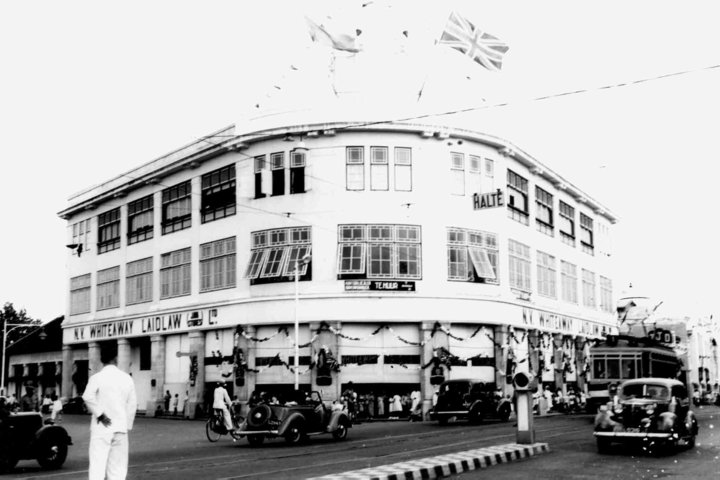
[2] Whiteway Laidlaw (Whiteway, Laidlaw & Co., Ltd.) was a Scottish firm that operated a chain of department stores throughout the Far East.

3. Encounter

1930s swimming pool in colonial East Java
Photo courtesy of Jan Krancher

The town's climate is typical of the tropics, sultry. Swimming is a favourite pastime, in the big pool of Tegalsari, almost every evening for a game of water polo or just swimming. Good sorts there, many of them in swimming gear which should be a full size larger, the clinging wet material accentuating their bodies. Ostensibly unaware of that, the girls hang about on the springboards or recline on the floor before the shower recesses. Sometimes with a boyfriend, sometimes alone with a quasi-forbidding allure about them. Yet if the right approach is made you might be lucky.

It is a beautiful April evening. There are quite a few swimmers about with the usual sounds of laughter, calling and splashing. At the head of the large, oblong space of water is a raised platform of tiles where occasionally Sunday dances are held. This platform runs from the upper landing of the entrance staircase to the edge of the wading pool. At the far end of the deep water section the boys are practising shots with a polo ball. "Wham!" slams the hard leather against the crossbar.

From the platform the water looks invitingly cool, reflecting the lights in dancing strings of flashes.

"Look, Dad, I can swim!" cries a small boy splashing about in a kapok girdle.

"Wham!" That ball again.

One of the good sorts, emerging from the water, pulls herself up the iron rungs, her hands high up on the railing. And she does it slowly. Heavy breasts beneath scanty wool, dark, dripping cowlicks in armpits. The fountain basin set in the wall of the wading pool gushes a blue, transparent veil of water.

"Daddy, Daddy, look now, I can swim!" But Daddy is all eyes for the girl.

Come, let's swim. I start walking toward the change rooms and I come by the wading pool. There, in the shallow water, is another girl, standing upright, ready to throw an orange coloured ball.

"Well now, that's good son. Keep close to the side," says Daddy finally.

A blonde. She is pretty, very pretty. Sixteen or seventeen, no more. Nothing fleshy and sexual about her. Just an attractive girl in a two-piece bathing suit. Plenty of blondes around, salesgirls in department stores or shopping with Mum, well guarded and warned against menacing males. So she's not for you, boy. But, oh, isn't she beautiful! The boys are calling me to join them but for some inexplicable reason I don't feel like swimming, not just yet. She is an eye-full in that two-piece suit but there is something different, something arresting about her. The lankiness and awkward grace of youth have just begun to bud into a warm femininity, but there is that other thing - a wholesomeness of bearing so refreshingly natural, without that studied pose commonly adopted by beautiful girls. But enough of it; she's definitely not for me. Bet her mother is around somewhere, watching her like a hawk.

Let's join the boys - but then, who wants to throw around a stupid ball? Better get changed and get in the pool so you can see her real close. Among all the people I see only her face, already trusted and familiar. Again I try to reason, to withdraw, but I am helpless. Her features are flawless, a cream-rich complexion and a lovely figure. She's got that ball again, throwing it back and lifting her arms to set her bathing cap right. Fine young breasts press against the fabric. A droplet of water runs down from her ever so slightly tilted nose to parted lips, delicately formed, revealing even, white teeth. She smiles. A million dollar smile.

Then her eyes, blue, notice my helpless gaping. With a studied air of cool indifference she turns her head away, bends down in a brief posture of tenderly provocative curves and swims to the opposite edge of the pool. Staying where I am, I force myself to look elsewhere. But a minute later I hear a movement in the water, and to my surprise I see her now quite nearby, hanging on to the railing. With her is a little girl, clearly a younger sister. My heart beats faster. She is so excitingly close that a small birthmark on her arm is visible. Then I blurt out, "Is she your little sister?"

"Can't you see that for yourself?" is all she says before swimming away. She and her sister leave shortly after that, and the pool becomes terribly empty.

"What happened?" says Mum to me when I am home.

"What do you mean? Nothing, of course. I just had a swim, that's all."

"You seem to look different. I don't know, but anyway, different."

"Mum, I said I had a swim as I always do, almost every day!"

Before going to bed, I look sharply at myself in the mirror but can't see anything special.

Back at the pool, the following evening, I marvel at the sight of her stepping down the steps. What is it that she has, that makes my heart beat faster? Standing on the edge near the water, she pauses a moment to strap her cap on, turning her head slightly sideways. I drink it all in, openly and shamelessly. She must have noticed it, perhaps remembering my staring eyes, for a fleeting smile is on her sweet face before she dives into the water. Now for a careful approach. It is very important that she should not be offended by too bold an advance. Or worse, that she should become bored by silly talk like that of yesterday. But first, get her undivided attention.

Soon it becomes evident that all the display of fast swimming and fancy diving from the high board does not make the slightest impression on her, but it does draw the curiosity of my mates, who call out to each other with insinuating remarks aimed at me. At last, stopping the nonsense, I swim straight to her to say, without any preliminaries, "How are you? Isn't it a beautiful evening?" We start talking to each other.

An hour later we are still at it, leaning against the partition of the wading pool or hanging on to the railing with one hand while running softly through the water with the other. Then, of course, an exchange of names. Hers is Lisa, and that there is her little sister Christine. Instinct warns me that, to gain a favourable impression, none of the usual tricks will do with her. The smart innuendo, the slight nudge would have been incomprehensible to her young frankness, an insult to her genuine innocence.

Lisa is not quite seventeen, she will be that next month. With the same frankness in approach, typical of her, she asks how old I might be. Good heavens, twenty-four! That makes me seven years older, and a critical moment has arrived. She might withdraw now, for I am branded an "oldie." Indeed she calls me that, but with a twinkle in her eyes, for she does not care, really. Time has flown, she has to go, and then the offer is made to escort her home. Again a few critical seconds. The way is now clear for her to end it all with a friendly but positive "Rather not, Mum and Dad don't want me to go out with boys." Or worse still, "My boyfriend will be waiting for me to take me home." I hold my breath. Then, pushing herself from railing, she swims with easy strokes to the first rung of the ladder. Pulling herself halfway up and turning her head to look over one creamy white shoulder, she answers, with noticeable surprise in her tone, that this was a rather silly question. Of course she would want me to escort her home.

On the nape of her girlish neck tiny droplets cling to the golden locks curling from beneath the rim of her white bathing cap. There is a dimple on her back behind each shoulder tip. A little fullness in the flesh under her arms above the strap of her brassiere makes her soft and womanly. I feel like rushing the ladder to crush her in my arms.

The swimming pool has become the central point of thoughts around which the whole day revolves. She never arrives at the pool before half past seven, which gives me enough time to spare whenever I am invited to have a drink with the master or the mate of one of the ships we are agents for. "Oh, there you are. What'll you have?" And more often than not, the talk turns to that swastika banner-wielding Hitler again. Also Japan, of all countries, is brought into the conversation as another threat to world peace. Can't they talk about anything else? Germany is so far away, and who cares about Japan? Made-in-Japan is cheap, inferior stuff, and that'll be the same with her military power, no doubt.

The evenings consist mostly of the swimming pool and escorting her home on the bicycle. Not much variety, but very important. In parting, all I dare is to touch her hand on the steering handle and say, "See you tomorrow." That is how much I respect her, which is so different from the other girls I have met before. The thought how-far-can-I-go-now simply does not occur. Her charm and appeal to me is in a different note, which is a new experience, and a good one. For it makes the grass lusher, the trees greener and the sky more blue.

Photo Source: Netherlands Institute for War Documentation

I have been called up for military training at the First Infantry Battalion, in Bandung, right across to the other side of Java, for a month. The drill and coaching in handling firearms is more intensified than ever before. The sergeant says that we must prepare for war; who knows, perhaps we shall have to go to Holland to help fight that Hitler bastard, he says. Granted our machine guns, Vickers and Schwarzlose, date back to the Great War, but they are still effective. The evenings without Lisa are dreadfully lonesome.

The scissors click, deftly snipping off strands of hair, which he lifts with the comb. He is Japanese, like so many barbers in the Dutch East Indies, in his forties with a rotund face. Beaming at me through his glasses in the mirror, he looks very much like that vicar in Holland some years ago. They always smile, Japanese barbers, talking with a soft hissing and that cast-iron grin creasing the skin at the corners of their eyes. Very polite and friendly people. Finished with the job, he proceeds to massage my neck and shoulders, which is included in the price. Through the open window we hear the drone of the much advertised, newly acquired squadron of Curtis Hawk interceptor fighter planes. I cannot resist asking him whether Japan would ever attack us, to which he replies without hesitation that Nippon is a friend of the Dutch, with his whole face smiling, except for the eyes.

We will meet again under somewhat different circumstances.

Back in Surabaya, she says, "Have you been faithful to me?" So good to hear from her, because that could mean that she believes that we belong to each other. When I reply, "Of course, and you?" she just looks at me, but it's enough to make me warm all over, for I suddenly know that I love this girl. That I love her deeply.

Taking her home one evening, her little sister happens not to be with us, and by silent mutual consent a different road is used, leading to a grassy hillock with a broad, old tree on top. It stands at a little distance from the main traffic of Darmo Boulevard where she lives at number 159.

At the foot of the hill a pretext is found to alight and then...the first kiss. Her lips taste fresh and sweet, they tremble softly. I kiss her again, tenderly, and her hand moves up to rest on my shoulder, her breath sweet on my face. Withdrawing, she lightly brushes her lips on my cheek and whispers, "What took you so long?"

Photo Source: www.worldwar2today.com

Overhead, searchlights probe the night sky with pencil-slim beams, and a single plane drones steadily behind the clouds. Reassuring evidence of the always ready and efficient preparedness of our forces. "Look how high they can reach with those beams!" I say with a song inside of me, a tingling emotion. But what a stupid thing to say at a moment like this. I kiss her again, and feel that nothing can ever come between us.

(Many years later, this precious moment will be remembered and marveled at. In the world of Hitler, Mussolini and Tojo, long before all that which was going to happen to us took place, there was that first kiss at the foot of the hill, with the milky white beams slicing the darkness aloft. Thousands of other couples might well have been doing the same thing at that precise moment, but to me it is so important. For I realize now that right from the beginning, when she stood there in the wading pool, it must have been in my heart: that girl is the only one I want to marry, to have children by and to grow old together. But would she feel the same thing? And there is her answer, before that old tree, when she whispered, "What took you so long?")

Her Majesty's Cruiser De Ruyter
Photo Source: ww2incolor.com

The only diversion allowed to her without the company of her parents is the swimming pool and pictures on Sunday afternoon. She is rather fond of films, and usually goes to the matinees with a girlfriend. Naturally she would rather go with me, but it is better not to let her mother know. She might be considered too young to go with a man seven years older. Her father, a warrant officer on Her Majesty's cruiser De Ruyter, is often away at sea. So a meeting point is arranged, somewhere on Darmo Boulevard on her way to the cinema on the bicycle. It is on a Sunday afternoon that we have our first rendezvous. Cycling along the boulevard, I see people tending their front gardens. The weather is fine, a man is washing his car, another pushes a very noisy grass mower. It is about three o'clock. Any moment now she could appear on the opposite side of the two-way road across the double tram line. Beneath the let-down awning on a porch teenagers dance to the tune of a record player turned on full: the Andrew Sisters' Bei Mir Bist Du Schoen. Next door a grey haired dog pokes its nose through a fence grating to bark at my bicycle. The tram clanks by. When it is gone I catch sight of her fine legs pushing the pedals and the red flare of lipstick. Daylight has enhanced the lovely colouring of her skin. What a lucky man I am.

Soon our surreptitious meetings at the pool and at the Maxim become unbearable, and an introduction to her parents is pressed through. Grudgingly at first, they finally consent to the fact that their daughter is growing up and should be allowed to have a boyfriend. Lisa and I feel that life now is really beginning.

The news from Germany is not so good. There is an angry, bellicose voice and unbelievably ugly reports about persecution and execution of Jews, and anyone who is found an enemy of the Nazi pestilence, the new Kraut philosophy.

"If I've said it once, I've said it a dozen times," goes the captain after a long swig from his beer mug. "They're all alike. Put them in uniform and they become bloody Huns, all of them Germans. We've seen it in the Great War and we'll see it again." Framed in the porthole is a disk of sky, pink in the setting sun. Lisa and I are going out tonight for our first dance. Let's finish our drink and go home. So he is mad, that Hitler. Who cares? Thanking them for the drinks, I bid them good night. But they don't hear me, deeply absorbed as they are in a discussion about Germany. Their voices are clearly audible at the foot of the gangway. "It will be England again to come to the rescue, you'll see!"

After the sultry day, the cool wind in the open car is medicine. Tonight she has her hair styled in a roll over her shoulders. She is simply smashing. I look at her face now and then, set in a gentle glow by the overhead passing street lights, while the car radio announces the arrival of a squadron of Glenn Martin bombers from America. A spokesman of the General Headquarters follows to say that this has brought our air force up to date, and henceforth we will be able to cope with any aggressor. A beautiful evening with a beautiful girl. What more can you wish? What aggressor?


Glenn Martin B-10 bombers
Photo Source: howstuffworks.com

4. The Darkening Sky


September 1939. The sands of time are running out. Then the first thunderbolt: Britain and France at war with Germany. Holland mobilises, prepared for the worst. In the Dutch East Indies there is no mobilisation, but the call to report for military drill comes time after time. I am hardly back in civvies before I have to put on my uniform again for duty at another depot. They say we have to be ready. For what? For the Japanese, they say. For the little fellows with spectacles, barbers, watchmakers, you know, them!

They must be joking! The Japanese of all people, they must be aware of the terrific naval power Britain packs in Singapore. It would be madness!

That seems to be true for the rest of the year, and the first four months of the next pass without any real threat to our country. Then 9 May, 1940, which is Lisa's birthday. Everybody brings presents. Her parents with their guests drink and talk merrily on the porch outside. We are on the couch in the dimly lit lounge room, in her hand the silver powder box I have given her. Turning it over and over, she gazes at it, as if it is something of great value.

It is very late, well past midnight, but no one thinks of leaving. They are all in a happy mood, particularly Lisa's mother because her husband is home.

Photo Source: Netherlands Institute for War Documentation

Suddenly army trucks coming rolling by, full of soldiers, and more come, the heavies with powerful, growling motors. Where are they going to at this time of the night? Everybody gets on their feet. A glass smashes on the floor, followed by a nervous, giggled apology. Her mother says that it is nothing, it will bring luck. Then no more trucks come and the agitation dies. Returning to the lounge room, I notice that the radio has ceased playing music. Instead I hear a single voice saying over and over again through the crackle of static, "The code word is Berlin!"

We two on the couch are mercifully unaware that the beginning of the end has been announced with that single word, "Berlin", which will shatter the best years of our life together.

At breakfast, the news is broken that the pack has been released, hurled into the Low Countries and France. That means Holland is invaded, Holland is at war! Incredible and astonishing! The trucks on the road last night, they were taking troops to strategic positions to block off any possible escape route for "them": people with German names or from German stock, no matter how long ago. They are arrested, interrogated and smack-bang into concentration camps with them. Only those who can adequately present proof of Dutch citizenship are set free and sent home with a red face and ruffled feathers. We, the Dutch in the colonies, are very angry indeed at the murderous Huns, and we'll show them. Newspaper editorials and spokesmen for the government, churchmen and anybody else feeling that he has something to say, all agree that it'll be total war, that we'll fight them and show them that the Dutch had not for nothing fought a war against the Spanish, for eighty years, mind you.

Suspected German sympathisers interned at a camp near Batavia, Java.
Photo Source: Koninklijk Instituut voor Taal-, Land- en Volkenkunde

It is all over in four days. Holland is made German property, and her masters, contemptuously knocking aside the British and French forces, then proceed to take over most of Western Europe.

The outlook in Western Europe is dark indeed, but the sun is still very much shining in the colonies, the only remaining strongholds. The tricolour proudly flying from the mast gives strength to the cry that "Holland shall rise again!" Yes, the four words grow into a dictum, an epigram stamped across postage stamps, flashed across the screen in the cinemas, engraved on buttons. In the meanwhile, the radio and tabloids warn, we must realise that the defence of our so profitable colonies rests now entirely in our own hands. Remember, they say, that we must be prepared to stand up and fight with everything we have. True, this "everything" is not much; alarmingly small indeed are our military forces. But isn't it the spirit that counts, the old Dutch fighting spirit when the call comes to go to war for Queen and Country?

She calls it affectionately "our own little table in our own little cafe." A charming, small establishment facing the main road, from which we two are looking at the rain pouring down in sheets. Anything but war-minded we are, stubbornly hanging on to a dream world that cannot become bad because it is going to be ours - when we will be married next year. So here in this cozy little place, holding hands, we gaze happily at the tram filled with wet and annoyed passengers, at the motor cars with their busily fanning screenwipers and tyres whizzing on wet bitumen. A hat is swirled by the wind into the gutter, its owner running madly to retrieve it. A man enters the room in dripping coat and hat, angrily shaking the water from his umbrella. It is all so normal and ordinary; nothing is changed at all. It rains, which is a nuisance and people get annoyed, which is to be expected. Everything is going on as before - as if Holland is not lost to the Huns, as if the tragedy of Europe is not real, not a fact.

Photo Source: Time magazine, 1942

Months go by. Months of speeches about our war effort, delivered by experts, well-spoken gentlemen in dinner suits, one hand loosely tugging at the knot of their tie, emitting one gem of informative advice after another. Desk marshals, chuckling complacently, offer free detailed forecasts of what is going to happen to Japan should that country be so impertinent as to start anything. But they won't of course. The U.S.A. is seeing to that, no risk. Parties for the benefit of the British war machine are the order of the day. Parties where lots of fun is to be had. The army works at top speed to break the called-up men into the art of killing. The Battle of Britain, comfortably distant, is applauded and toasted upon. The regular non-coms and privates of the forces, beforehand barred and shunned by almost all public establishments of drinking, eating and dancing, are suddenly made much of and cordially invited to come and be entertained. Everyone in Her Majesty's uniform is beckoned to a lift in the cars, which all carry a sticker to that effect on the windscreen. Even so, at this stage, to most people the grimness of the situation has not quite sunk in. To many of the conscripts, tossing about on their bug-ridden army cots, the separation from sweetheart or family is more worrying than the news that Japan seems to become militarily stronger day by day.

Christmas morning, 1940. A small tree is put up in her home. The step ladder is a bit wobbly; great care is needed to avoid accidents while putting up trinkets on its branches. The awnings have been lowered to shut out the midday glare. The room is pleasantly cool. I hear her talking to somebody outside on the porch. On the road a shoemaker is chanting his typical call: "Bikin sepatu-uuh!" From the radio soft piano music fills the room, Chopin's prelude written for George Sand. Lisa enters to give a hand, and it is as if the music was composed for her. Coloured light from the stained-glass front door ripples over her blond hair. Picking up a little silver ball, she reaches upward to me on the ladder, in her eyes a glint sparkling, a reflection, that will always stay on in my memory. One more tinsel bell is hung and I step down. She leaves the room to help her mother prepare the dinner. Look at all that silver and gold glitter on the tree. The little red candles and the star high on top. Has that tree still a place in this world, with all this is happening?

May 1941. First Battalion Infantry at Bandung, snap-up call for two months cadre training programme consisting of hard drill, record time in stripping and assembling a machine gun, how to manipulate a bayonet that got stuck between ribs and how to salute an officer correctly. Within a month I am made corporal.

Wedding Day
Photo Source: Frank Samethini Collection

4 June, 1941. Our wedding at last, come what may. Lisa arrives by train, alone, to marry me in my corporal's uniform. None of our parents can make it. At the registrar's office the two witnesses are waiting for a very brief ceremony. We walk up to the desk, the gavel is brought down and we walk back as man and wife. No point in having a church wedding with our parents absent and our friends all away.

So different from what we both anticipated and planned together. In her sweet face I read the hurt at the businesslike proceeding, but it cannot be helped. We wanted to get married and if it has to be like this, then be it so. Who knows what the future will hold? There may be so little time left. Pluck the day, today is ours. Whose will it be tomorrow?

In July we return to Surabaya, a couple joined in wedlock. Our happiness is boundless. Refusing to be worried by the ever worsening news, we welcome every excuse for going out to movies, parties or just some dancing. To the stirring beat of drums, percussion and bass we dance, lost to the world. Suddenly the sirens howl, the waiters run to draw the curtains for another snap black-out practice in war-prepared Surabaya. Tactfully, the band leader switches to national songs and everybody is singing away about Holland's Flag, about Piet Hein who took the Spanish Silver Fleet and about the Girl by the Mill. People singing perhaps louder, smiling perhaps more than ever before.

Image Source: www.autographsmovieposters.com

Afterwards we go for a drive in the cool night air along the river, winding silvery through the park, dark and empty. There is the Maxim's frontage, blazing the title of a new film with Abbott and Costello, Buck Privates. The terrace of the Simpang Club is deserted but further on, on the Hellendoorn's ground floor, dancing is in full sway. Proceeding along the mainway, we see that there is the usual after-congress ball in Town Hall Gardens. After all, it was only an air raid practice. There seems to be something timeless in Surabaya. Uptown the glitter of night life, downtown the quietness of the quay with the sleeping sailing craft huddled along the old mooring site, and far out on the Roads, the winking beacon light. It is all so peaceful and friendly, so unchangeable in iron-clad security.

Photo Source: Netherlands Institute for War Documentation

The year is almost over. On the darkened porch she tells of the coming bliss. A baby! Speechless, I kiss her with a new feeling of respect under the dark sky - a sky torn to pieces by darting, probing white shafts of the practising searchlight crews, prepared and ready as ever to stand firm.

7 December, 1941. Hundreds of Japanese airplanes attack in the early morning hours, without provocation or warning, the assembled fleet of the United States of America in Hawaii. The bulk of the naval power of a country not at war with Japan is sunk or crippled. The infamy of Pearl Harbour. The dreaded words are broadcast by radio to all of the Dutch East Indies. We are now also at war with Japan.

Schwarzlose machine gun
Photo Source: www.grebbeberg.nl

Stinging sweat runs from my forehead into my eyes and down into the corners of my mouth, to drip on my hand holding the breech of the machine gun. My hand has been there for the last half hour, the other one at the trigger guard. Both exactly where they should be, to move at a moment's notice, swiftly and precisely, to set the elevation, fire and reload this Schwarzlose machine gun. The army training took care of that. These hands, in fact the whole body, are now legally owned as a tool - and if necessary, a disposable one - of the Royal Dutch East Indies Army. My private life is written off. I am wholly expendable, nothing but an instrument to execute the order given through that little speaker in the concrete bunker wall, whenever that order will be given. Talking back is not allowed, not possible. Just wait, and remember to aim for the belly, better chance to hit where it matters. Forget about her, forget about anything else but your duty to Queen and Country, to kill as many as you can before you yourself are killed. And if you are, don't worry. The government will look after her and the baby, provided there is a government when it's all over, naturally. The relief arrives at dusk. Nothing has happened at our fort. Nothing could have. They are too far off yet. [1]

One evening towards Christmas, a group of female cabaret entertainers arrive at our fort to cheer up the gun crews and the infantry detachment. The girls are quickly ushered behind the curtain of the makeshift stage floor in the canteen, brim-full with suddenly catcalling and whistling soldiers. The men lick their lips. Many have been without women for almost a year. The curtain is raised when the fort commander arrives with his staff, and we see girls dressed in Hawaiian grass skirts and strings of paper flowers on their necks on low-cut blouses. A deep silence falls on the audience. The guitars begin to twang, and a pretty dish, all curves, steps forward. Slowly gyrating her hips, she sings, "Si - si -si." A soldier, unable to hold himself any longer and top heavy with booze, roars, "Let me lay you, dearie-ie!" Tumult. An angry order from the fort commander to bring the curtain down at once. Loud snickers from the men. The troupe is sent back to town, the serenading soldier arrested and locked up in the cooler. The gentlemen-officers' unanimous verdict is that the men have become unfit for mixed company.

Dutch soldiers in jungle combat
Photo Source: Netherlands Institute for War Documentation

Weeks pass without a shot being fired by us at the fort. But the radio tells of defeat, of bitter defeat by the ridiculed little men, the former smiling, bowing and hissing barbers, merchants of inferior goods made in Japan. There are also numerous reports of bravery from other sectors of our forces, but the closing message of the bulletin is always the same: battle lost, we retreat before the swarming ants. Only a miracle can stem the Yellow Flood, but miracles are not easily gotten. Only the slogans, of course, are still on the market, to keep up the fighting spirit for when they land on Java's shores. The radio has a classic one this morning: "Is it not better to die standing on our feet than to live further on our knees?" These rich colonies, which made Holland so immensely rich, have they not deserved something better than slogans? A military force big enough to withstand an aggressor, perhaps? Or are we leaning too heavily on Allied assistance? Alone with my thoughts in the pillbox, it all seems like a bad dream, happening so fast. Yesterday these hands held her. Today they are on cold gun-steel.


Acoustic anti-aircraft locator
Photo Source: Netherlands Institute for War Documentation

I am reading a letter from Lisa while on duty in the listening post ("Darling, do you want it to be a boy or a girl?"), when suddenly a sound from a great distance enters the earphones. Growing louder and louder, it seems to come from every direction. No, wait, from high in the invisible vault above the cloud banks it comes! In a flash I recognise it with sudden, racing heart: approaching aircraft. Can't be ours, we haven't got that many! My thumb sinks the alarm button while I reach for her letter fluttering to the floor. My field glasses show the Jap airplanes up as silver-winged, transparent dragonflies, three flights of five bombers in each squadron, moving slowly across the sky, too high for the black and white popping blossoms of our ack-ack. What little is left of our fighter planes whiningly soar upwards to meet their fate. The dragonflies move on southwards - southwards! But that is Surabaya! Fear clutches my throat. My God! Almost immediately I hear the dull boom of exploding bombs in a muffled staccato that pierces through my heart. Where, oh God, have they fallen?

"Three flights of five bombers in each squadron"
Mitsubishi G4M medium bombers

Photo Source: commons.wikimedia.org

Japanese bombs fall on Surabaya
Photo Source: The Dutch East Indies Campaign 1941-1942

Cold sweat runs down my back while the machines fly on with maddening confidence and determination. Where are our fighter planes? What happened to them? Her letter is still in my hand, and her words dance across the paper: "Darling, do you want it to be a boy or a girl?" Another muffled roar. Shuddering incessantly, as if attacked by malaria, I catch sight of a bluebottle settling down quietly and gracefully on a softly swaying buttercup in the grass, without a care in the world. I hurl a rock at it. There is a sudden commotion behind the bunker when a soldier leaps out of his shelter, swearing and shouting, to empty his rifle at the sky. In panic dozens of herons fly up from the swamp with loud shrieking and flapping of wings. The soldier is brought down with a tackle by a mate, who leads the now hysterically sobbing man back into the bunker. A long, low rumble rises from the harbour area, followed by one, two explosions. Putting my rifle down, I fold my hands in a silent prayer for help. Others take off their helmets and bow their heads. What else can we do? An hour or so later, the all-clear is sounded while a black smoke column rises up into the empty sky. Our last fighter plane limps down to the burning airfield. [2]

I am greatly relieved to receive a note from Lisa telling me that they are all safe and well. She was visiting a friend when it happened, and had hidden under the bed. The night before has been the longest of my life.

The following week a few more air raids are directed on fortifications outside Surabaya, but the scattered pillboxes and gun emplacements are perfectly camouflaged and no direct hit is suffered. The enemy aircraft, unchallenged since the last Dutch plane was downed, fly low over the dense swamp vegetation in an effort to draw fire and so pinpoint our gun positions. But the order by the fort commander is clear: repulse enemy landings on the beaches and nothing else. Do not shoot at aircraft, do not even shake a fist at them lest they spot you. Keep your head low and swear if you must, but at all events stay out of sight. What kind of war is this?

The news couldn't be worse. Tarakan, an important fuel point in the archipelago, has fallen. The battleships Prince of Wales and Repulse, Britain's pride and boast, are embarrassingly made short work of by Japanese planes which sink them one after the other. To top it off, Singapore capitulates, and an ominous silence descends over all that part of Southeast Asia. The net is closing around us. [3]


Mum and Lisa
Photo Source: Han Samethini Collection

I get twenty-four hours leave and find Surabaya swarming with British and Australian soldiers. The hinges of our front gate creak noisily, as they did in those distant days when I came home from work. Our old dog rises on stiff legs and lifts his head, yelping with pleasure. Lisa walks out on the porch and I rush to her. Her eyes grow misty and her fingers dig deep into my back while she kisses me with trembling, salty lips. Then, collecting herself, she withdraws, wiping her eyes dry on her sleeve. She leads me into the bedroom, to the cupboards and self-knitted baby things. Mum, who had discreetly waited in the lounge, enters with open arms. Her eyes too are misty. The war is pushed into the background now that I am with them again. A growing awareness of security returns now that I am safely back home and see how they fuss over me. The intimacy of our house, with its little old painting in the wide frame, the low wicker table on the porch with its circular imprints of many a glass and a chipped ashtray. The hollow thumping of our footfalls on the wooden floor of the rear veranda sound as they always did. In the kitchen our cook is preparing favourite dishes, welcoming me with a broad grin and uplifted ladle. All this seems to say to me not to worry, it's not all that bad.

Our baby, growing under Lisa's heart, has moved quite a few times as a healthy baby should, says Mum. April, said the doctor, maybe the beginning of April. We sit around the wicker table on the porch, our favourite spot, and talk about anything but the war. On the wall that infernal clock is ticking the minutes away.

Later that night, sleep is fought back lest some of the valuable time with her will be lost. Wan wisps of light from the bedside lamp quiver in a corner of the ceiling as they always did before, when we were just married and sheer happiness would keep me awake. Now everything is harshly different. She had cried a little and then fallen asleep on my shoulder, softly breathing on my cheek. On the chest of drawers the alarm clock is ticking off precious time. A faint glow from the dimmed street lights is visible through the shutters of the bedroom window. It is very still. Far over the river a siren shrinks away in a dying wail. Silently I vow to come back to this girl, whatever the cost, whatever the price.

Too soon I return to mosquitoes, smells, whispered passwords, dirty yarns. One night after patrol the boys bring out the gin and we drink ourselves into a devil-may-care mood, on top of the pillbox. There is a flash in the clouds to the south over the town where she sleeps. Thunder breaks faintly in the distance, then louder, galloping across the sky, rolling away out to sea. Is it an omen of bad things to come? A sickening feeling of impending disaster, a sense of dead certainty, creeps up. With hot liquor breath in my nostrils, I spit into the night. Damn!


De Ruyter in wartime grey camouflage scheme
Photo Source: Australian War Memorial AWM 305837

There is that early hour when the binoculars pick up the sleek outlines in camouflage grey, stealing through the mist of dawn into the open sea. Our gallant Navy sailing to their last engagement with the enemy, to bear the brunt of the great onslaught. To go down in glory against a vastly superior fleet. Lisa's father, there on that cruiser De Ruyter, will perish with the crew and their admiral, whose last signal flying from the mast - "I attack, follow me!" - will become the code of honour earned for the Battle of the Java Sea.

A grey dawn breaks through the mangroves. The swamp stinks as it does every morning. The first sun rays light up the black clouds overhead. Soon it will rain. The day is born that will go down as the blackest day in the history of the Royal Dutch East Indies Forces. The order given by our supreme command is, surrender unconditionally to the enemy. In bitter silence they come, from the firing positions, from the big guns so perfectly camouflaged against air attack. They come to pile arms and ammunition in one big heap before the commander's bunker. This has been ordered by the Imperial Japanese Army, which will arrive to take over tomorrow. We all go to the canteen to drink, and drink. "Here's to victory, blast the Japs!" sounding hollow and desperate.

It is well past midnight. In quietness the last beer is drunk, standing around a dying fire. A fire that was made of documents, anything which could be valuable to the enemy. On top of the glowing cinders lies something which was once a book. Though consumed by the flames, it has not collapsed into an unrecognisable heap of grey dust, but still retains roughly its original shape in a blackened hunk. The letters of the title on the front cover, though whitish, are still legible. A photograph of a head has been turned by the fire into a grimacing skull. It is, or rather was, a copy of a volume published not so long ago, and at that timed dubbed as "pessimistic" and the "product of a defeatist." It was a book outlining and predicting with certainty the coming onslaught from the north. The author, H. Abend, an American correspondent, had named it Japan Unmasked. Finally we turn in, overcome with sleep. Tomorrow is another day.


Footnotes

[1] According to notes jotted in his bible, Frank was posted to Fort Menari in December, 1941. His descriptions indicate it was a heavy gun battery rather than a massive, European-style citadel. This would seem to be supported by the archival Dutch Defense Ministry document Commandant Zeemacht in Nederlands-Indie, (1942-) 1945-1950, which refers to it as "de batterij Menari" (Nummer Toegang 2:13:72, page 214).

[2] The first major Japanese bombing raids against East Java began on 3 February, 1942. Dutch and Allied interceptors, outnumbered and suffering heavy casualties, continued operations through the end of the month. Evidently the air-to-air combat after 3 February took place beyond visual range of Fort Menari.

[3] Tarakan fell on 13 January, 1942. The Prince of Wales and Repulse were sunk the preceding month, on 10 December. Singapore surrendered on 15 February.

5. The Unspeakable Days


Tomorrow has become today. The first of the days of evil, the days of standing face to face with yellow-brown bullet-heads, slanted stone-cold eyes, the cotton peaked caps with sunflaps and small red star, the bowlegs, the ridiculous long swords in leather scabbards, and a mentality utterly beyond human appeal. Standing face to face with Japan Unmasked, without its former civilised veneer of the diplomat, the businessman from Mitsui, the Olympic games. The days of prison, barbed wire, punches in the face, kicks on the shin and groin. Torture to extract information, death for an unsuccessful escape attempt. The stark humiliation of defenseless captives, exhibited in truckloads driven through town for the teaching of the gaping natives. Behold the degradation of the white men, bullied slaves of Nippon, the Light of Asia. See white men bow down to pay homage to anything walking about in the khaki of the invincible Imperial Japanese Army from the land of the rising sun, the descendants of the gods.

Image Source: Geheugen van Nederland


The days of sullen, stabbing hunger burning inside like an open wound. The clinging stench from the latrines, the wretchedness of our situation. The boiling sun, searing us into numbing tiredness. The flies - the pestering, festering flies - and at night the bite of the indestructible lice.

As an added sting, all this is happening in the town of happy, carefree yesterday, on the street corner of the Hellendoorn, or before the Simpang Club, the Town Hall Gardens, the Shanghai Restaurant, in our own Surabaya of the golden times. Is it not just around that block where once the blissful past reigned? When we felt so confident, so secure, when in blind complacency a rock-strong trust was placed in Dutch efficiency, the myth of the British Empire and the might of the Hollywood-promoted American navy and air force. In time many of us will cease to believe in anything or anybody except, as a last resort, in prayer. It is said that this would be the idea, the meaning of the world, the entire universe - that from time to time creation should go down on its knees, in humbleness and submission. [1]


On us have descended the unspeakable days of our lives. And high above all this, the sky looking down - blue blazing or dark cloudy sky, always unruffled, cold and indifferent.

The weeks flow into each other in grey, dull monotony. All non-Asians are herded into concentration camps without any means of communication with family left behind. The honouring of Sunday is not permitted. There remains only hard, unrelenting work, hunger and pain.

One thing there is that they cannot take away from us: our unflinching faith in the ultimate victory by our Allied Forces, in a year, maybe in a few years time. So grit your teeth, soldier. Brace yourself and take it, take it all, and to hell with them. Remember, we've got to be there when the war is over. Our families are putting their trust in that, living for that day. In the meantime, try to get on that particular work detail which will bring us near them, near the place we once called home. Perhaps luck may happen to us, perhaps the guard will be in a benevolent mood and let us have a few words with our wife, sweetheart or mother. And they will tell us not to worry, tell us all sorts of stories to prove they are cared for.

Our gallant women, living in the world outside the gate, who would rather die than let us in on their silent battle for survival, their hardship and suffering, bearing on their frail shoulders the lot, without the support of husband, brother or father. But on that work detail they will be wearing their best, saved for an occasion like this. And they will be wearing their brightest nothing-is-wrong smile too. They will have saved and scraped for a small parcel for us, some clothing, tobacco, food. At the risk of being discovered and mauled by the guard they will smuggle a letter or just a note over the wall, telling us not to worry, that Johnnie has grown another tooth and that all is well. Yes, and in the beginning we are stupid enough to believe the fairy tale from our gallant women and girls.

Our truck halts by a small cafe. A table before the window leaps at me in sudden recognition - our own little table, she used to call it, and it still bears the same checkered tablecloth too. And there was the chair she always took, preferring to sit in a corner. The truck moves on with grinding changing of gears. For a moment I had leapt back in time, with a pang of longing knifing through my heart.


Rumour exchange (click image to enlarge)
"Tokyo bombed flat", "The Americans have landed in Bali!"

Image Source: Web site "Cartoons van K.S. van der Sterren"

Rumours of Japanese defeats at the hands of the Americans abound. Some of us seem to thrive on these stories, going from the wildly improbable to the utterly impossible. They walk about with that certain glint in their eyes which marks the true rumour maker. So when one of them, a newspaper clipping in his hand, grabs my arm smilingly, I want to shake him off. But he hangs on and makes me read a small notice - Lisa has become the mother of a daughter! My eyes, glued to those few words, read them over and over again with a feeling of pride and gladness, and of sadness and longing.

A very unpopular but necessary job is emptying the latrines, which is done strictly on a roster. A sailor, formerly of the cruiser De Ruyter, had performed the task a few days before but has been ordered to do so again. He refuses it flatly. Whether he is justified in his refusal is beside the point. The incredible, unbelievable thing is that his case is brought before the enemy! Our Dutch second-in-command, in civilian life of mediocre background, had been made a captain of our fort. This rank had given him authority and power to order people about, in which he delighted, a trauma so typical of characters suffering from the father of all traumas, an inferiority complex. It had turned him into a self-made Captain Bligh, and before capitulation he was always difficult to deal with. But now he has committed the worst sin in the eyes of all his fellow prisoners: he has reported to the enemy! And the Jap decides to set an example. We have to fall in, facing the parade ground, to which the sailor is led by armed Japs. Once more he is ordered to do the job and again he refuses for all to hear. Then a Jap steps forward and judo strikes our man sprawling to the ground, whereupon others move in with rifle butt and boot. For most of us this is the first time we witness a manifestation of their mentality, which is not a pretty thing to see. But what makes it more revolting is that it was inflicted through the attitude of one of our own officers! The victim is soon unconscious and is carried away, more dead than alive. During the whole ghastly performance at least a platoon of Japs were in the trees around the square, their machine pistols at the ready. The creep in captain's uniform is unanimously declared an outlaw, to be dealt with as soon as the war is over.

After this incident the enemy's mood is worse than ever. Perhaps they are disappointed because we did not come rushing into them, overrunning them with our vastly superior numbers. Perhaps they took that chance. These people have been carefully spoon-fed with a deep hatred of anyone against them. To them war is a matter of killing rather than of survival for themselves. These fanatics have been brought up to believe with absolute certainty that the immortal soul of every Japanese soldier is lifted straight into the Shinto-heaven for warriors, should death befall them in honourable war. A wholly military-minded indoctrination took care of that important preparation before they were sent to Southeast Asia, or to any part of the world where they had to fight for Nippon. Moreover, should we have started anything, most likely our women and children outside the camp would have had to foot the bill according to the way of the Japanese, and likewise of the Nazi Germans and the Soviets.


Officers of the Kempeitai
Photo Source: Netherlands Institute for War Documentation

Here are people who torture and kill men and women of a vanquished nation. Here are creatures, calling themselves soldiers, who bayoneted British servicemen who had fled from Singapore, been stranded on the east coast of Sumatra and had surrendered to the Japanese. And these warriors of Nippon then had female nurses from the same ship line up on the beach facing the sea, and mowed them down with machine guns. Here are people who force our women to squat with their knees on the sharpened edge of bamboo slats for hours on end, until the bamboo slowly penetrates the skin and flesh right to the bone. Only because the women had tried to catch a glimpse of their beloved husbands through a crack in the fence. People able, and willing, to inflict the heinous, unprintable cutting and piercing in the "questioning rooms" of their secret police, the Kempeitai.

As true as it is that alcohol may bring out the real mentality of an individual, war exposes that of the warring race. To be capable of committing these atrocities, on human beings already defeated and therefore defenseless, calls for a state of mind which to specify as cruel is to miss the heart of the matter. The mercilessness is not isolated to a few perpetrators, but officially ordered. The degree in receptivity to humane principles characterizes one kind of people, en masse, from another, irrespective of colour of skin, culture or technical knowledge. You may be defeated and yet bear a certain amount of respect for the enemy. For the Jap we can only feel such an intense revulsion that it is beyond hatred. If and when we can kill them, we would do so as if dealing with a snake - something unwanted, alien, not deserving remorse or afterthought.

A few weeks later we witness another performance staged by our captors, but this one is somewhat hilarious. A Dutch officer is held responsible for something or other, and this time the Nip has a new idea. Before the assembled prisoners the officer in question is handed a knife and ordered to commit harakiri, face-saving self murder. For the occasion a roofless bamboo-mat cubicle is erected, to which our man is led with an expression of utter consternation on his face. Vehemently protesting, he is finally pushed inside with force and the door discreetly closed behind him. One full minute of silence passes, after which the Jap master of ceremonies opens the door. What he sees is certainly not an honourable death, for we hear loud scolding and face slapping!

Then the Jap emerges again to wait, after which he sends another Jap up on a step ladder to peep from above. But this Jap, looking down into the cubicle, shakes his head in a hopeless gesture. The officer-prisoner, the same perplexed expression frozen on his face, is led out. After the customary number of clouts, but otherwise unharmed, he is sent back in disgrace to his fellow barbarians. Fortunately the Jap, in one of his unpredictable moods, does not decide to take the matter into his own hands by killing the officer inside the cubicle, and so let it appear as if the prisoner did commit suicide. Who could prove the contrary?

On a manganese ore work detail an old wine barrel is discovered, containing a Burgundy of respectable vintage. While our guard is fitfully dozing in a corner of the wharf, we first fill our canteens and then the party is on. Hours later we return to camp, high as a tick, bracing ourselves against the inevitable bashing and kicking. But here again, for some inexplicable reason, the guard morons decide to take our obvious rosy state of affairs as a great joke and laugh their silly heads off. The following day an overwhelming number of volunteers eagerly present themselves on the parade ground for the manganese job. We venture to believe that perhaps the Japs have decided to adopt a more forgiving attitude. It is not so. One of ours has escaped, and went to the last place he should ever have gone to - his home. Promptly captured, he is led, after a gruelling waiting time, to a small strip of beach well known to patrons of the once so popular nightclub "Seaview". A firing squad is waiting. Refusing the blindfold, our man spits the squad leader in the eyes and hails the Queen until the bullets rip into him.

The grass, lush and green in the corner of the parade ground, is like a carpet against my back. The tops of the trees move in the wind of a cloudless afternoon. Obscured from view by the bamboo wall, I can hear people outside on the street talking and calling to each other. Indonesians and Chinese, free to go and come as they please. The clip-clop of wooden sandals, the call of the street vendor, the ring of the bicycle bell. All so oddly quiet and peaceful. With blind eyes gazing at the blue vault above, I set out on a trip. By some magic transformation it has become possible to be among those free men outside, and to walk in a certain direction. First down the street to the kiosk on the corner, then to the left side, up over the bridge. Down the lane of sycamores along the river and then through the shortcut by the vacant lot....Come off it, this won't do! Funny, though, that I should get up this morning with a strange feeling that, whatever will happen, Lisa and the baby will be safe and that we'll be together again after the war. I can't explain this conviction. The minister said that was God working in me. Why me?


Here they come, surging like a flood through the wide open gates of our camp, their cries a mingling of laughter and weeping. Our noble-hearted masters, on the anniversary of their gallant attack on Pearl Harbour, allow them a three hour visit to meet brother, father or husband on "home ground."[2] However, kissing will not be permitted. None of that barbaric habit, too offensive to the refined, ethical Japanese code of bushido. As soon as the women are inside the order is completely neglected. Nothing can stop it. Even our guards turn their backs to it. For me there will be no kissing at all. Lisa has not come, nor anyone of my family! It is very disheartening to stand in my best uniform shirt and trousers, only to gaze at the open entrance with a cold, sinking feeling inside. Then one of the visitors who knows Lisa, notices my bewilderment and tells me that he had seen her going in a different direction. Perhaps she has gone to the wrong camp, thinking that I had been among those who were moved to a different location a few days ago. Maybe she'll turn up later.

Nearby, a young mother in a low-cut, sleeveless frock is bent over her baby in a wire basket, looking up to her husband, her pretty face tilted slantwise. He is softly talking to her, holding her gaze. Brushing her chestnut-brown hair aside with her arm, she holds it up to screen off the glare of the sun. A radiant picture of parted, moist lips, eyes brimming with happiness. Her armpit reveals a patch of dark pinpoints of shaven hair. Around the base of her pert little nose are tiny freckles, larger ones on the upper part of her breasts pressing together in a long, deep cleft visible in the front opening of her dress. A bosom full of allurement and mother's milk. The complete absorption into each other, the bond between a man and his woman, composed of spiritual and physical attraction. The realization of that unchangeable truth, exhibited by that young couple there, seems to take away some of the hopelessness of our situation, strange as it may seem. They are kissing, with great hunger, hands clasping hips and waist, bodies strained to press against each other. One of her sun-tanned legs, drawn up at an angle, shows a feminine rounded knee and heavy thigh, the skin pale white at the pink-laced lining of her panty. All of it I observe unemotionally, clinically, for though I am free of worry, the disappointment at Lisa's absence is too deep to leave room for excitement. Their mouths rub and knead. She withdraws her swollen lips shining with saliva. She gives a little start when he whispers to her, and both look at the toilets. Shaking her head, she gestures questioningly at the basket. Again he whispers to her, casting a fleeting glance in my direction. Good grief! Is their need, even at a time like this, so great that they do not care to be seen entering the toilet together? What are we, animals?

"All right, you two, I'll mind the baby."

She walks out in front, he follows her casually without the slightest trace of embarrassment. Under her cotton frock the buttocks move promisingly. At the open gate a few sparrows are pecking in the dust. The baby is cooing.

Two days later, a note from Lisa. After having been misdirected to another camp miles away, she finally arrived at ours, but found the gates closed. "Everyone at home is quite well," she writes. "So don't worry, darling. The baby is growing like anything. You should see her. I'm so happy with our baby Mary-Em. Do you like the name? She reminds me of you every day." The note also contains a warning to be very careful in dealing with the enemy. A week ago, a Dutch civilian, for some reason or other still free, had been summoned by a Japanese officer to his quarters. The Dutchman recognised the Jap at once. Both had been together for years at the same high school in Surabaya, years before the war. The Nip suggested a toast to Japan's victory. The Dutchman refused, telling him in no uncertain terms what he thought of the Japanese and Japan in general. Without a moment's hesitation the Nip drew his sword and beheaded his old school friend on the spot.

After another two months of hoping and waiting we are assembled on the parade ground, not for a surprise roll-call this time, but for good news. Through the benevolence of his divinity, the good Emperor of Japan has granted another three hours visit in celebration of his birthday. Tomorrow I will see Lisa.

The two grandmothers, Lisa and Mary-Em are seated on the lawn. I feel very much like a father with the baby holding my finger. We talk and laugh like on a picnic without hundred of people around. Lisa is as beautiful as ever but with an added tone of matureness. Though barely twenty years of age, she is not quite the young girl anymore - the girl of the wading pool, of hand-holding and movie watching, of that unforgettable time of growing intimacy. Motherhood has not affected her figure; she is as slender as before. Time has stood still with her since that first kiss, except for that air of ripeness, not seen but sensed.

There is so much to tell, and yet so little, for none of us wants to mention what is so much on our minds. The conversation is kept strictly to ordinary, everyday things. We avoid saying, "I love you" or "I long for you." We do not even say, "I'm so lonely." I hear little things about the baby and how good the doctor was who had brought a toy for Mary-Em. And naturally we say, again and again, that it will be over soon and everything will be back to normal.

The three hours have swept by, almost unnoticed. We rise to our feet, striving to keep our voices level. Now I've got to say something to cheer them up, but a lump has risen in my throat. Words will not come, only a mumbled "So long." So long, for God only knows how many months, years it will be. They understand, and say little themselves. One has to be strong, one has to be cool. Hysterics will not help.

First I kiss the two mothers, then the sleeping baby, and then her quivering lips are on mine, her sweet breath on my cheek, as so many times before. Not a single word is spoken. What is there to say?

She is going now, walking backwards away from me. Backwards, so she can look at me as long as possible until the dense crowd of departing people will swallow her up. There goes her dear, lovely face, moving away. She has reached the gate now, one hand pulling the pram, the other hand flown to her mouth. Tears glitter in her eyes. What I see in them I cannot describe - the turmoil, the sadness, the fear and the boundless love this beautiful girl is offering to me.

Suddenly, harshly, it has become a fact. They are gone. The visit is something of the past. But her eyes are still there on the small patch of grass that was our world for three hours. There is the spot where she sat, here the imprint of the pram wheels in the soil.

Picking up the basket, I go to my sleeping place in the dormitory. I turn down the mosquito net. Hidden by the green webbing, I softly cry on the food and the tobacco, some photographs and underwear their loving hands have put in the basket for me.

I'm crying for the first and the last time in this rotten war, on the birthday of that rotten Emperor of Japan. [3]

Japanese soldiers parade in celebration of the Emperor's birthday
Surabaya, 29 April, 1942

Source: Koninklijk Instituut voor Taal-, Land- en Volkenkunde, Leiden

Footnotes

[1] A contemporary Red Cross document, dated 6 June, 1942 (appended to a Swedish Consulate report of conditions under the Japanese occupation), lists seven POW camps in Surbaya: Jaarmarkt, Darmo, Tandjong Perak, Coen Boulevard (Christian Brother-school), H.B.S. (Middle School), Auxilliary prison Bubutan and Koblen. The document also mentions the temporary POW camp at Menari, Frank's first place of internment. Lisa recalls that one of Frank's camps was a former high school, indicating Coen Boelvard or H.B.S.

[2] There is some confusion of dates here. Frank's notes ("S'pore: Nov/Apr, '43") show that he was in Singapore on 7 December, 1942.

[3] Lisa records that she tried without success to visit Frank on the Emperor's birthday (29 April), a date verified by the Swedish Consulate report as the first opportunity granted by the Japanese for POWs to meet with relatives. The successful visit of Lisa, Mary-em and the two grandmothers took place in June or July, 1942.

6. Destination Railroad


Shortly afterwards the downtrodden, defeated and humiliated remnants of the Royal Netherlands Indies Army and Allied Forces are bundled off to Batavia, for all we know to work in a large camp. A hastily scribbled note to Lisa, telling her of our moving and not to worry, is taken by a friendly Indonesian, bless him, who promises to deliver it.

How am I to know that shortly after our departure, Lisa too will put put into a concentration camp with our little baby Mary-Em!

After arrival at Batavia, our heads are shaved and a number pinned on our uniforms. Sonei, the Jap commander, is confronted with a man who has refused to be shaved. Calmly he takes this man by the hand and leads him to a chair under a glaring electric globe. Guards pin the arms down. Then Sonei himself winds some hair locks round and between the scissor blades, their points resting on the scalp, and forcibly jerks them up. A scream of pain from the wriggling victim, a bloody patch where a bunch of hair is torn out by the roots. The operation is repeated until the head turns into a red pulp and the unconscious man is carried away. Naturally we all have to witness it. A creature like Sonei must have an audience watching, as a final touch to heighten the pleasure of inflicting pain. The most horrifying part of the ghastly performance is that Sonei's face had not for a moment lost its expression of loving care while manipulating the instrument. How sweet it would be to slowly kill this gentleman, with similar meticulous care. But would we? Would we lower ourselves to his level?


Capt. Kenichi Sonei
Under arrest for war crimes, 1946
Photo Source: home.versatel.nl

After everyone is shaven we fall in for roll-call. It is then that we finally hear what our lot is to be: transport to Singapore, then to Thailand to work on the construction of a railroad from Bangkok right through the jungle of Thailand to Moulmein in Burma. As work-slaves no doubt. The fall down the hill has truly begun.

We may have lost our hair, dignity, self-respect, but there is one thing we stubbornly hang on to - a firm belief in the ultimate superiority of the Allied Forces. They will win in the end, come what may. The Jap knows, feels this, and how he hates it. How he loathes this undefeatable belief which he reads in our eyes looking down on him. Most of us are taller than him, whatever his rank in the Imperial Army. Standing upright, we have to lower our eyes to look at the enemy when addressed by him. It stirs up an inferiority complex than can manifest itself only in a frenzy of kicking and punching. But all the time those eyes keep looking down on him, until they become glazed with pain and the victim of the day is brought down. To break that hated spirit, shatter that incredible, white man's morale, is their daily aim. Very little is left untried by the cowards to achieve that end. Yes, cowards, no matter what has been said about the high fighting morale of the Japanese forces. Anyone among them who is capable of doing this to defenseless people is of the same base quality of which cowards are made. False rumours about landings or victorious operations by the Americans are spread among our men by the Japs themselves, by dropping a hint or casual remark. The object, of course, is to stimulate optimism, only to cut it down again by contrary evidence. A system adopted from the German Gestapo to drive us to frustration.

There is the black day when two escapees, mere boys, are captured and brought before the closed ranks to die. Tied up to the barbed wire fence, they are blindfolded and then butchered with bayonets. Their pitiful groans are blotted out by the hoarse shrieks from the thrusting, lunging robots who do their work according to some weird ritual: two thrusts in the throat, two in the belly and finally two in the heart. At another time a captured soldier is tied to a post, condemned to perish at the hand of a one-man firing squad. The bespectacled Nip is unable to do his job properly whilst the doomed man possesses a horrifyingly strong constitution. Time after time the shots ring out, sending wood splinters flying through the air from the post he is strapped to. All the time the victim remains standing on his feet, crying for water, until suddenly his legs fold and he sags forward in the ropes, into merciful death.

Two days later, in the middle of the night, there is the sound of a rifle being fired. A shouting of men, lights are switched on and doors flung open. From the barbed wire fence between two sheds hangs a prisoner, dead, shot between the eyes. Nearby stands a Nip guard, rifle in the crook of his arm. He explains that he found the prisoner trying to escape over the wire, ignoring an order to stand back. We do not believe that. We think that the man, on his way to the latrines, had been forced at gunpoint to step close to the fence on the pretext of something or other, and then shot in cold blood. But who is to know? Even Sonei seems to have doubts, for he orders the guard to disarm himself and step into the office. Sonei closes the door with one hand, unbuckling his belt with the other. The sound of leather on skin and the moans are music to our ears. Sonei seems a man of principles. One may torture or kill a prisoner of war for a little or big thing he is guilty of, but first there must be legal proof of his "crime."

On the day of departure to Singapore our former Governor-General and also our Chief-in-Command of the Dutch Forces, both with heads shaven, are placed on top of our gear piled in the lorry. The message of this reads, that's all they are good for, only to look after the rank-and-files' baggage. But we know that these top-ranking men had been offered a place in the last airplane to Australia, and that both had declined. That is good enough for us to regard them still as G.G. and C.I.C. [1]

Image Source: Geheugen van Nederland / The Museon


Like cattle for the meat market, we are loaded into the ' tween decks and the lower holds of a former Dutch freighter moored alongside the customs wharf of Batavia's harbour. Packed like peas in a pod, with hardly room to turn around. The odour of sweating bodies is sickening. Fortunately when we are out on the open sea a number of our men are sent to the upper deck, bringing some relief to the others down below. The situation worsens when the vessel starts to roll and many become seasick, splattering vomit on their fellow prisoners.

Then, look, a man gets out an old, battered accordion and begins to play. Holy cow, can he play! Many turn to look at him and listen to evergreen tunes and airs known all over the world. First a few start to sing, faltering at the beginning. But then they catch on and others join in. The voices take on the beat of the accordion, feeling one another out. More follow, and more, into a massive choir of prisoners singing with heart and soul. Angry orders are yelled down from the bridge but for once they are ignored. To the men this is the one way to fight the fear of the unknown future, to hit back at the enemy. Hundreds of voices sing in praise of the green hills of England and Ireland, the white beaches of Australia, the fair dunes of Holland and the bonnie lads of Scotland. And this choir, this multiplied scream of hope and longing, this prayer rises from the bottom of the cattle ship, soaring upwards, high above the upper deck where bullet-heads gaze down in amazement. Rising higher yet, above the masts and gliding seagulls and the drifting clouds, into the blue sky. Is there Someone to hear us?

After two days we disembark at Singapore and are taken to the A.I.F. and Changi camps. Our group is assigned to the A.I.F. sector, mainly populated by Australian prisoners of war, in whose hands the entire management rests. The only time a Nip is seen is on a work detail outside the camp's perimeter. Food, of course, is scarce but at least orders in hated Japanese are not being screamed at us. Instead there is the calm, friendly Australian tongue telling us the rules and do-nots of the camp. One may even ask questions. There is also a clean place to eat and sleep. There are benches under palm trees on the lawn where one may watch a game of cricket. A man strolls up to me, offering his hand to shake, a man wiry and deeply tanned, in his middle thirties with firm features and blue eyes. Jack, of the Australian Engineers Corps, welcomes me into the workshop to become a carpenter's hand. No experience in the trade is required. Cutting axe-handles is all there is to be done. On the first day I am observed and assessed. The verdict seems favourable and, in typical Australian manner, I am taken into their midst with good humoured profanity. One of Jack's mates is a short man with big hands, hands enormously strong, they say. In the months that follow Jack becomes a close friend. Evenings after supper we play cards in the workshop compound or listen to stories, tall and short, about the Outback, the fishing, the drinking and of course the horse races. It's good to be with them, hearing them talk of their great love, Australia.

Christmas Eve, 1942. The garrison church, a weather-beaten shed with holes in the roof, is packed. The small, well-kept lawn in front is crowded with listeners. Visible through the open windows is the tree, adorned with tin stars and a few candles. "Silent Night, Holy Night" brings a knife through my heart. I want to run away from it all.

The name "Lisa" tattooed on my right arm brings me fully awake early on Christmas morning. What happened? I remember that we had a little celebration with my Aussie mates in the workshop after church, that each of us got a pint of fair dinkum Amontilado sherry, well matured all these months hidden in the soil under the flooring. I must have got drunk. Jack confirms it, adding that they felt that each of the guests should have a little memento of the gathering. Anyway I didn't seem to have objections; I had already passed out when they started on me.

My brother Han is reported seen in the hospital area of Changi. On my way there, good care is taken to salute the Sikh guards in the correct manner. Calling themselves "Free Indians," they have gone over to the enemy. A mean lot they are, worse than the Japs when it comes to finding an excuse for bashing us up. A chapel stands further down the road, its door open. Inside, an Aussie on a step ladder repairing the stained-glass window says "Howdy" without looking up from his work. On an impulse, I take a seat before the small altar and bow my head. But words will not come. Do I still believe? Then it all wells up, gushing forth into violent prayer. A moment later I am outside again, feeling much relieved. Han is not in the hospital and, thanks to the Lord, not in the ever growing plot of mounds of freshly dug soil. Back in my camp Han runs to meet me at the gate, and all is well.

"The wizard on the accordion"
Han Samethini (circa 1941)

Photo Source: Han Samethini Collection

Han, the wizard on the accordion as he is known, is craving to try his hand again on the keyboard of a piano. He hasn't touched one in donkey years. We find the officer in charge of entertainment, sporting a fierce martial moustache, supervising a Shakespeare play performed in the open air theatre. First he attempts to ignore us, but we plant ourselves right in front of him.

"Yes?" with contempt in his eyes for the two foreigners who dare to interrupt his listening. We tell him.

"Yes, of course that's a piano there on the stage - but not for amateurs, thank you. However, there's another one in the church which could be made available at some time or other. But mind, none of this swing music. We do not permit jazz in church."

The chappie is pathetic. Not wishing to waste another word on the empire builder, we return to our section, which happens to border on the entertainment grounds. Han takes the old "squeeze box" from the hook, accepting a tailor-made cigarette from one of the boys who anticipates what is coming. Bonnie Banks of Loch Lomond is followed by When Irish Eyes Are Smiling and Beautiful Dreamer. When he gets to Tipperary, everyone in the open air theatre has walked out on the Bard to join us in the great sing-song, led by the amateur.

A few days later Han is gone again, up north. Then, at bed time, the news is circulated about an American landing on Java, with not only the exact date also the details of the number of warships and aircraft. Could this be the real thing? The boys of the work shop have access to certain channels. A clandestine radio has been mentioned in a very roundabout way by Jack himself. Let's check with him. It is pitch dark now, but I know the way blindfolded.

First, down the steps leading to the rear of the barracks. Here is the foot path to the latrines - yes, here they are, no need to see, they smell fitfully. And here now are the clotheslines. Careful, don't bump your head on the posts (ouch! - here's one). A few more strides, now turn sharply to the right to get by the garbage incinerators (a feeble glow of burning cinders, that's it). Circle and up the hill path screened by a bamboo hedge. Yes, that's the foliage, more darkly outlined in the night. From the summit of the hillock the silhouette of the workshop is easily made out in the distance against the brighter night sky. Going down, one is quickly absorbed in the blanket of darkness. Here is the foot of the hill. Now across the "little meadow", as it's called by the boys, where bullfrogs have their domain. Quickly sliding down, I step carefully through wet grass - goodness, what a racket the frogs are making tonight. Another hundred yards or so and the plank over the ditch should be reached, right in front of the workshop. Good grief, the grass in the darkness is so slippery....Blast it! A soft, clammy thing moves under my foot sole - damn frogs. My breathing goes too fast. Calm down. Wait, that plank must be here, or here. Let me feel with my foot. The ditch is pretty deep, Jack had said. Nothing. Must have gone in the wrong direction. Damn it, how to get back in such darkness?

A hand is pressed with great force on my mouth, the other pinning my arms down. My heart skips a beat or two before enough senses are recovered to throw my body weight over on one leg, kicking high with the other, backwards and upwards. A whispered four-letter word, and the hand is taken away from my hurting lips. Quickly I call his name, recognizing the big, strong hands. There is a pause. Then, bringing his mouth to my ear, he whispers, "Get the hell out of here. Go back to the Dutch sector as fast and as quiet as possible. Forget what happened tonight. Piss off, but for cripesake, don't let anyone see you!" Without a sound he is swallowed up in the night. The frogs are clanging like gongs.

It is late when finally, after sneaking back to my sector, I slip under the blanket. For Pete's sake, what has happened?

The following morning the Dutch section is put into trucks and we are on our way to Singapore. Passing Changi gaol, we notice numerous handkerchiefs waving through the barred window slots. They are white women and children. Women whose lot will be more hazardous because of their sex, but who still can find the time to bid us farewell and good luck.

After several hours waiting at the railway station in Singapore we are loaded, no, pressed, with force and rifle butt into a steel cargo van. So many that I feel every bone and knuckle of bodies pressed hard on my chest, face and back. Unbelief and then fear is taking possession of my mind. In a matter of seconds I am boxed in a great mass of damp, hot flesh. Perspiration bursting from all my pores trickles down my back and stomach in long rivulets. Beneath my feet the wheels start to roll: ding-dong, ding-dong, then faster, ding-dang, ding-dang, ding-dang. It is pitch dark save for a pinpoint of light through a nail hole in the roof. A am completely drenched in my own sweat and theirs. Pressed like sardines a can, it is utterly impossible to move an inch away from wide open mouths blowing stale air into my face. Oh my God, we'll suffocate. My throat is parched and burning. All about me the stertorous breathing of men fighting for air. And the wheels clang and hammer their ding-dang, ding-dang. Somebody yells, "Open the door, you bloody bastards, murderers!", his scream vibrating against the hot tin roof. It sets off a general pushing, twisting and kicking. My shoulder is bitten. Howling, loud cursing, blasphemous and foul. Beasts, beset with all the possessive drive to get out at any cost. But nobody can move an inch. The compressed mass of our bodies is our own straight-jacket, keeping us pinned down on the spot where we are. Ding-dang, ding-dang. At last the uncontrolled screaming wears itself out into a hoarse groaning and gasping. The sharp odour of urine and dung of stark fear fills the air. Instinct for self-preservation has silenced us while we try to breathe slowly and sparingly in an attempt to stay alive as long as possible.

Oh God, Lisa, is this the end? With my heart pumping like mad, a cold anger is rising inside me against the rancid smelling, tacky skin of others glued on my face and back. Ding-dang, ding-dang. A little later the pounding of the wheels seems to become slower, and then the train pulls to a halt. An eternity later the bolts rattle and the doors of our oven are pushed aside.

Out we tumble and fall, throwing ourselves into a wonderful wide world filled with sweet, delicious air, as much as we want, in long drawn, panting gulps. A Jap officer has us fall in for numbering. Afterwards he expresses his regrets for the hardship suffered by our group as a result of a misinterpretation of his instructions to use three vans for our group, not just one. He is oh so sorry, but from now on there will be enough room for us and, in the same breath - will four men step forward for a burial? One of our men has been found dead, probably through suffocation or heart failure, take your pick. He must have died standing, shored up by the men jammed in the van. His could have been the body pressed against mine. After the burial our group is divided into three wagon loads with buckets of food and water. First class treatment we call that, putting us in better spirits in spite of what has passed. We have grown hard. Death has become an everyday occurrence, and has lost its awe. The cynical thought crosses my mind that the dead man has followed up on that slogan of the courageous days before the invasion, that one about "better to die standing on our feet than to live further on our knees."

For days more, all that we hear is the pounding of the wheels, blotting out conversation and even the mind. Only at night the wheels grow silent for an hour or so, while we step down for exercise and victualling. Most of the time is passed in sleeping, which is just as well, with a view of what is in store for us.

We awake to a loud silence. The train is stationary. A moment later the order to alight is given, then we are counted over and over again without giving us any reason for it. The word circulates among us that one of our men has jumped the train. Good luck to him, whoever he may be. He'll need every bit of that.


Footnotes

[1] Governor General Tjarda van Starkenborch-Stachower and Lt. General Hein ter Poorten.

7. Andre

Photo Source: pictopia.com

The time is early afternoon, April, 1943. They take us to a plot of unkempt grass and dusty bushes before a dilapidated wooden building. Posters of an agricultural character hang from pegs on the front wall. Over the door, engraved in a crest, are a crossed hoe and spade. Probably in happier times an advisory bureau for farming, before the onslaught of the locusts from Nippon. Others like us must have spent the night on the same grounds, judging from the rubbish and fly-covered unprintable things lying about. Small mounds of ashes and blackened sticks where fires had been going. Our section is on the front line facing a rotund Jap army captain. He wears glasses, vaguely reminding me of someone from the dim past. He steps on the balustrade, beaming through his spectacles, whips out a whistle and blows.

"My friends, this place Ban Pong in Thailand. You start here marching to Kinsayok, yes? You plenty hard work, plenty food, plenty happy. Tomorrow start walk. Okay go alone, go two men, go three men, or all together, that is okay. Must arrive next stop before night. If not before night, plenty bash-up. Nippon soldier walk top-side, Nippon soldier walk rear-side. Half-day time stop for food."

Good grief, it's him! The barber in Bandung, with the face of a vicar. The son-of-a-bitch.

The men begin to talk among themselves, but the vicar blows again on his whistle. When it is quiet he continues.

"You walk ten days. If you try to escape...", and then with his moon face breaking into a smile and the eyes mere slits, "Do not forget. Thai man bring you back to me. Thai man knows I pay him much money."

A pause. Then, saying it evenly, without fervour but with an audible smacking of his thick lips, "And then I fix you."

Really a nice chap, this former barber, claiming to be a friend of the Dutch. How good it would be to meet him again after the war, with a well-oiled horse whip near at hand.

Let's try and sleep. I'll need it, need it very much. How could we march ten days in our condition? Here's a clean spot. When I drop my haversack, a voice behind me says:

"Ah don't smell them here. Mus' be a good spot."

The man has a peculiar way of talking. [1] Invited to share the patch, he steps closer and brings his face to nigh on top of my collar badges to read my rank, squinting like an owl in daylight. A gaunt, wiry sort of man, six-footer, big ears, wooden face with skin tanned by a lifetime of tropical sun. Looks pretty tough. Grunting his approval, he extends a gnarled hand to shake. His name, Andre de la Porte, regular sergeant, Dutch East Indies Army, twenty-two years service, my boy. Hates sergeant majors, that's why he looked first at my rank.

"Mah old man drank all the port, so call me jus' Andre, son."

I offer him my name, rubbing by painful fingers.

"You mus' be of of them militia wet-pants sergeants, but don't worry. Jus' stick to me, sonny, and ol' Andre'll teach you how to walk, and also how to pinch food."

With that he lowers himself onto the grass to roll a smoke. Like everybody else, he wears self-made sandals, but goodness, what toes he has - exceptionally large, with leathery skin crisscrossed by a fine network of tiny black nicks and scars. These remarkable toes are attached to the largest feet I've ever seen.

"Take a gander at them beauties, wet-pants. They took me through many miles of bush and mire with no trouble, when you were jus' a little tit-slobberin' brat. Believe you me, jus' stick to me when we git movin' tomorrow." Licking his cigarette and putting it in his mouth, he continues, "Can you see properly, wet-pants? 'Cause that's what Ah want you to do fer me. Ah do the walkin' and you do the seein' fer us, right?" Again he offers his hand to shake, which I prefer to ignore.

"The partnership is O.K., Andre, but not so much of that wet-pants business, thank you." I ask him what he thinks of that rumour of the Americans having fought a big sea battle or something.

"Sea battle at Midway, son, not Java. Somewheres in the Pacific. Japs got a terrible beatin' this time!" He adds that the man who told him was trustworthy. Andre is willing to lay ten to one that it's true.

The following morning he is up at the crack of dawn, busily pottering about. He has made a fire and boiled water. I smell the marvelous fragrance of real coffee. After filling our mugs he walks away and is soon lost behind the bush. Where did he get the coffee from? Ten minutes later he is back with an unopened can of Jap bully beef. We haven't had meat for a long time, so I watch him in respectful silence while he prepares our breakfast, boiled sweet potatoes, bully beef and onions, with another mug of sweet hot coffee. A king's breakfast. I know better than to ask how he got all this. Last night's introductory talk revealed that there is only one thing worse than sergeants-major: blokes who ask too many questions.

The starting signal for the first leg is given at about eight. Before setting off, Andre makes me loosen the shoulder straps of my pack and also the belt of my shorts, explaining the need to let the bloodstream go unhindered through "them big veins." Very important if one has to march all day.

"And fer pete's sake, stick to me. Ah need yer peepers."

An hour suffices to show that, in walking, Andre runs rings round the rest of us, moving at a never-slackening pace uphill or downhill. "Stick to me" is what I do, but there are moments when I curse him.

The ranks, closed at the start, have gradually strung out in a long line of walkers in small groups, in pairs like us or even men going solo. Because it is only the first day of the hike most of us tread at a steady pace, except for the weak and the old. Some seem to wish to reach the finish before anyone else, goodness knows why. "Never mind, boy. Jus' follow me, that's the trick. We'll pass them fools yet, you'll see," is Andre's only comment.

Lunch break. A number of Thai street hawkers squat on the road. Fruit, eggs, fish and vegetables are offered for money or barter. They want our shirts, shoes, anything we wear. Andre puts up a crooked finger of warning. "Jap grub will do fer now. Don't git too much in the gizzard when there is much footwork to do. Git money." I've got one pair of uniform trousers, worn on my wedding day, and Andre has a uniform jacket. We sell them for a good price. Moving about the vendors, here and there picking up a fruit or vegetable for closer inspection, Andre does not seem to find anything to his liking. He does some haggling but nothing changes hands - until I notice a bunch of bananas beneath the canvas of his haversack. The art of "pinching food" does not seem to require good eyesight.

We are on our way again under the burning sun. I've got blisters on my feet, and they hurt. But blisters or not, an instinct tells me to hang on to him. We seem to be going at a faster pace. A lot of others have been overtaken, including the sprinters of the early morning. Shucks, the old boy has steel in his legs.

"Are we stepping out, Andre?"

"No, wet-pants, Ah told you. Them fellers are pooped out. Now quit yappin' and follow me butt. Here, have a banana."

A big pile of slush lies in the middle of the road but the old buzzard does not seem to notice. I wait until he's got one foot in the water then, pulling him aside and guiding him around, I remark that he could have had wet pants himself, were I not at his side.

"Ah better quit callin' you that, boy, or next time you'll shut yer trap!"

The first night stop is reached at dusk, bringing much relief. My foot soles are burning and I've got a painful throbbing in my calves and thighs. We dump our packs on a dry spot and proceed to do some road shopping. Onion omelets with fresh tomatoes and greens are bought and added to the usual camp menu of boiled rice and watery soup.

"Fill her up and then shut-eye. Plenty of sleep is what we want, sonny." Suddenly I feel like I've known him all my life.

A motor lorry in low gear whines into camp, pulling to a halt before the cookhouse: members of our group, collapsed along the road, picked up and brought in for sickbay. Poor wretches. Goodness, they look sick!

After chow, Andre inspects my feet in the glow of our small fire. Squinting at the mass of blisters, he opens them one by one, painlessly, with a safety razor blade. A raw onion, cut in half, is rubbed in. Ouch! An old remedy. Tomorrow the skin will be horny and dry. No more blisters.

The sun is up when I open my eyes. My legs feel like sticks of dead wood. For breakfast we have bananas and smoky porridge. There goes the starting signal. A number of our men cannot walk anymore. Doc says they are finished - and he doesn't mean for walking only.

At half-way break we sell more of our possessions. I throw in my extra pair of boots and get ten tikals for it. None of the natives want Andre's boots; who has feet like his? A couple of men decide to be smart by making out that they have become too weak for further walking. They will sit by the road and wait for the truck. "Lunatics. Them fools will git clobbered by the natives or worse!"

Again the endlessness and the burning sun. On reaching the second night stop we buy pork, fruit and chilies. "Them green peppers is hot as hell, but full of veetamins." It's difficult to find a clean spot. The place reeks to high heaven. With much rumbling the lorry rolls into camp. Among the drop-outs are two bright boys with swollen lips and black eyes. The Japs must have guessed their little game.

Photo Source: www.vagabondish.com

Following day. Legs are playing up badly. I can only walk at a slow pace, with stitches of pain shooting up from calves to groin. The old boy curses and swears like a trooper only knows, but he sticks to me. Weary beyond words, at last are too tired even to gripe. The afternoon wears on under the blowtorch in the sky, the terrain becoming more rugged as we press deeper into the country. I limp from the pain and stiffness in my legs, my head is swimming, while I've lost all sense of movement. Andre's voice reaches me as if from a distance. He is worried about what has been said about Thai wanderers, armed with double-edge knives, attacking stragglers, leaving their victims naked, stripped of everything they possessed.

A small clearing on the roadside catches my misted eyes. A patch of grass in the shrubs, like the one she sat on with the baby on the bloody Emperor's birthday. To this green spot I drag myself as quickly as my wobbly legs can bear. "Only ten, five minutes, Andre. I must!"

My legs buckle, and sinking down to the ground I slowly lie on my back. There is a rushing in my ears - then Dad's voice, clear as a bell, but what he says is lost in that sound. Behind my closed eyelids I see her face, with sadness in it. Another voice, the old sergeant's, warning me to fire low and watch the barrel for overheating. The rushing grows louder, her face looms up through a reddish mist - Lisa, Lisa, don't go away!

"Git up, boy. Git up, son!" Andre jerks my arm forcefully. "They've passed us, the whole bloody lot of them!" His strong arms lift me up and put me back on the road, that blasted, rotten, murderous road. But because her face had appeared so clearly, that face full of sadness, a will has grown inside, forcing me to press on. To march on, with each step burning and stabbing like hell.

The crunching of rubber tyres on hard-caked mud...and there appears a tricycle beside us! A pedal rickshaw pushed by a grinning Thai! He halts. We stand frozen. In front of him that inviting seat for two. Where he came from, who cares? In two seconds flat we are on that seat, at a cut-throat price of course. Again, who cares? We're saved!

A little while later we pass the Jap rear guard who, gaping in astonishment, looks at us with indecision, even alarm. But then, shaking his head, he motions us to carry on. Then the boys, one by one, group by group. They laugh and shout in wonder or openly curse our good fortune. Andre just looks ahead until we pass a sergeant-major. Then Andre turns to look at him, grinning from ear to ear. The Nip at the top, the laconic type who of the two, doesn't even seem surprised when he steps aside to let us through. Our grandiose entry into Tarsao camp is noticed by an Aussie soldier at the gate whose mouth falls open on catching sight of us. Slamming his hat to the ground, he bursts out, "Gawd strike me down, look at them lucky bastards!" At this camp we are to rest for a full two days. A greater number of prisoners than anticipated has collapsed. The Japanese Railroad Command has decided that we should be rested.

Tarsao POW camp

Our fire is going. We have feasted on eggs and pork, and are now "burning the weed." An old mate of Andre's, half Dutch, half Chinese, by the name of Kang, had a minute before stepped into the light to squat down for a neighbourly smoke and chat. He finishes rolling his cigarette and, while reaching for a cinder, asks if we had heard the whisper. What whisper? Taking his time for lighting and exhaling luxuriously, he throws back his head to look at us through lowered eyelids and continues. It is the whisper which, late the night before departure from Singapore, had circulated with lightning speed among the Chinese on the dockyards. Strictly for Chinese ears, that is, only those who can be trusted. Hadn't we heard? No, of course not; we don't speak the lingo like he does, do we? Well then, Kang has got it from a good friend among the Chinese, just before boarding the train. But mind now, this thing is dynamite, might blow up in our face if we're not careful. So shut up, whatever you do. If the Japs were to get even the smallest hint, hell would break loose. Now come closer and listen...

A Jap soldier, on guard at a warehouse down at the docks, had left his post that night to follow a couple of Chinese heading for a rendezvous with POW traders in Changi. Whiskey and wine from the dockyard were to change hands for sterling currency. Somehow the guard must have guessed what was going on, but apparently had kept it all to himself, as no repercussive action by the Nips had been taken. Whatever the guard had in mind, perhaps a lion's share in profits through blackmail, nobody will ever know. Because that night, moonless and black as pitch, he was promptly ambushed inside the camp's perimeter, strangled and buried on the spot, rifle and all, before he could say banzai. As far as anybody knows, no "questioning" of inmates of Changi, nor of Chinese labour on the docks, had been carried out by the Kempeitai. Clearly the Nips had no inkling of what had happened to him. Perhaps they thought he had, in pursuit of a suspect, lost his way in the darkness, fallen into the harbour and been taken by a shark. Whether the story is absolutely true, a hundred percent, Kang can't say, but once more, shut up.

This is a very dangerous rumour. I smoke in silence, gazing at the glowing embers, my mind racing back the the night of the frogs.

The following morning, after rubbing my back and legs with palm oil, Andre now does what he calls "teasin' them muscles, gittin' them loose an' ready." He knows his job but it hurts awfully. Done with kneading and tearing, he orders me move as little as possible for the rest of the day. As if I were able to do anything but lie still on the grass where he had done his work. The old warhorse does all the chores, now and then stooping over me to beat the flies from my oil-soaked back and legs. As he's so darned nearsighted, more often than not I am hit by his calloused hands instead of the flies. I take it in silence, for where can I find a better friend than he?

A good job he did yesterday. Back on the road, I have no difficulty in keeping up with him. Almost all we had is sold for fresh greens, meat and fruit. The good food does wonders. In spite of the gruelling hike day after day, we remain fit as a fiddle.

There is a man among us who carries in his rucksack four large books tooled in rich leather, the remnants of what was once an expensive set of encyclopaedia. Before the war a man of letters, recognized and respected, he is now nothing but another railroad-slave-to-be. To please him the boys call him "the professor." He is an elderly man who should not carry those books with him. Anyone can see that they are heavy. He should sell them for food, but no, never would he part with his dear books, his most treasured possessions. Everybody knows he cannot read anymore since his eyes have deserted him through malnutrition, but he won't admit it. Now and then he'll put on spectacles to leaf through the pages in an ostentatious manner, or rest his hand lovingly on the chipped golden lettering of the cover. At times his shriveled face bears the expression of pained surprise, as if he has just become fully aware of the shocking turn in his life. The boys say he is slightly off his rocker. Maybe so, but perhaps those books remind him, reassure him, of a dignified past. Probably they are to him four dignitaries, pillars on which the preservation of his sanity rests. The professor is walking in our group now and I carry his books for a while, taking turns with Andre. To show his gratitude the old man starts to introduce us to the world of relativity, and rambles on and on until Andre butts in, "This here reeleety thing, can you eat it?" Whereupon the old prof drops off in hurt silence. Andre hands him a juicy mango.

After midday break the professor decides to wait for the lorry. We leave him on the roadside, sitting on his books. When I turn to look at him, he has dropped out of sight over a dip in the road.

No liberation rumours are ventured tonight. The only news was brought in with the lorry, carrying the old professor, his throat slit from ear to ear. Dead and naked, stripped of everything, including his dear books.

After nine days of marching, an ever-growing number of sick men are left behind in the road camps with little chance of survival. Though we are guarded by only two Japs, it is clear that chances for escape are slim in the extreme. Either the robbers will get us or the natives will report to the enemy. Hence, we walk until we drop. And yet more often than one would think, a group of walkers sooner or later starts to sing the marching songs of old. Or they swap yarns, shockingly rude sometimes, but nevertheless a proof of an unbeatable spirit. It is good to walk with such people.

It is the ninth day after we left Ban Pong. We have crossed a shallow river and are climbing up the bank, when my eyes fall on a scene so much in contrast with the dull greyness of the surrounding wilderness that I cannot but stop to look at it. Just then the order is given for the midday halt. Andre, muttering an obscenity, walks off. It is a small enclosure, a paddock, in the center of which is a broken down structure covered with moss. A short flight of steps leads to a base fenced in by railing and wooden posts supporting a skeleton roof. It looks like, no, it is a bandstand! What in tarnation would a bandstand be doing here? Most of the shingles on the roof frame are missing. The grass has grown very tall. The whole thing appears to have been deserted a long time ago. A jacaranda tree in full bloom stands guard on the edge of the paddock, its dazzling purple bursting through the holes in the roof. The tall treetops of the jungle move softly in the wind, but down below on the paddock nothing stirs. In spite of its forlornness a breath of peace and quietness seems to hang fluttering in the air. Suddenly something flies upward from the grass to dissolve in the shimmering haze. A bird? Or a locust? The tranquility of it all remains undisturbed. Was it a bandstand? Who knows - and who knows now whether I have reached a degree of fatigue where I begin to see things which are not there? For in a fleeting moment, the tall grass and the holes in the roof disappear, the bandmaster raises his baton, and...it is Jules Fohrman conducting his orchestra on the open ground floor of the Hellendoorn in Surabaya. The pavement crowded with onlookers, every table occupied, golden beer in frosted tall glasses. Under the dazzling chandelier the hands on the violin bows rise and fall simultaneously, fingers fly over the keys of the concert piano in a soundless liquid cascade...

Jacaranda tree
Photo Source: www.biodiversityexplorer.org

"Yoroshi kah?" which means "Good, isn't it?" in Japanese. Startled, I look up at the guard in amazement. Only this morning the rat had beaten up one of ours with noticeable gusto. How could he find beauty in anything? Then, in broken English, he continues, "Nippon cherry trees all bloom, our house roof all flowers from cherry trees." His eyes have lost their leering hardness, and the faintest trace of a smile works at the corners of his mouth. Abruptly turning about, he walks off, leaving me perplexed about his words. How right Kipling was: "...and never the twain shall meet." I shall never understand the Asiatic mind. But then, were not the hell-hounds of Nazidom spawned from a great nation of the world's greatest philosophers and composers of music?

The signal to break up, and a last glance at the paddock. But it has lost its charm. It is no more than a vacant lot and a broken down shed. Only the tree is there still, having party of its own.

Where the dickens is Andre? He is right behind me, grinning woodenly, showing a big hunk of native tobacco. He has bought it from a Thai girl and paid more than she asked for. Why? A flicker of animation crosses his usually impassive face. Why? Because he took the lass to the brushwood. Nice, plump girl. Man, that was a lay, a royal lay, and gladly he paid for it. It renders me speechless. Of all times and of all people, Andre! We walk in silence. Then he adds that, naturally, the tobacco will be shared, but he will want my bible. Very thin paper, just right for a good smoke, and we don't want to spoil good tobacco with bad paper, do we? But my refusal is adamant. Andre calls me a fool - how come we suddenly get religious? In reply I remind him of the tricycle which came just in time for me. It shuts him up.

In camp I notice a box of genuine Italian cigarette papers and buy some for him. He calls me "wet-pants" affectionately and offers to go into detail about his experiences in the afternoon. Again, my "no" is the answer to that.

We have reached the last night camp before our final destination. This camp is called Tonchan. Its trees are full of vultures. [2]

Map of Tonchan South POW camp
From the personal diary of J.T. Rea
Image Courtesy of Mary Jane Bennett, daughter of J.T. (Jim) Rea

Andre's face, puckered in concentration, hovers closely over the cooking pot. The skin at the corners of his eyes is pinched in many creases, his lower lip drawn across yellow teeth.

"Andre, what are you cooking?"

"Vulture, natcherly."

"You're joking!"

"See fer yourself. The feathers are in that bush there."

In alarm I run to see, but clearly they're chicken feathers.

This morning, shortly after arrival, we witnessed an incident which did well to illustrate what lengths hunger drives a man to. A tawny Briton had just received his ration and was on his way to the group. Unseen, one of the slow-flying vultures came sailing from behind, grabbed the tin of food from the bony hand and made for the next tree. Before you could say "Magna Carta" the very hungry and very angry Briton had got hold of one wing, picked up a stick and clubbed the bird to death. Thereupon he began, cool as a cucumber, to pluck the feathers. It took a lot of convincing before the message got through that the flesh of this kind of fowl is inedible.

Andre, finished with cooking, calls me to supper. No Jap grub is to go with the chicken stew - "spoils the flavor." But he has fried a few bananas instead, which go well with it. We eat in silence. It's delicious.

"How much did you have to pay for the chicken, Andre. What's my share?"

"Eat an' shuddup."


Footnotes

[1] In the manuscript, Frank attempts to convey the sound of Andre's Dutch dialect to English readers by altering the spellings of many words. Andre's dialogue makes for difficult reading in the original, and so has been modified in this version.

[2] There were three Tonchan camps: South, Central and a bridge camp. It is not known which of these Frank refers to.

8. The River

Photo Source: travelblog.org

We have reached the finish, Kinsayok work camp. The road at last has come to an end, a road of ten days walk, starting with 900 men and leaving 500-odd standing on their feet. Andre and I are among the fortunate ones, but my luck did not last long. Yesterday I came down with dysentery.

As one should, I reported this to my section commander and was promptly whisked off to the dysentery compound of Kinsayok, where I am now. One side of it borders the river, the other sides are fenced off by a wall of bamboo from the "healthier" parts of the camp. At the entrance to the compound a friendly jester has painted a skull and crossbones, in case anyone should think too lightly about it. As usual, there are no medicines to combat the disease and no beds are available. We lie on our groundsheets on the naked earth, in a canvas tent with about a dozen others, which makes the situation rather crowded. Should it rain and water come streaming in, well, that would be just too bad. Prisoner-orderlies keep off ants and spiders as much as possible, dish out the twice-daily rice porridge and lay us out on a litter, should our number pop up. There is the Doc or minister or priest, but no Japs to be seen, possessed as they are with a holy terror of the disease. The compound is the home ground of the filthy death; it is indeed the ultimate low in squalor and wretchedness. A doom-laden place redolent with the terrifying, unhurried certainty of death.

Five days have passed, five terrible days. Never before have I been so close, side by side literally, with the thing called Death. Just a minute ago it was right there in front of me. This morning it had come within ten inches from where I lie. Soon after death has come, a putrid and vaguely sweet smell emanates, like that which came, long ago, from the soggy flower stems, brown-green and rotten, when they were pulled out of the pond in the garden. Flies pounce in the hundreds to crawl and swarm over the eyes, open or closed, the nostrils and the mouth - entering the mouth when it was opened, which was the most dreadful thing to watch. This thing, death, this last snap, renders me humble and terrified at the same time because it is so absolutely final, the end. Here in the dysentery sector it usually comes stealthily, unnoticed for a time. The empty, drained husk has no more fight left to struggle or offer even a little resistance. Minister and priest, each in his own way, can do no more than comfort and prepare him for the grave. They kneel beside their men, whisper to them, read from The Book, but most of the time their patients do not listen anymore, having reached the state of extreme exhaustion taking them beyond the realm of worry or anxiety.

Map of Kinsayok POW camp
Image Source: http://www.britain-at-war.org.uk

Though very weak since arriving at this camp, I still manage to find the will to eat, to devour anything at all I can lay my hand on. The doctor says that it is a good sign when I have enough pluck left to try to fight the disease, which is in fact the only way to get well in our conditions. His advice is, make the best possible effort to keep your food inside for a reasonable time, and you've got it beat. And that is just what I am going to do. I'm not going to be felled by some lousy dysentery after surviving that long walk!

About a week has passed. The sullen pain in the abdomen is gone. Every morning at dawn Andre has come with greens and fruit. At first it seemed hopeless; the food would not stay inside long enough to be digested. But I tried again and again, and learned not to take too much at one meal, but to nibble a little, many times. That seemed to do the trick. Slowly but steadily my strength is seeping back.

My place in the tent is at the entrance, next to an Australian who I call Neighbour. He's never told me his real name. So what? What's a name in the condition we are in? Andre always brings more than needed for one day's nourishment, and the fruits and vegetables are of course shared with Neighbour. Often he makes out like he does not want the food, but it is obvious he has reached the state where he wants it badly. I slip the food beneath his blanket so that the other occupants will not notice. There isn't enough for all. It feels good to help an Aussie, in return for the friendship they gave, back in Changi. He is still full of life, a cause for wonder considering what little meat he has on his bones, and he is quick to smile, particularly with his eyes, large and deeply set in a drawn-out face.

Here time is lost. Nobody gives a damn. As far as we are concerned the day is divisible into three parts: when the flies start to come, when they are at their worst and when the bastards disappear. Dawn is when the orderlies come to take the dead out, to lay them in rows outside the tents for the tally officer's check. Men who died during the night, unnoticed, passing away beside sleeping inmates. Most of them appear to have died quietly, even with a certain amount of dignity. Unfortunately there are some for whom death did not come easily. They are found with a cavernous mouth open in a soundless shriek, others with a clawing hand frozen in a last groping for help. The dead are buried as quickly as possible, but never fast enough to prevent the flies from settling in clusters on the head-end of the burlap-covered corpses. Later these flies will land on our faces, hands and food.

Midday is when the doctor takes our pulses, talks to us a moment, or declares us dead. What else can he do without any medicines? As regards declaring someone dead, that can be done by anybody. Just watch the flies. If they all alight on one man, you can be sure the chap has cashed in. Simple, and always true. After the doctor has gone the clergy take over to care for their flock, dead or alive. Differences in denominations have ceased to exist. Hope and solace are offered to anyone who cares to listen, to believe, if he is still able to. I call them "men of God", who seem to recover with us, to suffer and die with us, time after time.

Night. That is when the pigeons stop their cooing in the treetops and all the flies have gone. But now it is the mosquitoes' turn to feed. The best protection is to pull the blanket over head and hands. One more reason why some of us die unobserved. Of course, there are those who do not care anymore about mosquitoes, which regale themselves on a feast of sick blood.

When it is quite dark, Neighbour and I have our bedside talk about the hometown and the folks left behind. We never tire of listening to the description of what is eating in our hearts.

Tonight, he says, tonight he is feeling particularly well, thanks to the extra food, no doubt. He insists that, when the war is over, I should come to Australia, the best country in the world, where he will take care of me until I have found work and a home for my family. Solemnly we shake hands over blankets. An hour or so later, while I am tossing about, fully awake, Neighbor is asleep with a trace of a smile on his face, no doubt dreaming of his beloved Australia. There is that owl again outside in the woods, and I can hear the river. The still contours of the sleeping men are dimly lit by the fluttering flame by the tent post.

Another day's forenoon. Andre and I are having a last smoke together; he will shortly depart to another camp. Money offered for all the food he had brought is curtly brushed aside. Then some small talk about this and that. Afterwards we stand in silence, gazing at our cigarette ends. Suddenly he grasps my shoulders with his strong, bony hands, squints closely, and blowing his smoky breath in my face, mumbles, "Now don't you go an' die on me, wet-pants, 'cus Ah may need your peepers some other day." And with that a very good friend turns about and walks away, forever.

I step into the tent and find Neighbor asleep. He is the only one left, the others having returned to their outfits or been laid out for the last roll-call. Overwhelmed by a sudden lightness in the head, I lie down and doze off.

Somebody tugs at my arm, constantly. Groping through layers of sleepiness, I open my eyes. It is Neighbor, and one look at his face turns me cold and fully awake. He is going! He is dying, all the symptoms are there. Dear God, not him, please, not him! He did say that he was feeling better, didn't he? Give him another chance, just one more chance, please? Where is the doctor, the orderly?

"Orderly! Orderly!"

Desperately trying to speak, he reaches out with his chin towards me, making every effort to say something. I put my ear quickly to his mouth but there is no sound, only his lips move feebly.

"Orderly! Orderly! Doctor! God!"

His hand goes to his breast pocket, drops limply back on the blanket - and I understand. He has read it a hundred times before, but if he wants to hear the words once more...

Fading ink on the stained envelope, the letter unfolding in my hands is smudged, some of the words hardly legible. But this letter was the last one to reach him from Australia, just before our capitulation had put an end to all communication with home. Reading will be difficult with the big lump in my throat but it must be done. Quickly, there isn't much time left.

I begin to read, and his eyes are fixed on the letter - large eyes, sunk deep in their sockets. A minute of reading passes, seconds more - then a sudden commotion outside blots out my voice. Shouting and screaming, buckets clattering down. Visible in the tent opening are two orderlies outside slugging it out, heaven knows what for, their voices shrill in blasphemous, filthy language.

"SHUT UP, IDIOTS! STOP THAT! I've got to read!" But they pay no heed and just go on. Raising my voice above the din, I continue:

"...and I end this letter with the hope to see you again soon, darling, for they say that it will all be over in a month or two. How happy we shall be when you are home again. With all my love..."

Folding the letter, I glance at him and see - oh, God, no! A fat, stinking fly is crawling over his naked eyeball.

For God's sake, close his eyes, they've got to be closed! But they won't. They open up as soon as I take my hand away, staring with a cracked smile in them. But that's impossible, that cannot be so. When one dies, his eyes close...and he's dead, stone dead, there's no heartbeat at all. Damn! That rotten fly again. Suddenly my own eyes become moist, tears tasting salty in my mouth. Try again, press them down. Still they won't close!

That does it. Now I've had enough, plenty enough of death and flies. Out, out, or something will snap. I can't find the tent opening, can't see through these stupid tears. Beating madly on the canvas, my fist suddenly hits through the open tent flap and the momentum throws me out on all fours. I jump up and run away, away from that stinking tent with that stinking fly. There's a tree. I beat that tree, beat it with my fist until it hurts and bleeds. Oh God, why?!

Footsteps, and a hand is laid on my shoulder. It is the minister. He talks about God, heaven. Let him. Who cares? He's a good man, the minister, but he'll be dead one day, perhaps soon. Then a fly will crawl over his eye too. Stifling a scream, I close my eyes tightly and hand him the crumpled letter, the last one from Australia, and walk back to the tent. It is empty. On the place where he had lain and talked to me, on the place where he had died - a fly, busily exploring the naked earth.

At dusk my name is called and a moment later my brother Han enters, sporting a long, thin beard. Stooping down, he calls my name again and starts to cry, begging me not to die. What does he mean, die! I rave about flies, orderlies, the bad food and the filth. His face lights up while he brushes tears from his cheeks, saying that to hear me carrying on like that means, thank heaven, that he has no reason to worry. Is there anything he can do? Yes, a pair of pants is badly needed; I've got only one pair left on my body. He takes a pair of faded khaki pants out of his haversack and hands them over. Good old Han. A minute later and he is gone again, running all the way back to his outfit. He was given ten minutes to see me before marching off to a river camp, way up north.

A cold loneliness falls upon me. A chilling awareness of being completely cut off from everyone I have loved or cared for. Lisa, baby, family, Andre, Neighbor. And there's Han, going away too. What the hell is the use of caring for anybody, anything? What did Andre say when I became so upset at the sight of what the lorry had brought in at that road camp? The naked corpse with the ugly wound, which was once a friendly and learned man. Andre had said, "You care too much. Don't, boy. You wanna take, take. You wanna give, give. But don't give yerself away. Stop carin'. Cus' there's only one thing to care for. Git the ass out in one piece, wet-pants, that's all you wanna do."

How right the old trooper was. I want to get away from people now, from friends and mates. I pick up my bundle and go to see Doc for permission to stake out my own place under that tree, yonder by the river. The doctor, knowing that by now I have beaten the dysentery, has no objections. The Japs, however, insist on an observation period of two weeks before anyone is officially declared clean. Where I wish to sleep in the meanwhile is up to me, as long as it is within the compound.

Here now I lie, under the tree where that owl I've been hearing at night must have its nest. Let's try to find it. I scan the trunk to where it divides itself into branches, twigs, boughs and a myriad of leaves. I can't find anything that looks like a bird's nest, or does an owl have one? What about a hole? Once more the truck is checked right up to the top. Hold it, this tree has a double crown! Yes, it is a double crown, positively. I know my trees, remember?

"Talk to me, tree."

I see you, boy. Look how tall I am.

"You've got a double crown!"

Photo Source: Han Samethini Collection

Goodness! Flashing back from a far-away world, a secret game. I was a child of four, five years? It seems centuries ago. I forgot all about it, until this moment. But that I should remember it now, of all times, and here, of all places. Yes, that happy, careless childhood, and now here, in this wretched place. Yet, there it is. I am playing the old game all over again. I heard the tree talk. Maybe I am hearing things, having become a bit confused through what has passed during the last week. Well, so be it. It'll take my mind off worse things. The mess orderly rattles with his spoon on a bucket: the signal for those who can walk to come and get their meal. The day is almost done. Diffused light shimmers through the brush.

Image Source: www.digitaltutors.com

Night has fallen. Sleep will not come. I am wide awake. A light breeze which sprang up late in the afternoon is blowing now with force on the treetops of the dense jungle on the other side of the river, about fifty yards away. The trees shake and bend sideways, and straighten up again. Over the rolling wilderness roof rides a quarter-moon, blinking silvery behind racing and scattering clouds. And high above all this, a carnival of glittering stars in a sky swept clean by the wind. All that is across the water seems so pure and wild. The dark mass of jungle rises behind a fringe of elephant grass, untouched as yet by the filth and suffering brought by man upon this side of the river. Oh, how hateful this place is, and everything it stands for.

A pang of desolate longing for freedom sets off an absurd, crazy thought. What about swimming over to that no-man's land across the water, to feel the touch of Jap-free soil? Stay there just a little while, then...then what? It's still a million miles from home, and I'd be shot on sight if caught. But I'm a good swimmer, always was one, especially underwater. Besides, who would think of watching this part of the camp, where people are dying or weakened by dysentery? How wide would the river be from here to, say, that patch of shrub on the edge of the opposite bank? Forty, fifty yards? What had started a moment ago as merely a spontaneous idea is already turning into considered planning. A feeble voice of warning: Wait! Wait! What's this, an obsession? Have you gone mad?

A gust of wind brings the smell of blood-excrement from the latrines to where I am under the tree. It is only a whiff, but it is sufficient to spark the planning into a driving force...

Photo Source: www.astroleaguephils.com

Undressing quickly to a pair of brief shorts, I crawl through the undergrowth and slip quietly into the water. A chill runs along my back as I pause for a moment to adjust my body to the colder temperature. Above me in the brush an insect creaks, shrill and monotonous. Now! Inhaling deeply, I bend down at the knees until completely immersed and swim with forceful strokes in the general direction of the opposite shore. Soft mud and slippery things brush along my face. Careful, I'm too close to the bottom. Let's get up a bit.

At least a minute of swimming has passed. The undercurrent is stronger than I suspected. Blood pounding in my temples, I feel a stinging pressure in my ears, unmistakable signs of tiredness. I feel the river pulling with increasing force at my arms and legs - God, where am I being drawn to? I should have reached the other side by now. I'm going too far downstream, to the guardhouse jetty! Easy target for their bullets. For God's sake, back to the tree, back, back. But my lungs are bursting. I must get air this instant or drown. Easy, easy, no splashing. Keep hands and legs underwater. Don't make any noise.

My head emerges, cool air brushes along my hot face. I press my lips hard to muffle the sound of gasping. I open my eyes...

It's all right! There's the tree, right there on the opposite shore. I've come up at the right spot. I bubble a sigh of relief into the water. Now for that patch of shrub on the edge. Get beneath the tangle of branches and leaves to hold it. Just a moment to make certain that nobody is watching me on this side. Now crawl onshore, but keep the body flat on the ground. A large cloud sails toward the moon, seconds later dimming its light. In that instant I flit through the waist-high grass towards the shelter of the darkness beneath the trees.

Here I stand, holding my breath, ears pricked for any suspicious sound. Have they seen me? What's that, there on the grass, a man crouched for a leap? My throat thickens with sudden panic. Thanks heavens, no, it's only a clump of nettles. Overhead the moonlight is totally cut off by overarching leaves and branches of the forest. Icy droplets fall from the rustling foliage. The wind tugs softly at my wet body, causing a violent shiver. The dip has sobered my mind, leaving me in heart-sinking doubt. What is the purpose of all this? The earth under my feet is still another part of Jap-infested land. So back at once, but wait. Wait until the moonlight has gone. Then an odd sensation, a strange awareness of being unencumbered is filling me. Now I'm free, yes, free! I know that this can be only in the imagination but yet, in some deep way, it is there. I feel as if I have torn myself from a cesspool, from an existence of hopeless wretchedness. Fear is gone. Only an alertness and a watchfulness remain, with a now tingling emotion, a dream of fancy: on this side of the river I am a free man, on the other I am a prisoner.

Down the river must be the guardhouse. An angry Japanese voice throws a challenge into the night. A torch light is flashed on. Another voice answers, a fisherman, challenged by the guard. Too far to be dangerous but it is a warning. Crouching in the grass, I crawl back to the river.

At first I had made a genuine attempt to listen to the voice of warning and I stayed where I was in the compound. Alas, the pull is too strong. It's so easy. All I need is to be careful. Also, that jungle sector appears completely deserted. Daytime scrutiny from the spot by the tree has not revealed any form of human life. It is nothing but a patch of wilderness considered unworthy of attention by the Japanese. Thus I have reasoned, but it is so fascinating, this new thing. Keep yourself within earshot of the camp and keep out of the light while moving about, that's all you have to do.

Photo Source: www.tripadvisor.com

And so I go, night after night, exploring a little bit more every time. I find a paw-paw tree bearing ripe fruit, offering a pleasant change to the daily rice and stew. The railroad's clamour has driven off the big cats, but occasionally a skittering in the brush, a dull pounce and a little cry, prove that there are enough small beasts of prey around. Sometimes there is a screech from a little monkey in panic, roused from sleep. Squatting in the fork of an old willow's branches, I can look for hours at the reddish, glimmering camp lights across the river. All around me the never-ending drone of the cicadas recall the evenings in Java's hills. I listen to the sweeping rustle of a light rain across the grass, the soughing sound of the water beneath my dangling feet. One night the shimmer of the moon reflected in the water bore the image of delicately formed lips, gently curved forehead. Her face in all its girlish sweetness, whispering, terribly hurting, to be cast aside at once. Before the air grows too chilly, before the moon has sunk under the treeline, back I am in camp, deep in dreamless sleep. The daily bath and fresh fruit are wholesome. The doctor seems surprised at what he terms "an undue healthy outlook."

9. Hairbreadth Escape

Photo Source: www.travelblog.org

It is the last night on the river. Tomorrow I'll be back in the railroad. I have to be careful tonight, for it's a full moon. There's a small hill not far from where I usually move about in no man's land, and I have been planning to climb up to the top and come down again, just for the heck of it. Besides, it will be the last time.

As always the crossing of the river is made without incident. I make my way through the dense thicket of lantana covering the slope of the hill. The pungent, wild smell of the shrub is everywhere, as it was in the old days on the sugar plantation in Java. The climb becomes increasingly difficult through the closely knit twigs and branches. Sweat pricks irritatingly in numerous nicks and scratches on my legs and arms. I'm thinking of abandoning the whole idea when I reach a spot where the thicket unexpectedly gives way to a narrow gully, the entire length of which consists of a sandy bottom sparsely interspersed with clumps of tight-plaited weeds. The gully's lack of vegetation, in contrast with the dense growth of the lantana, makes its course easily traceable, running like a scar from the foot of the hill to the crest.

The going will not be difficult if I follow that gully, so I decide to go on. When I get to the top I find a small pit filled with water, strangely opaque and still as glass beneath the vine partly covering its surface. Dampness has made a spider's web on the leaves look like a filigree of silver bubbles. The bamboo stick I carry shows the pit's depth to be at least six feet. Continuing on my way, I come to the end of the gully just below the top of the hill, where the vegetation is as tall as a man. After some effort I reach the summit. Light shimmers through the lower branches of the woods. The air is very quiet here but for a light breeze. The leaves on the upper boughs tremble feebly against the deep-blue sky. Pushing the branches aside, I step forward, only to stop short and to gaze at...

A small clearing. A cabbage patch fenced in with bamboo sticks. A little platform on posts, with a canopy of palm leaves, from which strings of empty tins run across the cabbage plants. The tins rattle softly in the wind. During the daytime children sit on the platform to pull at the strings, chasing the birds away from the crop. I've seen it so often back in the East Indies. But there is another thing which makes me step, in a burst of recklessness, out of the protective darkness of the thicket into the full moonlight: a young, well-built Thai girl standing beside the platform, clad only in a cotton bodice and a loosely tied sarong, tying her hair in a roll behind her neck. Her face is turned away but all of her is revealed in the bright moonlight with almost photographic clarity: upheld arms, pointed elbows, small breasts clearly defined under the material, low hanging sarong exposing bare midriff and navel.


The girl, bathed in moonlight. The still of the night, broken only by softly clinking tins. It is overwhelming. All I can do is just stand there and gape, until suddenly and unaccountably I am struck by a keen awareness of being watched by someone else. Almost immediately my keenly alert ears pick up the snap of dry wood breaking under a foot. Instinct tells that it is the cautiously moving foot of a stalker - who is after me!

The jolt of fear rushes the blood from my jaws as I swiftly step backwards into the brushwood, my eyes fastened in the direction of the sound. Presently I catch the glint of moonlight reflected on spectacle lenses, in the dull greyness of a cluster of dwarf trees about fifty yards away. My heart seems to miss several beats before racing violently, while my brain signals frantically to suppress the threatening wave of cold panic. Calling on every ounce of willpower, I manage to remain calm, knowing that only a cool head can bring safety. Running away at this moment would be suicidal. The moving leaves would clearly mark the direction of flight, offering an easy target for his gun. If only that water pit could be reached unobserved, to hide myself in the water beneath the vine covering! I crouch on all fours, with every muscle tense and drawn for the backward leap, my eyes glued to the danger spot. I...there! That glint again, on the edge of the grove now, moving in my direction! Slowly a dark shape emerges from the shadows, edging forward but keeping out of the light, wishing to remain undetected until dead certain of his target.

The girl must have seen him, for she lets out a thin cry while gathering up her sarong. The Jap, casting all caution aside, leaps into the light, angrily ordering her into silence. Then, turning his face in a slightly different direction from where I am cowering in the lantana, he inches forward. His face beneath the peaked khaki cap is clearly visible in the bright light. Good God, it's the vicar, the friendly sadist, the former barber from Bandung! The chap who addressed us in Ban Pong on the eve of the long march. There won't be any mercy from him. I've got to run for it, but how? In the meantime, I must be absolutely still, not making the slightest sound. From the way he acts, he might not know where precisely I am hiding in the brush. He has his back towards me now.

The girl, in sudden fright, bawls loudly and hysterically. Turning quickly about, the Jap runs to her, his hand raised to smack her face. My mind is races. It's now or never. I throw the bamboo stick high and far to the right, to deflect his attention. It lands with incredible noise in the scrub. Halting his run midway and whirling on the spot where the stick crashed into the lantana, he throws himself madly forward to the brush line, hand reaching for his sword.

I've seen enough. Swiftly slipping back the gully, I dash in a wild, zigzag run down the hill as fast as possible. God, help me! If only he will keep going in the wrong direction, long enough for me to reach the treeline of the forest where I can hide. I run and run, making as little sound as possible. I reach the trees, my face and arms burning, flayed by sharp thorns, my heart nearly bursting through my chest. An instinct drives me on again. Stumbling and rising, I finally make it to the forest fringe by the river. Here I drop on my stomach, on the verge of blacking out, with white spots dancing before my eyes. A few moments rest is a must. Panting and groaning, I scan the opposite river bank for the marking point, the double crowned tree....It is not there, it is nowhere! It must be further upstream, but where, in God's name? Jumping up, I drop back into the grass, for somewhere in the woods behind me the air is rent by a whistle - once, twice. A few seconds later a powerful light flashes on, the shaft probing, touching at shrubs and tree trunks, tendrils of mist swirling through the milky white beam. That's the guardhouse, fifty yards downstream. I press myself down to the ground.

Orders crackle from the guard, the sudden commotion silencing the droning and chirping in the woods. All is quiet around me now but for the loud pounding in my ears. Get into that water, quickly! Wriggling forward on my stomach through the tall grass, I slip quietly into the dark river between the reeds, but not before I take off my boots and stick them deep into the slush. As suddenly as they have ceased their chirping the crickets and cicadas resume their monotonous song. A little cloud of gnats circles my head, humming as if nothing out of order has happened, as if all of this were just a bad dream and nothing more. The fern leaves, growing in a thick clump over the shore edge where I am hiding, hang lifeless and waxen in the cold light.

Treading water, making no sound, I take time to recover my breath, for it will be quite a stretch upstream and I'll have to swim mostly underwater. Not a light task, but what else can I do with my life at stake? Also, I must keep to this side of the river for a better view of the opposite treeline, to pick out the double crown. The whistle screams again, but this time from a farther difference. Invisible in the darkness, birds fly up with clapping of wings. A repeated shouting from the guardhouse. An outboard motor sputters, then roars to life. Seconds later, silhouetted against the stationary light beam, a sampan full of soldiers crosses the river, straight for a spot about a hundred yards from where I am. Thank heaven for the break! It is clear they've decided to go where the whistle blew before searching the river. This is good fortune and I'll grasp it while it lasts. Now dive, and swim, swim!

I break the surface of the water at measured intervals, for air and a quick look around for the tree. At the start the frightening thought that I'd be a sitting duck if discovered spurred me on to go as fast as possible, but common sense has quickly checked it. Fate only knows how long I'll have to swim, how long my muscles will be able to put up with it. A steady pace will be my best chance to reach the right spot to cross over. But find that tree, find it before I am reported missing, or I'll never see her again! Crazily, I remember a swim contest years ago, swimming for the school colours while the boys on the sideline were egging me on. Go! Go! Go! Now the prize is life, and only a single voice is whispering: Swim! Swim for me!

The swimming seems to last for an eternity. There is the singing pressure in my ears again. More and more often I have to come up for air. They must have seen me by now. God, please help! I feel a searing pain stabbing in my back and thighs. Cramps will come soon. They say that drowning is the best way to die, but I won't, I won't! I shall see her again! With my face skin hot and taut by the immense effort, my throat and nostrils smarting, I come up again. My eyes, burning in their sockets, wildly search the shoreline. No, no...Oh, yes! Yes, that is the tree! The silly crown with the two silly, lovely plumes beckoning to come, to come quickly.

I have no strength left in me to cross the river underwater. With only my head above the surface I paddle slowly across the water, breathing in hissing gasps. Fortunately the moon has almost gone down behind the ridge, and then visibility will be very poor. Suddenly a shot rings out from the woods on the hill. Good, that means they are still looking for me in the wrong direction.

I get to the dysentery compound's shore and stop to rest again. I am very weak. The sound of another shot from the same direction. Panting heavily, I reach out into the dense bamboo brush bordering the river and find a root to hang on to while I vomit with my mouth in the water to muffle the sound of my retching. A few moments pass. Then pulling forward with my hands on the vegetation, I finally make it to the tree. I push my briefs as deeply as possible into the mud and dry myself carefully before putting my shorts on. I had better get inside a tent. It could raise suspicion if they were to find me under the tree, so close to the river. Wrapping my blanket and towel in the groundsheet, I wait until the fading moonlight has fully gone. The sweat on my forehead feels cold while I stand here motionless, for this will be the moment of truth. I must reach the tent undetected, otherwise... A chill crawls up my spine. In a flash I see wood splinters flying from the post to which they had tied him.

Now! Quick! Stepping carefully so as not to make a revealing sound, I steal into the tent and select a spot between two sleeping men. Pulling the blanket high over my head, I wait with hammering heart for the footfalls to come rushing on, for the disaster, the end. Lisa, Lisa, forgive me.

But the compound remains still and quiet. So far, I have been very fortunate. So far, I have been bestowed with providential luck. Thank you, Lord.

Roused by the voices of men talking, I slowly open my eyes, groping my way out of sleepiness. Then memory leaps back, and doubt. Would anyone have seen, would anyone know? Quietly, as casually as possible, I rise to my feet, watching them out of the corner of my eye. But nobody in the tent seems to take a special interest in me. In a corner lies a shape covered with a blanket, black with flies. In another corner two men play a game of cribbage. A skeleton arm and hand rise slowly from a bed to scratch feebly the stubble on a cheekbone.

Outside I join a group of men talking agitatedly and ask what the fuss is about. Fuss? They ask me if I have been dead or something. Boy, I must have been sleeping, all right, or perhaps unconscious is a better word! It's about the one who supposedly had slipped out and in again. Nobody knows if it's true. Even the Nips are not sure anymore. But last night every section of the camp had been checked thoroughly. Even this otherwise shunned section had a visit by one of them, his nose and mouth covered with a cloth, clearly not too pleased with his task. Accompanied by Doc, he had, with a hurricane lamp, checked if everyone was present, dead or alive. At last the enemy had concluded that it had all been a false alarm. A certain Jap officer who started the general alert had been summoned to headquarters, taking with him a seriously hill Jap soldier to the Nip hospital. The soldier, belonging to the party searching for the alleged fugitive, had chanced upon a water pit. Thinking that their quarry might be hiding in the water, he had thrust his hand through the plants covering the pit. Another soldier, who had shot the snake, told Doc all about it.

I stand frozen, grasping the full extent of the stupid irresponsibility of my nightly excursions. Turning my face away lest they might read my thoughts, I walk as casually as possible back to the tent, my head in turmoil. What beastly luck! Or was God helping me? When I sign off, Doc says, without a flicker crossing the good man's face, "Wasn't it a good thing for you to get inside the tent before the storm broke? A pretty bad wind last night, was it not? Haven't you got boots? See the orderly, tell him I sent you. Boots are becoming available every day here."

10. Railroad

Australian POWs carrying railway sleepers
Photo Source: www.hellfirepass.com

Railroad: A word which most of us in later years will immediately associate with the dull ache of hunger, the stench of festering ulcers, the searing sun. Work gang: The soreness of extreme fatigue, the sting of the smack in the face, the pain of the kick on the shin, the rifle butt in the back. Railroad: the ultimate in hardship, the end of the fall. Whatever hope we had in the preceding years, in the Java and Singapore camps, has fled into nothingness. All the horror written about slavery in books of history and fiction has leaped out of the pages to engulf and consume us, in a never ending hell passing from one day to another. But as history shows, all the brutality in the world cannot halt the will to survive. The rags we wear, what meagre possessions we have tucked away in frayed rucksacks, our very lives, all of that is owned by the Japanese. But the rumours, improbable as they may sound, are ours. Ours to be passed on in whispers and listened to hungrily. Yes, the rumours are ours. And the unsquashable, incredible sense of humour, witty and often biting, that too is ours, that also the Japanese cannot take away. For the rumours and sense of humour are an essential part of the spirit to carry us through until victory is ours, or until death has stilled our lips.


Korean guards on the Burma Railway
Source: Japan Times

Our guards are mostly Koreans, a conquered, hence an inferior, race according to the simple standard of Japanese philosophy. Therefore Koreans, though wearing the Imperial Army's uniform, cannot attain promotion, a fact which infuriates them to no end. And on whom else can their wrath be better cooled off than on us, defenceless prisoners of another inferior race? We fear them more than the Japanese, impossible as it may seem.

Breakfast at six consists of a thirteen fluid ounce milk can quantity of cooked rice and horse radish stew. Meat in any form is absent. Our midday meal is exactly the same and meted out together with breakfast. It is wise to eat both portions at the same time, for in this climate cooked rice turns quickly sour. One may buy fresh fruit and vegetables at the sector where I work, a much needed addition to daily menu. Sometimes we receive payment in Thai tikals, which is also a great help. After breakfast and roll-call we are taken by truck about ten miles north to uproot bamboo trees. For tools we have our bare hands and rusty picks. A forester of the good old times would say this is impossible, explaining that bamboo grows in tight clusters,like grass poles. We would want ropes, axes and whatnot. Mister Forester has no idea how cunning hunger can make a man. Should the pockmarked rat of Korea find less bamboo cleared than he has expected us to, ear-bashings and kicks will follow. But worse, no payment and thus no fruit. How much bamboo should have been cleared we will never know. That depends entirely on his mood of the day, which is revealed soon after the midday break. If his his face is pulled in a hideous grimace of wrinkles and glinting eyeslits, that means he is satisfied and smiling, and we may loaf for the rest of the working time. But should he bend down for a sapling or a rock, we had better resume quick-smart pulling bamboo again. Occasionally an elephant detail is sent our way and when the friendly brutes take over, a day's task is done in a matter of hours and Pockface will order yasme, meaning no more work unless a Jap of higher rank than his arrives on the scene. Therefore, as Korean guards go, Pockface is not too bad. We unanimously agree that after the war he should be killed quickly, for he is a good Korean bastard. We always know when Pockface is about to arrive, for he himself will call out loudly, "Condition Led, Condition Led!" as soon as he comes within earshot. Perhaps he had picked up the cry at some time or other, thinking that it was "Attention" in English. None of us will correct him.

Officially the railroad project is to open better trade and communications between Thailand and Burma. In reality it is, of course, to transport troops and equipment to Burma. For our hard labour, which may last from twelve to sixteen hours a day, we receive twenty-five tikal cents a day, approximately the same value in U.S. dollars, if and when the Jap is willing to pay. The officers among us receive one hundred and fifty to three hundred tikals a month, depending on their rank. This, we are told by the enemy, is in accordance with the Geneva Convention in treating POWs. But what about kicking men, wracked with disease, out of hospital and sending them to work, time and time again, by a ranting Sergeant Hiramatsu, who at all costs wishes to make up his workers quota for the day? Putting sick men on half rations and depriving them of pay? Trouncing the captured escapees before finally shooting them? Is that the Tokyo Convention?

On return from work we are free to go to any section of the camp or, if we wish, to the river for a bath. Stepping out of the water after a good scrub-down, you get that feeling of revival, of being human again, cleansed of grime and degradation. There is the usual supper of rice and horse radish stew, with the weevils trapped and cooked in the rice. But who'd be so squeamish as to object to some extra meat, little as it may be? Occasionally a pig's head and entrails, gratuitously donated by the Jap cookhouse, bring a nice, meaty flavor to the stew with fat globules floating on the top. For the worn-out and sick little else remains after supper than to sink down into heavy slumber. The fortunate ones, still relatively fit, use the time before lights out to seek a lost friend or relation among the new arrivals. Or, seated on bamboo slats, they will indulge in some chit-chat, a game of cards, read or listen to their neighbour's life-story or offer a point for discussion - such as the latest rumoured Japanese defeat at the hands of the Allies, the tending of indoor plants or the right approach to impotency. Anything under the sun, as long as it is delivered with enough gusto to hold the attention of the heterogeneous audience. Keep up the spirit, whatever the costs.


The day is done. Soon darkness will fall over the camp's square of parched grass and sand, on the attap roofs, the stinking latrines and the simple bamboo crosses a hundred yards further on. The movement in the sky at sunset is strikingly beautiful in Thailand, the land of the free, as its name says. The changing shades of the clouds in the fading sun rays, the darkening blue, the fiery red, the mauve and the soft-hued pink blend and flow out into a splendorous tumult of colors. It makes me still and pensive - the sharp, cruel contrast of that jubilant sky hovering over our wretched world of railroad slaves.

It is a mockery of our drab existence? Suddenly there is the sound of a guitar from somewhere down the aisle flanked by upward pointing feet on bamboo slats. Living in a state lower than beasts of burden, we still find time for talking, a few laughs and even music. Perhaps that is the answer for that glad firmament?

Night has fallen. The click and chirrup of insects, the drone of cicadas is heard in the dark forest pressing in on all sides. Our palm oil lamp can barely hold its own against the black night. A peddler of "coffee" made from toasted rice and raw sugar calls out his trademark "hot, sweet and filthy." Outside shapes are hopping from one spot to another in the flicker-light of the homemade lamps. Men on their way to the latrines hopping from one dry spot to another in the ankle-deep slush. It is quiet in our hut while we listen to the sound of the guitar. A few cigarettes glow in the darkness. Hear how the first, casual, lazy picking of chords changes into the introductory part of the theme. Then the air is filled with a stirring melody, a song I recognise with a twinge of pain:

When they begin the beguine
It brings back the sound of music so tender...

It brings back with hurting sharpness Surabaya. Stairs leading up to the platform. At the top of the stairs there is always that little gust of wind brushing your face. To the left is the big swimming pool, its water reflecting the string of overhanging lights. Right there is the wading pool...

It brings back a night of tropical splendour,
It brings back a memory ever green.

Lisa, my Lisa...

I'm with you once more,
Under the stars,

Her lips returning kiss for kiss.

And down by the shore an orchestra's playing,
And even the palms seem to be swaying
When they begin the beguine.

Her feet follow my steps with light, flowing ease. Our bodies, as one, sway in accord with the staccato of drums, the beat of the bass. Her blond eyelashes cast a thin shadow on her smooth, creamy skin.

To live again is past all endeavor
Except when that tune clutches my heart...

Stop it! No more hurting yourself. Damn that guitar!

This night I find myself in the grip of a very realistic dream, an intense subconscious reliving of the past. It won't do me any good, I know, but what else have I got left?

Leaning with the arm across the back of the front seat, turning my face to the two men on the rear seat, I am swapping jokes with the passengers while our car is driven through the Saturday afternoon traffic of hooting claxons and ringing tram bells. They are the two stevedore chiefs, Stocky and Auer. We'll be having an after-work drink at the Hellendoorn in a minute.

Then another scene flashes across my mind. Mother, standing on our porch, welcoming me. I hear her saying that there'll be something special for dinner, and did I not forget to book seats for that good movie tonight?

Then Lisa is sitting next to me while our car is passing that huge billboard: "Keep That Schoolgirl Complexion with Lux!" The shiny asphalt paving mirroring the glow of arc lights. Faces behind the windscreens of the other cars, all with the same smile frozen on their lips. The sound of an automobile's horn - one long, endless hoot.

"There, you're at it again, wet-pants." Would he still be alive?

The bite of a bedbug lands me, long before daybreak, smack-bang onto the bamboo slats. I can't sleep anymore, and go to the cookhouse for a mug of the brew which passes for tea. The fires under the large cooking pans crackle merrily, casting a shimmering shine on a man, seated on a log with his back towards me. I recognize his stoop and the stick he carries. Nico the Brain, as he is called, listed as unfit. No one has ever seen him do a stitch of work. Something or someone seems to protect him, for the Japs leave him alone.

"Tunis and Bizerte captured, three hundred-thousand prisoners taken. Curtains for Rommel!" is his morning greeting. I know this is true; he is not one for passing mere rumours. It is very good news indeed, but too far away to do us any good. Over the roof of the cookhouse a billow of smoke tries to rub off the twinkle of the Morning Star.

"Time and the ocean, and some fostering star, in high cabal, have made us as we are," says Nico, who has followed my glance upward. The early morning air is fresh, clean, with a smell of burning damp wood. I am hungry. In the orange glow of the fires his lips are white, bloodless. His face is lean and pinched. His eyes, with deep shadows under them, sparkle, looking straight at me. It is the arresting face of a highly intelligent mind. [1]

"Nico, do you still believe in God?"

Yesterday, when I put that question to him, he kept staring at the fire. Taking his pipe from his pocket without taking his eyes from the flames, he answers, "Why do you want to believe in Him?"

"Because I can't understand why the sky is so beautiful."

He looks at me sharply, his eyes intent with speculation, and then recognition mixed with interest.

"It is better to question His goodwill than not to believe in God. Come to my place this evening after supper. I shall be giving a talk on the Atlantis of the Western Mind. Everyone, of course, is welcome but I'm especially inviting you."

So tonight I have an appointment. Normally slaves do not have appointments. They get orders, or meet with sudden happenings, mostly unfortunate to them. But this evening I have an arrangement to meet somebody, who of course is another slave in another bug-ridden attap hut. Nevertheless, I shave myself carefully and put my khaki shirt and best shorts on. It is important to keep up appearances now and then, lest you become wholly degenerated.

We are sitting in a semicircle around Nico in the half-darkness of his hut, a single candle burning on an upturned tin beside his bed.

Image Source: dummidumbwit.wordpress.com

"It is Plato who tells us in one of his manuscripts of Atlantis, that legendary island west of Gibraltar, blessed with an incredibly beautiful nature. Its people, Plato wrote, were gifted with a sun of knowledge before which the stars of Western culture grew pale and insignificant. However, later this earthly paradise was swallowed up by the ocean as a punishment for the great wickedness of the people of Atlantis. This tale ignited the curiosity of the Western world and a research was made of the accuracy of Plato's words as to the whereabouts of the sunken island.

"But the Western world knows not only of a geographical Atlantis. For quite some time, it has suffered also from an Atlantis of the mind, the lost Atlantis of the Truth, the Answer to the why-this-living, the true meaning of Birth-Suffering-Death. Naturally, most of us do not care a hoot as to why we live, but are only interested in how to live well. Those who did care, the great Thinkers of the past and of our time, were irresistibly drawn to that great problem. And here again, research was made to find the solution. The seeking, probing minds are called to roam, to wander through the desert of the incomprehensible leading to the oasis of pure reasoning, in their quest to find that which is far and beautiful."

At first we are merely listening, but then we become absorbed in close attention to what Nico presents, in a highly interesting explanation of the birth of philosophical thinking, in a romantic form of narration.

"The symbol of the wandering knight in reality and imagination, he who roams and roves and does not know whence. He who seeks but does not know what. The man-made symbol of Percival, the Knight of the Holy Grail, the lustre of which he once beheld, which he endeavors to find again through the lonely, desolate mountains and plains leading to Monsalvat."

Concluding his talk with equal verve, Nico illustrates Plato's image of the Cave and its chained Inhabitants, to which we listen as raptly as before. Then, as he finally ends his lecture, a gentleman dozing in a nearby bay breaks wind with a loud report, as if to underline the futility of lecturing on such an incredible subject in our wretched condition, where the quest for food and liberation should overpower every other thought. The man meets our indignant glares with a vapid staring in the candle flame. It is very clear he is a hopeless case. Nico, shrugging his shoulders, suggests we continue his narration at another time, enemy, weather and wind permitting. Thanking him, we go bedwards, wondering what people would say if they knew how we, in our circumstances, would gather to listen to a philosophical discourse.

Before turning in, I go to the cookhouse for a last mug of char. A man joins me who I vaguely recognize as one of the listeners. He grins and says, "Very interesting, what?" I nod and he continues, "I say, what was it all about anyway?"

The following day, on return from the railroad, we are met with a great commotion. Cholera has broken out in another camp down the river! We are not to bathe until further notice, and mess-kits and spoons are to be dipped in boiling water before and after meals. In normal circumstances the report of a cholera epidemic would probably have thrown us into a panic. Now, though, it means only a newly added threat to our lives. The edge is off. We have seen too much of death to be terrified by the news. It will be very uncomfortable in this heat to have to go to bed without a dip, but don't they say, "Rather smell bad, than well, dead?" With all the compulsory annual inoculations back in Java, the Dutch among us should be saturated with anti-cholera serum and have nothing to fear. But then, grossly undernourished as we are, our bodies could have lost much of their resistance. Better not think about it. The Japanese have their huts immediately fenced off with high palisades, with quicklime sprinkled at the base and on top of the fences. Of course it is the water they drink that they should watch. Anyway, who cares? It is to be hoped that our camp will not be visited by the "black vomit," but if it has to come, pray let the Nips get their share of it, so they will stop this railroad nonsense and send us home.

A vacancy for food carrier for the sick has come up, and I have been selected. Lucky me! It is an easy job, with a chance for an extra snack from the cook and, naturally, no more railroad work!

It is my second day on the new job. Waiting for the buckets to be filled with porridge, I am standing with my back against the cookhouse wall. I suddenly notice the double crown sticking above the tree tops about two hundred yards away. Yes, of course, that is the dysentery compound over there. The two plumes move in the wind, recalling the events of that night. A nerve begins to throb in the pit of my stomach. Man, that really was a close shave. Seems a long time since I was saved by that tree. Whatever made me do such a foolish thing?

Dishing out food offers an incredible experience. It is psychological, and I sense it right from the moment when I put the containers down and yell, "Come and get it!" Quite unnecessary, for the food queue is always there waiting for me. Right from the start I am aware of their eyes pin-pricking on the back of my lowered head and on my hand holding the dipper. Their fixed staring means on thing only. It is suspicion about my integrity, my ability and willingness to perform the task unbiased and with absolute fairness. Have I perhaps got friends or silent partners among those shuffling in the queue, for whom the dipper goes right to the bottom of the bucket to scoop whatever delicacy might be lying there? Will the others receive only the thinner portions of the stew? Thus my dipper goes every time conspicuously as deep into the food as before. But after a time, unavoidably, the stew will have become thinner, and it is then when their mistrust is expressed in loudly muttered abuse, so that I have to force myself not to hit them with the dipper.


Footnote

[1] Nico quotes an English poem, Sir William Watson's Ode on the Coronation of King Edward VII.

11. Bridge on the Kwai


Tamarkan steel bridge under construction
Photo Source: mekongexpress.com

It is my last day in Kinsayok. A certain number of the sick, together with medical orderlies and food carriers, are to be put on transport for Tamarkan, a hospital and workers camp down the River Kwai. Tomorrow we start on the journey, lasting two days, with a stop-over at Tarsao. Taking my leave of the boys in the bamboo detail, I learn that things have become easier for them. Pockface, deadly afraid of the cholera, permits them to buy food at will so that his gang will become strong enough to withstand the dreaded disease and not contaminate Pockface.

The lorry's motor sputters to life, the backflap is closed behind us. The driver eases the clutch. Looking back over my shoulder, I scan the treetops. Yes, there it is, the double crown, afire in the first rays of the sun.

"Wot yer lookin' at?" grunts an inquisitive character.

"I? I'm looking at a Christmas tree."

On the way to Tarsao, a small wooden cross stands on a little mound of stones beside the road. It bears an illegible inscription.

After roll-call I find Hendrik with his inseparable pipe, sitting on his bed, gloomily staring at his mud-spattered boots. It seems ages ago since I saw him last, this wisecracking, cynical man nicknamed the "air-polluter" because of the foul smelling mixture which goes for tobacco, and of which he seems to have an inexhaustible stock.

"Hello there, how are you? What's up, Hendrik? You look like you're down to your last pipe! And that, of course, would be to good to be true. Say, whose grave is that on the road?"

It makes me sad to hear the story, because I remember Tim so well. Shock of sun-bleached hair, all freckles, generous mouth with always that touch of a smile at the corners. Always there to give a hand, no matter what. Liked by everybody in the street where he lived. Then that motorbike accident, and Tim on the brink of death. The operation lasted three hours but the team of surgeons were able to save him. As a tribute to their skill, the local paper carried an article explaining how his breastbone had been pushed against the right ventricle of his heart, making things complicated if not irreparable. However, science had carried him through, and Tim would show the scar, five inches across his chest, to anyone who cared. Then, three years later, Henrik had to bury him.

"Why?"

"Tried to escape. The bloody natives caught him and brought him to the Nips."

"Good God! He was so young!"

"We laid him down in his blanket and groundsheet. What shook me most of all was that two bullets had penetrated him precisely through his scar, left there on the pale, hairless chest by those doctors who had worked so hard to save his life! Those two black holes in the pink stripe on his chest made me see, in all its intensity, the mad monstrosity of man-made war. The ultimate in evil. Three years ago skilled hands, specially trained for the task, had with utmost care and precision set his breastbone right, relieving his heart from pressure so that he might live - in conformity with the principle that man must at all costs endeavour to preserve life."

He stops, spits on the ground, and continues. "War has changed all that. War has, with a turn of the hand, made it lawful to take this boy outside and shoot hot lead into his heart, tearing and blasting away tissue and bone so that his blood may flow and his life be put to an end, and to hell with what had been so masterfully performed by the surgeons. In conformity with the principle that in war man must at all costs endeavor to kill the other fellow. Shoot, cut, stab him, anything, so long as you make certain that his heart stops beating, that he is forever lost to his people, girl, family."

Never have I seen that composed, cynical man so upset. Tim's death must have struck him deeply. What can I say? His pipe has gone out, and I offer him some tobacco.

"Thanks," he says. And then with a sigh, "I've heard mankind referred to as the crown of creation. To me it is more like a hat full of holes."


Air reconnaissance photo of Tamarkan POW camp


Enlargement of another recce photo, showing Tamarkan barracks and POWs
Photo Source: www.airrecce.co.uk

May 1943. Our group has now been four weeks in Tamarkan. In Siamese it is called Tambol Tha Makam, too long a name for ordinary POW use, so the men have dubbed it Tamarkan. It lies a few hundred yards from the bridge which spans the River Kwai. Soon after the completion of the bridge it will be made into a base rest-camp for the very ill. The fit men will be sent elsewhere, until they too are worn out and sent back to Tamarkan, where thousands of sick are attended to by POW personnel as best as possible in the prevailing conditions.

The camps in Thailand may be divided into bad and good camps. In the former, food is absolutely insufficient, the Nips worse than usual. The close of every day is marked with a beating or a hospitalisation. Tamarkan is one of the good camps, where a British colonel is in charge who constantly fights with the Japanese for better working conditions and rations. It is said that even the enemy holds him in high regard. The housing is the same as in all the other camps. Bamboo framework huts with palm thatch (attap) roof, divided in bays of bamboo slat sleeping platforms about two feet off the ground, at both sides along a central gangway. The huts and grounds are comparatively clean, the work not as back-breaking. Even the Nips are reasonably human, though one of them has to be especially watched. He is recognised as one of the attendants of the Tijioda department store, on Tunjungan in Surabaya, before the war. The blighter may understand Dutch. But best of all, the food is good! Incredible but true. You can stick a fork in the stew, which has plenty of meat and greens. Those on a special diet get boiled duck eggs and custard!

To us comes suddenly a sign of life from home! It is not much. All we get is one and the same postcard with one and the same printed line in Malay:

"I (we) are doing well and so (is) are the child(ren) and family. Love from..." Delete where required.

Efficient and simple, so typical of our friends from Nippon. There is one for me. I read the cold, impersonal line over and over again, for it was her hand which struck out the letters and wrote her name. A faint glimmer in the darkness to tell me that she is still there, alive and waiting. My head is in a turmoil of thankful joy. Our reply has to be in the same form, but in English. First we are called to the parade ground to listen to the peaked cap, high boots and samurai sword, outlining Japan's sudden willingness to follow the Geneva Convention, and the goodness of her soldiers in general.


POW reply postcard (sent by a British prisoner)
Source: www.far-eastern-heroes.org.uk

I am called on the mat to face a charge of insubordination. An English speaking sergeant-major, insisting that he be addressed with "sir", which I had flatly refused, has put me there. At the colonel's office the sergeant-major barks, "Ten-SHUN!" and, smartly saluting, reports me to the British camp's head with:

"This is the bloke, Colonel, Sah!"

Piercing grey-blue eyes in a commanding face, but with a gentle light in them.

"You know the charge, sergeant. What have you got to say?"

"I cannot accept being referred to as 'bloke', Colonel. My rank is sergeant, as the sergeant-major knows. As to the charge, it is in our own Dutch army not customary to address non-coms, or even officers otherwise than with their rank. I therefore respectfully suggest that what is good enough for Dutch officers would be good enough for British sergeant-majors."


Lt. Colonel Philip Toosey, POW commanding officer at Tamarkan
Photo Source: cambridgeforecast.wordpress.com

With an unmistakable twinkle in his eyes, Colonel Toosey glances at the Dutch captain standing at his side, who nods. [1]

"Very well then, sergeant, you may go. Sergeant-major, please remain."

A world in turbulence, thousands of people dying in battle, and here I am, refusing to say "sir" to another slave. Childish, if not just that it would have been so important to us to be able to say "no" for once without being bashed or kicked for it.

It's my twenty-eighth birthday. We'll have plenty of "yeast" for this occasion. A concoction of fermented boiled rice, recommended by our medical staff as a resistant to beri-beri. Our kind of yeast, however, fortified with loving care from one stage to another for days and days, has developed such a high percentage of alcohol that it truly deserves its name "Thai Moonshine" or "Railroad Gut". Tonight we'll also have the twice monthly play performed on the camp's stage. All in all, my birthday will be properly marked. The British are experts in finding all sorts of diversion to break the monotony of waiting, slugging on in dust and bugs for an uncertain future in an endless war fought in a world elsewhere.


Tamarkan camp stage
Source: PIX Magazine / Han Samethini Collection

Among us are professional actors of an army welfare group captured in Singapore. As always, tonight's show will feature the "Incomparable Bobby", who wears his hair long and is positively feminine in posture and behaviour. On stage, the men say, he is superb in depicting whatever type of woman is required for the situation, moving about in a variety of dresses from a flimsy nightie to a plunging neckline evening gown. In most cases the script requires a young, frivolous wench caught in a web of naughty innuendo or straight out dirty jokes applauded by a roaring audience. Sometimes at the finish of the show he will convincingly figure in the sacred role of the soldier's wife, waving goodbye to her slowly backward stepping husband, departing for war, while the orchestra plays a heartrending When the Poppies Bloom Again. Afterwards we all silently retire, full of renewed solidarity and nostalgia.

We are seated on jute bags in front of the stage. The curtains are closed. The show is about to start. The band plays Stardust. I think of a Sunday afternoon dance at the swimming pool, the light on the water casting reflections on the ceiling above the swaying couples on the floor. Would she be thinking of me? It's my birthday. Memories are cruel. Gosh, that moonshine is strong. The curtain goes up. Bobby appears, swaying his hips amid catcalls.

That was all yesterday. Now we are listening to a lecture on philosophy. Nico embarks on the second part of the Atlantis of the Western Mind, and soon, as before, we are swept into the fascinating world of deep thinking, a world of Descartes and Kant. The grandiose conception of Space and Time as forms of mental observation. The Germany of Kant's time, when an attempt was made to conquer the universe by sheer reasoning, compared with the Germany of the Third Reich seeking to take the world by brute force.

Nico's deeply sunken eyes shine behind the horn-rimmed glasses. His bloodless lips beneath the clipped bristle pout and widen, draw back and round themselves, forming in quick but beautifully worded sentences the teaching of philosophical thinking. Not in dry scientific lecturing but in his own artful illustration, in the living colours of high adventure. It is amazing how he knows how to hold us in his spell.

There will always remain the memory of a rough, weather-lined face, a broad smile and very blue eyes. The keen eyes of a seafaring man, used to scan the horizon across the waters. He and I are climbing the bank of the river Kwai, walking through the grass in the afternoon sun with the bridge in the background. A simple but wise man he is, one of the very good friends I've made in wartime. Transferred to an administrative section, I've been tasked with listing working inmates of Tamarkan according to their physical fitness for "heavy duty" and "light duty" work. The hardest job, for which an age limit of twenty-one years can be set, is the so called "ack-ack" job. It means lugging water drums along a steep hill to an anti-aircraft gun post on the top, where the Jap crew has a habit of belting the water carrier each time he reaches the parapet. They don't do it always, just when they feel like it. Light duty is some manual work for the maintenance of the rail track. It is on an occasion when I am assigning work details to a newly arrived group that I meet him. His name is Joop, a former corporal paymaster on a Dutch minesweeper, sunk in the Roads of Surabaya.

"How long were you in the Navy?"

"Twelve'n a half, matey." A short pause, and then: "Why I'm still a corporal is none of yer business." With a stuck-out chin he points to my shoulder bars. "Anyways, takes longer to become a corp'l in the Navy than sarge in the mud-eaters' army."

Well over the age limit for heavy duty, of course, but he deserves some prodding for what he has said about the Army.

"You want some ack-ack maybe?"

"Don't ye send uncle Joop up there! Ye darn well know I'm too old for that. Tell ye what, no ack-ack for Joop, an' I'll show ye how to splice a rope so they'll make ye a general after the war. How's that?"

Joop is ten years my senior and knew Lisa's father. His English, limited to a few swearing words, is in his opinion enought to communicate with our Allies. And he gets away with that too, for one cannot help liking him. Everything is broad with this man, chest, smile and mind. Soon, as a matter of course, this sober thinking, often painfully outspoken man and I become sworn friends. And so, when later my clerical job is handed over to an invalided fellow prisoner, I ask to be put on the maintenance job with Joop, which is granted. My mate declares that a smart move. Landcrabs should stick with seamen if they know what's good for them.

When I get up the following morning, I find that he has drunk all my "yeast" the night before, and we get to grappling and rolling over the slates. He is heavier than I but his riper age is the handicap which makes us about even. A bruised lip for me and a cut eyebrow for him, but we are not mad anymore. He swears never to touch my hooch unless in an emergency, which is about every hour when he is not asleep.

Photo Source: www.mywisewife.com

The bridge across the river Kwai has twelve arches. The six in the middle span the water, the others on both sides have dried and cracked mud beneath them. During the monsoon season from June to October, says the old Thai man with much pointing and waving of his hands, the Kwai will be in flood, and there will be water under the bridge from one end to the other. His eyes shine with remarkable brightness in the ancient face, crisscrossed with many lines and furrows. His profession is catching fish. Sometimes he sells it to work details of our camp when the guard happens to be in a good mood. Time will reveal that he has a sideline paying him considerably more money. None of us is aware of it and, fortunately for him, neither is the enemy.

It is a good bridge, steel on reinforced concrete piles. The bridge, originally from the Dutch railways in Java, will have to carry trains with troops and equipment from Saigon and Bangkok through mostly jungle terrain to Burma. The quick conquest of Burma has encouraged the Japanese to set their eyes on India.

A railroad of about 250 miles, built with cheap POW labour, would be better than the long sea route around the Malay Peninsula, which would take up valuable time and shipping space. Not to speak of the threat from Allied submarines in the Bay of Bengal. Our work detail is engaged in looking after the track, cleaning it of weeds and creepers. A continuous job, for the jungle never ceases to reclaim that which is taken from it.

During the midday pause we buy a fish. Joop says it's a bass, from the old man, whose attap hut is about half a mile downstream from the bridge. From where we are, we see the structure cutting through the perspective of the brown water-ribbon flowing between thick grey-green belts of vegetation.

"What a target for air-bombing!"

"Whadya mean target?" Joop exclaims. "It's a hell of a job to find the bridge anyways. From high up there all them trees look like nothing but kale. I reck'n they've got to fly pretty low to spot it an' drop their bombs. An' ye know this place here is lousy with ack-ack."

We find a good spot to cook the fish. There isn't anything better than sitting in the open air, hungry and all, watching that fish being grilled over a wood fire, with the nice smell of roasting fish and burning cinders all blended together.

"Better than filles meenon or creep sooset," declares Joop, who had overheard a discussion on expert cooking between the cook and a former manager of a well-known restaurant. There is no need for further talk, watching our meal getting ready, in the shadow of the bridge on this fine afternoon in June. The uncertainty of our future is, for a short while, blurred away by a feeling of contentment. Later, nourished and in a lighthearted mood, we walk up the river bank to join the others.

A working party, returned from Kanchanaburi in the late evening, passes the word that the Americans have begun to attack in the Pacific. One of the Korean guards unwittingly confirms it more or less, "Americano boom-boom kah?" Could this be true that we are now at the beginning of the end?

The feared Japanese secret police, the Kempeitai, are wont to turn up at unexpected times and places. Tamarkan happens to be this week's target for these experts on delayed death. Two of ours, caught on a nightly excursion to the nearby village, have been locked up in the guardhouse and are now to meet their fate. A couple of our officers are selected to witness what the Kempeitai calls "corrective treatment".

The officers return from the guardhouse with bloodless, terror-stricken faces. The "treatment" was what would have won the acclaim of Satan himself. The prisoners were trussed up like pigs and hung by the feet upside down. Through a waterhose, water was forced into their throats until their stomachs were filled to the bursting point, whereupon the poor men were lowered so that that the monkeys could jump up and down on their swollen bellies!

"Joop, I can't eat. I'm not hungry. The poor men. How can God allow these animals to do what they did?"

"Don't ye get God into this, an' don't call them animals. That's too good for the mongrels. Animals are beautiful creatures who live by instinct an' kill when they're hungry or frightened. Now lemme take yer measure. Got me a nice piece of tarpaulin for working pants. Won't git bust in a hurry, ye can be sure of that. I'll make them for ye, ye'll only mess it up."

A month has passed when the news is circulated that western Sicily has fallen into Allied hands. It is passed from mouth to ear. We don't want the Japs to know that some among us have access to a source of news from the war front. However, they must have guessed something, for today everybody, sick or not, is suddenly ordered outside on the parade ground while out huts are honeycombed by scores of Nips, eager to find that radio. Nothing is found and we are allowed to return to our bays. It is heartening news which must be true, otherwise no search for a radio would have been made. Joop wears his sailor's cap, only put on for festive occasions. Otherwise it is the old army straw hat for him, "about the only good thing them mud-eaters have invented."

Shortly afterwards we are put to air attack drills. This means running for the trenches outside our huts while the enemy shouts and argues among themselves about who should be in charge of this or that sector. From the hilltop, now and then, a few blanks are fired into the air. All very impressive - and relaxing, for these air attack exercises may last from three to four hours, during which time there is no work.

At times, litters with sick are brought from upriver camps. We hear again of the heavy toll taken by cholera, which disappeared as suddenly as it came. For most of the featherweight bundles the hourglass is running out. Food and shelter have come too late. Among them are a few who could have been saved by the medicine they had hidden in their knapsacks! Anti-dysenteric, enough to cure dozens, hundreds of tikals worth. It is difficult to understand why they had waited so long to use the drug, or abstained from using it.

The order is given to catch flies, as many as we can. A bonus will be awarded to the best catcher. We are not to try the latrines; there kerosene will be applied. So we select the tropical ulcer huts for a hunting ground. It should be as good as the latrines, only you have to breath through the mouth, not through the nose, for the stench is unbearable.


Tropical ulcers on the legs of Burma Railway POWs
Photo Source: www.abc.net.au

The rays of the late sun gleam on his spectacles. The man in the hated uniform, yapping in that hated tongue. The interpreter takes over. We learn that the railroad will soon be completed, and another promise by Nippon will thus have been made true, a link between Thailand and Burma for the progress of their prosperity. Most important of all, Nippon will be pleased. On the day when the last sleeper is laid and the last nail hammered down, the occasion will be properly marked with a holiday for all. There will be sporting events in which the Japanese and Korean members of the camp force will gladly match their skill against anyone of ours. Furthermore, in gratitude to the many thousands who gave their lives for the construction of the railroad, a monument will be erected, bearing the appropriate emblems representing the countries where the dead came from. The privilege of materialising this noble thought has fallen on us. And so when the time has come to start building, the commander will be counting upon our willingness to work hard to finish the project in time for the unveiling.

Anyone among us who had thought he'd been hardened against any form of Japanese absurdity is rendered speechless. The example really surpasses all hypocrisy and outrageous national conceit hitherto encountered.

November is almost over. There are rumours of many Japanese aircraft downed over the Solomon Islands. If this is true the news will be at least four weeks old. The select few who have access to the hidden radio decided to let a month or so pass before spreading the news among the men. The enemy might then believe the natives responsible for it.

The tropical ulcer huts remind me of Kinsayok's dysentery compound. There is the familiar smell of death, that faint, lingering, sweet and stinking odour - like brown, water-soaked, rotting leaves and stems pulled out of a vase, or dragged out of the pond with a stick, back in the hills of Java long, long ago.

I have volunteered to relieve a sick hospital orderly. I don't know why, but Nico says I am driven by a subconscious sense of guilt. Joop says it is because I am a crackpot, but with that wide grin on his face. In my job I meet another enemy, beriberi, a disease caused by malnutrition. In the first stage its forthcoming is revealed by the feet becoming puffed, inflated. A thumb pressed on the skin leaves a depression. The puffiness will spread from the feet up to all over the body. Slowly, relentlessly, it will crawl up until the cheeks turn into balloons and the eyes are hidden in slits. They say that it is water which causes the puffiness. When it reaches the heart, it is all over. Naturally, the patient is told that the swelling seems to be abating, until he himself knows better, the lie becoming too obvious. With the end a change takes place in the body lying there ready to be buried. The ugliness of the balloon face is softened by an air of peacefulness, as if the fleeting soul has left a message: do not grieve for me, I am happy now.

A similar transformation in appearance is noticeable with dysentery. When at last the body is drained of every shred of will to live, when the last breath is exhaled over the white lips, the drawn face muscles seem to settle back into a mask of calm sleep. A faint expression of tranquility breaks at the mouth corners, as if he is saying to me: Is this death? Why did I run away from it?

Sometimes death does not come; the patient recovers. Everybody is glad then, even he who lies next to him, knowing that he himself will never get up anymore. He finds the superhuman strength to rejoice with the lucky neighbour. Yes, I have known them, the giants among the dying.

The orderly is back on his job and I have returned to railroad maintenance work. Joop and I are cleaning the track about fifty yards from the bridge, when the air alarm is sounded. Good, that means no work for at least two hours or so. But ho! What's that? The enemy seem very agitated, running about with bayonets fixed on the rifles and yelling, "Speedo! Speedo!"

"What's the matter? They gone crazy or something?"

Joop doesn't answer, lying on his back, intently gazing at the sky and screening his eyes with cupped hands.

"Listen, Joop, ack-ack is not firing."

Pointing to the sky, he says, "This is one time when they're not in a hurry to show where they got them fireworks. Little speck up there - no, not there, THERE! Screen yer eyes like I do. Got to look real sharp now. She's mighty high above them clouds."

"Where, what? Yes, got it! Can hardly see, so tiny. Hey, you're sure it's a plane?"

"Movin', all right. Circlin', taking pictures of the bridge here, or I'll eat my hat. That's one of ours, no risk."

"One of those Mosquito bombers we've heard of, maybe. You know, powerful motor and one big bomb. Fast as hell."

"Mosquito or not, how come she's gone straight to this here spot and takin' them pictures? I wanna know. No flyin' up and down, no seekin', but smack-damn centre there, circlin' and takin' them shots." A moment's silence. "Ye wanna know why?"

"Somebody signalled the exact position?"

"You're not bad, " says Joop, half mocking. "Yeah, somebody must 'ave plotted her smack right over this target."

"What if the Nips get the same notion?"

"They'll raise all kinds of hell to find the bloke and his transmitter."

Silence, hopeful silence while we look at the bridge and upwards into the sky. The old fisherman is casting his net with careful, measured intervals upon the slowly flowing water, quite undisturbed, it seems.

We are kept outside the gate until long after the aircraft has gone, while inside the camp all men are assembled on the parade ground. Inside the huts our personal belongings are turned upside down. Every book and bible is opened, undoubtedly to see if a pocket transmitter is hidden in a cut-out section between the covers. Nothing is discovered, and late in the day we are permitted to return to our huts. There is much talking; the war is started and fought all over again. The rumour makers run riot. Joop wears his sailor's cap.


Footnote

[1] The senior Dutch officer at Tamarkan was Capt. Hendrik Antoni Tillema, 1st Infantry Regiment, 11th Battalion, Royal Netherlands Indies Army. The Thailand-Burma Railway, 1942-1946: Documents and Selected Writings (Paul H. Kratoska, ed.)

12. Chungkai

Chungkai POW camp
Photo Source: www.far-eastern-heroes.org.uk

In the beginning of December, a number of fit personnel are to be sent to Chungkai, the largest hospital camp in the area, about five miles down the road. Our work will be mainly hut building. On our way to the parade ground, from where we are to march off, we halt at Nico's place to bid him goodbye. Nico asks me whether I have found an answer to that question I had put to him at that early morning hour by the cookhouse, and throughout his lectures on philosophy.

"As instructive as they were, Nico, they have nothing to do with my question, which is related entirely to the soul," I answer. "No explanation for that can be found in terms of logicality."

"I'm pleased to note from your answer that you've found the answer. First Corinthians 1:27," are his parting words. [1]

At Chungkai we select a place for ourselves at the entrance of the long hut facing the side of the hill where it slopes down to the river. In this camp fishing is permitted, so we want to be as close to the water as possible, for we have great plans. Another man, by the name of Harry, has joined us. He was born and raised in the Jordaan, a well known sector of prewar Amsterdam. The food here is as good as it was at Tamarkan, but the bugs here are known to be of a particularly persistent breed, so we go to sleep on the sun-warmed sand of the hill slope, weather permitting.

Having bathed and eaten, we lie on our groundsheets under the evening sky, dimlty lit by a waning moon: three contented, glowing cigarettes. The war and our conditions are simply put aside and forgotten. It is Joop who breaks the silence.

"Ye mind tellin' me what this here Nico meant with that one somethingth, one somethingth else? Ye landcrabs sure talk screwy!"

It is the start of a searching discussion on the question whether there is a God or not, until Joop begs to stop talking about it, lest him against drinking "yeast", which is not what the doctor ordered. Conversation then swerves to women, and there we really dig in until Joop walks off, muttering to himself audibly about "them silly hotpots", on his way to what he calls "sending a telegram to Tojo." He returns, and an hour later is snoring lustily. Harry and I are stirring beneath the sheets, unable to sleep. The moon is gone, the sky bright with a myriad of stars. A blue light hovers over the rooftops of the huts. The stretch of white sand runs from the hill down into the massive black-green wall of the forest way below. Nearer to us is the silvery, gleaming ribbon of the river, broken by grey cobwebs of young bamboo groves and darker scrub patches on its banks. A flight of bats zigzags around a tree.

The silence is suddenly broken by a giggle. Not loud, but distinctly cutting through the night. A darkly exciting giggle from a fully grown female. It had to be, the way it sounded, sexy, warmly promising. Two beads rise, two faces from where it seems to come. There, again that giggle, quite audible now. Pushing our bedsheets aside, we hurry as one man on our bare feet on the lukewarm sand. At the foot of the hill is a well worn path leading to the river, from where we pick up the sound of women talking and soft laughter. Quickly we move, without exchanging a word, to a bamboo grove from which the voices seem to come. Cowering on all fours, we look through an opening in the undergrowth and see a young native woman in a small boat, anchored at a little distance from our observation post, bending over the side, wringing a piece of cloth. The starlit water drops fall from her hands in a chain of silver. Bent over as she is, her behind looks big beneath the clinging wet sarong covering her body up to her armpits. She is talking to another young woman walking towards the boat in the shallow water, with her back turned to us. This one is rather plump, standing up to her knees in the river, wearing a halter and a sarong. Reaching the boat, she grips the gunwhale with both hands to heave herself over, while the other girl shifts to the opposite side to keep the boat in balance. With mounting excitement we watch the girl in the water wiggling her posterior this way and that, with one leg over the side to get in. Naturally, we both hope that the sarong will slip off. I feel an ant which has gotten between my toes, but I don't care. All I want is to goggle at that woman climbing into the boat. I feel a sting; the ant has bitten me. Without glancing downwards I crush it between my fingers. Giggling to her mate, the girl is almost over the side and...there goes the sarong!

"KOORAH!" The snarl explodes like a pistol shot, pushing my heart up in my throat. The girls shriek. With a flashing of legs and a surprisingly white bottom, the plump one tumbles in, almost capsizing the boat. I turn around to face the Korean guard who has sneaked upon us from behind. A moment later, two very embarrassed men climb the hill, two dogs ordered back to the kennel with their tails between their legs.

The man who calls himself a friend of mine roars with laughter, provoking my retort that twelve and a half years at sea must have pickled his hormones into impotence, or he would have understood. He replies that it is not the desire for women that strikes him as funny, but that we should be talking about religious matters and then be caught in the act of Peeping Tom! The blood rushes to my face.

"Don't git me wrong, matey. It's only natural an' yer not a hypocrite anyways, or ye wouldn't have told." A short pause. Then, with the beginning of a smile on his face, he says, "Next time take uncle Joop along. Wouldn't mind having an eyeful of it too."

"Oh, you would, eh?"

"Sure." Joop spits far out onto the sand. "I'm glad ye told me. Last night I hear ye carryin' on like that, I say to meself, me mate here has got his head all up in them clouds. Soon me an' him can't talk anymore about ordinary things. But now ye've come back to earth."

The small single huts, reserved for ranking POW officers, have small, well kept front gardens. The Japanese commander, named "Kakabu" for short (his real name being unpronouncable for Western tongues), is human, strange as that may seem. This Kakabu has always remained a farmer at heart, which he was before the war. His first order to every officer assigned to these huts is that the greatest possible attention should be given to their gardens, and that tomatoes should be grown. Kakabu is the self-appointed overseer, and woe betide the officer whose plot appears uncared for! Time after time, Kakabu, on his way in full dress uniform to a meeting of Japanese camp commanders, has dismissed his startled aides and squatted beside a POW officer busy in his garden. The meeting completely wiped from his mind, Kakabu helps with weeding and digging, giving free advice to the surprised officer.

One day we are detailed to dig a large pond of the "Duckoo Farm", Kakabu's latest hobby. The chosen spot is a patch of dried mud, fenced off with wire netting. On the ground are placed half a dozen large bamboo baskets full of squeaking yellow balls - the ducklings, packed in much too narrow a space. We start digging a small pond for the ducklings. In the afternoon the clay is hard enough to hold water, and the Korean supervisor opens the baskets. Several ducklings are found dead, for which we are held responsible, having taken too much time for digging, says the Korean. We tell him that it is really his fault for he should have let the ducklings out while we were digging. None would have suffocated.

His reply is what could be expected. We prisoners are all "no good-tenah", so he is going to smack our faces. We draw ourselves up as high as possible and look down on the chap with all the contempt we can muster. If he wants to smack our faces, let him reach for it. This prodding of his inferiority complex has its usual effect. His jaw muscles swell, the lips draw back over his buck teeth and the little rat-eyes assume the feared crazy glint. When he has worked himself up for a spitting and slapping session, in steps a powerfully built Jap sergeant who we recognise as Big Bert, nicknamed by Joop. Walking straight to the opened basket with the dead animals, he calls the Korean to him while pointing to the basket with an accusing finger. Then before our unbelieving, jubilant eyes the soldier is knocked to the ground by the sergeant, and ordered up to attention only to be flattened again. This goes on until the sergeant seems to be satisfied that the general purport of the message has penetrated the thick Korean skull. Leaving his victim standing on shaking legs and with glassy eyes, the sergeant orders us to return to our base.

At afternoon roll-call we become the undisputed subject of the day's major news. "That was even better than watching naked flesh," declares Harry, his voice thick with envy because he happened to be on another detail.

Thank goodness, no more "duckoo farming" for us. Hut building is our trade now, while Harry is made a medical orderly, moving about our hut busily painting ringworm and scabies with sulphur oil or wrapping bandages. He looks after our gear while we are away at work and he grows fatter by the day. The hut building job is not too bad but it requires our full attention and makes the day go by quickly. Joop is with the ground team digging holes and putting up the bamboo posts. I am working aloft, fixing the attap roof. "Roof Baboon" Joop calls me when he is in a bad mood, and it is "Mud Singer" to him from me. He does not like that, for it resembles army business.

The hut building was at first supervised by a Korean corporal who followed the common Japanese pattern of terrifying haste with every part of his job. Bays collapsed, roofs caved in and, of course, our men were blamed. A British lieutenant stepped in and calmly succeeded in letting the Korean allow him a week's trial for a systematised work plan with better results and less time involved. He divided the gang into sections, one for measuring up and digging holes, one for erecting the bamboo frame and attap portions and one for laying the attap roof. It worked so well that from thereon the entire operation was left to "Mister Tom", as the lieutenant was called, who had introduced task-work, a novelty in our relations with the enemy.

Everybody in Mister Tom's gangs works steadily, so for once the motto "speedo finish speedo bamboo" becomes true. The sooner we are finished with the day's task, the sooner we knock off. To top it off, Mister Tom got better pay for the hut builders, and needless to say, this lieutenant has become very popular among his fellow prisoners. Most of the huts are built for our own men, arriving daily in an unending trickle from jungle camps up north. The huts assigned to Japs receive a final touch before delivery: they are expertly loused up with a matchbox of prime bedbugs, emptied into the hollow bamboo frame.

Like Tamarkan, Chungkai is not too bad as far as POW camps go. The Japs are reasonable because their commander is humane, the work is not too hard and the food is pretty good. There is even a canteen where one may buy fried eggs, omelets, spicy snacks, ginger bread and rice flour doughnuts! Finely cut native tobacco, properly cured by former tobacco experts from the British-American Tobacco Company in the Indies, is rolled with cleverly constructed tools into cigarettes of reasonably thin paper. Scores of men, unfit for manual work, are being employed by the "factories", the entire profit of which is donated into the hospital fund. On "concert" days the theatre ground resounds will the calls of cigarette peddlers, all for obvious reasons picked from non-smokers. They sell light, medium and strong blends.

In the afternoon Joop and Harry go fishing, leaving the frying of the catch to me. Repeated trials have established that, no matter what bait is used or at what time I try it, I am absolutely unable to catch fish. Harry says some people are born with it; the fish are allergic to them. On a concert day Joop and I knock off from work as quickly as possible, take a dip in the river, eat our dinner and proceed to the theatre ground, where Harry will be waiting with two "reserved seats", two empty jute bags laid out beside his own.

Incredible but true, in the circumstances we three are having a jolly good time in Chungkai, and why not? Who knows what is waiting for us before this blasted war is over? Instinctively we know that our very lives are at the absolute whim of our captors, who could have killed us all at will. But every nerve and fibre of our bodies and minds are set on survival, pushing the thought of looming death aside, grabbing any opportunity for diversion, for laughter, to forget, to live on as long as possible.

Likable characters these two, Joop and Harry. They have that unbeatable quality of Amsterdam humour, a blend of razor-sharp wit and compassion. It is what a man needs when his war is lost and he has been turned into a slave of the enemy, asking himself all the time what has happened to his wife and their baby.

Except on rainy days we sleep out on the sand. Usually we talk, swap rumours, chuckle, before going to sleep. But sometimes I stay awake to listen to the voices coming in the still air, muffled, whispering, the echoes of the past. Neither Harry nor Joop have had a similar experience, or so they've said. Joop declared that the only sound he could hear on a particularly hot day was the grating voice of a bartender: "Ye wanna light or dark?"

What was the name of that Blue Funnel Line captain who had such a grating voice, cutting right through the clang of steam winches? "My compliments to the Mate when you go down, and ask him to see me when he has a chance, will you?" The gangway swaying under my feet when I step down to the wharf. The brakes of the tram screeching to a halt near the edge of the lawn sloping down from the bench under our tree. The baby-voice she puts on when talking to a kitten or a puppy. Damn it! This won't help. Why can't I sleep like those two there, snoring away? "Poppop-poppop", the faint throb of an outboard motor on the river, a sampan going upstream.

Suddenly I am back in Surabaya. The starter of the launch motor turn a few times and catches on. The bows cut through the brackish water. Alongside the quay the higher pitch of the motor braking in reverse. Our wharf office, telephone ringing beneath the slowly turning ceiling fan blades. It's five o'clock. Homewards now. Her blond head over busily knitting hands, her mouth pouting in a deliberate sulk. "Lisa wanna doggie. Do I get a doggie?" Later, her pretty voice through the bathroom door: "My own, let me call you my own..." Her favourite song in those days.

These pangs of the past, hated and loved, turn me weak and despondent.

They come not when the sun is on the hill,
The sky blue and deep.
They come to the mind when it's still
And tired, but cannot sleep.
When darkness ends the day they come
And steal upon me.
The pulsing thoughts, beating the drum
To fleeting stabs of memory.


Footnote

[1] "But God hath chosen the foolish things of the world to confound the wise; and God hath chosen the weak things of the world to confound the things which are mighty."

13. More of Chungkai

Chungkai Theatre
Image Source: www.fepow-community.org.uk

A man stumbles through the gate, leaning on bamboo crutches, one of his legs covered in a dirt-blackened bandage. His uniform hangs loosely in tatters on his pitiful, shrunken frame. His face is bent downwards, which is why I need a moment or two to recognise...my brother Han! Panic stricken, I run to him. "Han!" His tired eyes in the sallow face light up.

"Frank! So glad to see you. They said you were dead! Oh, my leg. It hurts, it hurts. What's happening to me?"

Taking his arm, I support him to the hut with fear in my heart as I smell the odour of a tropical ulcer. Oh my God, how far he is gone. He is so light, so awfully light! With a cold, sinking feeling I lay him down on the bamboo slats. "Jesus, not my brother, not him! You hear me?!" Han, too tired to speak, falls at once into a deep slumber. Only then I realise that all the time I haven't spoken a single word to him.

Doc says not to worry too much. Rest and good food might just do the trick - and quinine, of course, for he's got a fair dose of malaria too. But most of all the will to live will be decisive.

"No fear!" I call out while running down the path leading to the hut where they sell that broth of tripe, entrails, fat and green peppers, known for its nourishing effect.

Han has so many friends who give him all they can spare, a snack, rice, marmite and quinine, naturally.

Finally there comes the day when the silent prayers are answered, when the stinking holes in his leg close and the feverish gleam disappears from his eyes. In the hours spent at his bedside, he tells me all about the ordeal he had to go through, the horror of the railroad, his share of suffering. It is nothing new. His story is but an echo of that from many others, though with typical human selfishness, we here in Chungkai had forced ourselves to forget, to push back the screaming evil into the dark recesses of the mind, until the day of reckoning.

Sick prisoners arriving at Chungkai (painting by POW Jack Chalker)
Image Source: www.nzetc.org

An unending line of sick, wounded and maimed arrive daily, bringing with them new stories of deliberate, sadistic savagery. There were two brave Allied officers, discovered as the engineers of an excellent news distribution system, beaten to death and their bodies thrown in the Jap guardhouse latrine. An example of the incomprehensible Japanese wickedness, which does not wish to observe even the primitive rule of respect for the dead.

We hear about the astonishing virulence with which cholera has decimated camp populations, seeking its victims with such unpredictable swiftness among the weak as well as the strong, so that any precaution seemed useless. There is also a sickening example of cowardice, the well-nigh unbelievable story of one of our senior Dutch officers, who had refused a Dutchman a chance to escape the firing squad by switching his identity with one of the many dead ready for burial. The Dutch soldier, who had run away but was driven back by the impenetrable jungle, was made to report himself to the Jap camp office. He was shot the following day. The senior officer had to witness the execution. May his nights be without peace for the rest of his days. With every group of new arrivals, another stanza is added to the "song of the railroad", the unending lament, sinister and sad, of a seemingly God-forgotten time at a monstrous project on which sixty thousand have been put to work, and of whom sixteen thousand will perish.

At last Han has beaten the malaria and ulcers, but it's taken almost all the strength he has left in him. He is too weak as yet to walk by himself, but he says that he can play for the boys if they want him to. And so a time is set and one evening they take him to the stage on a stretcher. They place him in a chair before a large crowd assembled on the parade ground. For a moment or two his fingers run tentatively over the keyboard of his old accordion. A hush has fallen over the audience. Then, up spring and sparkle the notes, rising and tumbling down, in singles and in pairs, in chords of low and high notes like a musical fountain.

First they let him play a little while on his own, but not for long. As many times before, the magic of the sweeping rhythm and harmony of his music make them burst forth into singing. "Beautiful dreamer, wake unto me. Starlight and dewdrops are waiting for thee" sounds over the heads of the men. "Home, home on the range" echoes against the dusty attap walls, touching the trees looming in the darkness, touching the hardened souls of these ragged, skinny people drawn together in close unity. A unity which goes beyond the boundaries of rank and standing. For now the only important thing is Dinah and My Blue Heaven, and She's My Lady Luck, and Always, and more of the songs of old. But not Home Sweet Home; that is forbidden. The accordion is only audible at the start of each tune, the singing taking over immediately, drowning the mechanical sound in the human voices of the one and same hope they all carry in their hearts.

Lights-out comes much too soon. After Auld Lang Syne the men walk back to their quarters, contented, for had they not, for a little while at least, beaten the enemy?

We slip under our blankets. The air is crisp and clear, the stars singing their own silent choir. I am tired. Soon sleep will come. Tonight no sounds from the past steal upon me, but only a dim, fading echo of the singing: "There is a long, long trail a-winding, into the land of..."

One morning while I'm shaving, a brilliant idea pops up. I'm just about to start on my chin, the old fashioned razor blade in my hand coming into view in the mirror, and there and then it hits me that this kind of shaving knife does not require replacement as ordinary blades do. In our circumstances it is difficult if not impossible to obtain new razor blades, while this knife can be sharpened on a strop. Costs nothing to do that. So, why not use it to earn some money on the side? Be a barber, use the knife to cut off other people's beards for a fee. What could stop me?

"Manslaughter, that'll stop ye," says Joop.

"Oh, come on now, Joop. I can always learn."

"Not on me face, ye won't. An' I'd ask them to pay in advance 'cause them jokers will refuse to part with their dough when you've finished with them!"

Harry offers to stand by with a club, protecting me against the wrath of next-of-kin.

Indeed the first customers bleed profusely, and bluntly refuse to pay the five cent fee. But after a while I get the hang of it, and there is the time when half a tikal, about fifty cents, is easily made on a busy afternoon. Because the extra money is used to sustain our daily menu, Joop and Harry call me affectionately "Mister Figaro", telling everybody that they never had any doubt as to the successful outcome of their friend's career.

Han Samethini (bottom, second from right) with the Chungkai POW orchestra
Source: Han Samethini Collection

Han is up and walking all by himself. He is doing well. Exempted from manual work, he has been permanently attached to the entertainment group as an accordion player in the camp's proudly boasted orchestra, which is led by Norman Smith, a former musician and conductor in Britain.

Barry, formerly an established member of the guild of pickpockets in good old England, seats himself on the bamboo stool and orders a clean shave. He's grown a full, well-kept beard and it is odd that he suddenly wants to get rid of it.

"Airs get stuck in them twigs and whatnot," is his answer to my unspoken question. Certain stories have been going around about this man, only five feet tall but tough and agile, known for his expertness in sneaking through bush terrain or among huts in camp, noiseless and invisible. Never applying his skill on his fellow prisoners, he has on one or two occasions volunteered to steal medicines from the Jap store, with complete success. Undetected naturally, for he is still walking about.

After cutting his beard as closely as possible with the scissors, I start the lathering. Placing his hand on my arm, he says, "Listen mate, can't pay now. Flat broke, you might say. But when you've finished I got a good thing lined up for you. You'll get your fee double and over!" I continue the lathering in silence. When one side of his face is shaven, I wipe my razor and put it away.

"Right, let's hear it and see if it's good enough to finish the other half."

"Smart cookie, what? Listen 'ere. Can earn me a fried chicken tonight, a big fried chicken, see? But I need another feller for the job. If you can 'elp me, you've earned yourself 'alf a chook, fair 'nuff?"

It is late in the afternoon when I get to the spot by the river where Barry is to meet me. It is right on the bank near a Japanese kitchen, partly hidden behind a thick hibiscus hedge. Perhaps there is a job to do for the Jap cook, but for what on earth would he pay a whole chicken? Barry has also insisted that a start angling the moment I arrive. Why? Not a clue, but if that's necessary, all right, here goes. There is no need to bait the hook; the fish never bite when I am holding the rod, no matter what.

Ten or fifteen minutes pass. It is very quiet at this spot but for the cook's voice sounding now and then from the kitchen. He's probably talking to himself, for no other voice answers him. The river flows slow and lazy here. From the point where my fishing line enters the water, little swiftly spreading rings flow out in widening circles. Here and there the surface is broken with a soft popping sound where a fish snaps at a fly. Where the dickens is Barry? Another few minutes pass. Then a sudden "Nandeska?" and the Jap cook steps into view, startling me out of a growing drowsiness.

"You catchie fishie?" And without waiting for a reply, he grabs my angling rod and pulls the line out of the water. The sight of the baitless hook renders him speechless. He shakes his head in disbelief. Then mumbling, "Stoppo chisai", meaning something like "wait a minute", he disappears in the direction of the kitchen. After a few minutes he returns with some meat offal. He takes over now, applies the bait and flings the line into the water, moving the rod from left to right and back again. In no time a fair sized fish is landed, run through the gills and mouth with a twig and thrown on the grass at my feet. I take the rod, bait the hook and follow his technique to the letter but, alas, my proverbial bad luck with the noble sport is demonstrated once more. I am not made for catching fish, it is as simple as that. But not for this Jap, who seems determined to make me catch fish. He shows me how to bend my elbows, how to hold the rod and so on. I follow precisely his instructions but it is hopeless. Arms akimbo, he steps aside with an expression of astonishment on his face, that a barbarian like this prisoner of war would be unable to catch a fish in a river teeming with them. Finally he gives up. The usual shouted "buggero" and "kaneiro" precedes his exit. Good. I give up too. That damned Barry never turned up anyway. I decide to return to our hut.

"Don't tell us you caught that all by yourself," says Harry with raised eyebrows.

"Oh, shut up!"

"Barry was here, left this for you."

It is half a fried chicken, wrapped in a banana leaf. Harry then explains that the Jap cook, actually not a bad chap as Japs go, is known for his passion for angling, and his habit of interfering with anyone who happens to fish near his kitchen. Barry had planted me there as "bait for the hook", to get the cook away from his kitchen. While the Jap was kept busy with the greatest living fishing jinx at this side of the world, Barry struck and made away with two fat fried chooks.

I am speechless.

"Get on with it and bury the bones. That cook might be smarter than we think. We've had our share of the chicken, together with Barry."

14. Who is the Thief?

Photo Source: flickr.com

That Barry is indeed a remarkable character. For an ex-thief and jailbird he is pretty well-mannered, with a good general knowledge at his fingertips. It would be interesting to hear his personal history, but all he lets out is that he had been released from a jail sentence because of his willingness to volunteer for active service in the Far East. Fond of Kipling's poetry, particularly "Mad Carew", he will recite the whole poem by heart to anyone wishing to hear it. Though angry at him at first for having used me as a decoy, I finally had to admit that it had all resulted in a fine chicken dinner, so he is to be forgiven. [1]

One afternoon after work, I set up my barber stool and who comes for a shave - Barry. While being lathered he suddenly holds my brush-hand again as on that other day. What now? He asks me whether I would care to join him on a little exploration trip down the river. No, no, not for an escape attempt, but it could last till deep in the night. And of course no fishing this time, just lying low and watching.

"Oops, easy with that knife, cockie! What the 'ell are you blushing for?"

"Sorry, it's only a nick. Here, I'll fix it for you. What do you mean blushing? I'm not blushing." He'll be guessing a long time before he will hear from me about that night with Harry, watching the girls in the boat.

"Anyway, what do you mean by exploration trip?"

Barry tells me. We've all heard about the quinine thefts. Our officers are pretty certain that it is an inside job, inasmuch as someone completely unsuspected is helping himself to it, to sell to the Thai natives, who pay handsomely for the little white pills. And we all know about the scarcity of quinine, don't we? Why, the other day Doc himself had said that if he only had more quinine, fewer malaria patients would be dying. And now some lousy bastard coolly steals the precious stuff to fatten his money belt. How low can you sink!

A member of the camp's POW MP force, who is a friend of Harry, together with that work detail officer for hut building, Mister Tom (nice fellow, isn't he?), have been sweating it out night after night, lying in wait to catch the thief. But the thief never turns up. The pinching is done on nights when they aren't waiting for him, so the bastard is pretty smart too. Anyway, Barry has this idea of sneaking to the river jetty after dark to see who of ours is getting in touch with the natives of those riverboats. There is always one moored along the jetty. It will be a cert that the bird who is talking to the natives is the culprit. The spotting has to be done late at night, for whoever is the one, he wants to be sure that nobody catches him communicating with the boat crew. It is a long shot, Barry admits, but you never know, long shots sometimes hit the mark, and tonight his pal the MP man is on an off-night. Want to come along? Barry will have a witness then.

"All right," I say. "Tell me where and when, and keep that in your pocket - it's on the house."

On our stomachs we lie, eyes glued to the dark outline of the barge. The gangplank and a small section of the deck with a gaping black hatchway are set in a feeble orange glow from the kerosene jetty lamp. The rest of the boat is concealed in the night. Perfect scenery for a Robert Louis Stevenson tale of pirates and smugglers. Only, nothing stirs, nothing at all. No bearded, swarthy hombres, brandishing sabres, carrying a blindfolded victim over the gangplank. Barry whispers, "No good, cockie. Light's too weak. Can't pick 'im out, that is, if he comes. We got to get closer. Hush! What's that?"

A couple of Nip soldiers appear from nowhere and make for the gangplank. They step on board, bending low to get through the hatchway. The barge resumes its appearance of abandonment.

"Why don't they have a light on in that barge?"

"Dunno, cockie. Maybe they got one below deck."

Suddenly a short burst of laughter comes from inside the hatch, followed by hoarse, unintelligible babble from the soldiers. The laughter is definitely from females.

"Dammit, them's Thai whores. It's a brothel barge. Don't need no quinine, what you reckon?"

"Who knows, Barry? A floozie can handle merchandise as well as anybody."

"Maybe we can wait some more then."

A minute or two pass in silence. Oddly, no further sound is heard. Then, a loud cry from the women. We cannot make out what is said but it sounds like they are quarreling with their guests.

One or two seconds pass. Now there is shouting by the men, followed by what sounds like a smack and a frightened shriek.

Again a moment's pause. Another cry, much louder. An order barked by one of the soldiers.

"Look!" says Barry. There is no need for his warning; I have seen it too. A shape has detached itself from the darkness and is approaching the barge. It is a man, a Thai, cautiously stepping nearer and nearer, until he reaches the gangplank. From inside the hatch a long moan wells up, rising to a high, piercing whine, followed by a lightning chain of events, almost too fast to comprehend.

The Thai takes the jetty lamp from the post, jumps swiftly with one leap on board and throws it with great force down into the dark hatch opening. Then, wheeling about, he runs back onshore and is swallowed up by the night as suddenly as he came. A great flash roars up the hatchway, then a muffled explosion and an ear-splitting scream. In a matter of seconds the middle of the barge is set on fire by the combusting kerosene. Then, before our unbelieving eyes, naked men and women with violently shaking nipples and genitals come leaping out of the inferno to make for the boat side. Without uttering a single sound they throw themselves with great splashes into the river.

"Let's get the hell out of here, Barry! If we're caught now, we'll have a big job on our hands to prove that we didn't start it!"

The whole barge is on fire, casting a red glow on the overhanging foliage. A tall bamboo stalk caught in the licking flame tongues is, in a few seconds, into a twisted, smoking cinder.

"Oh, for cripes sake, don't stand there watching it like that! We've got to move, but fast. Come on!"

As quickly as we can, we run away from the river, stumbling and falling, keeping our heads well down in the tall grass, away from the all-revealing glare.

"Hold it, Barry!" But he has heard it too, for he halts abruptly. Quick footsteps sound on the path leading from the cookhouse to the jetty. That could be the guard rushing to the scene. As soon as it is still again we step onto the path and jog trot uphill, Barry in front. We are just about to turn round a curve when he stops suddenly, a warning finger put up to his lips. A man, his back halfway towards us, is gazing at the river, standing right in the middle of the path. One, two seconds, then he is swallowed up in the night. Though I could not recognise him, something in his bearing looked familiar.

"I'll trail 'im. You go to the latrines, where I'll meet you. But whatever you do, don't let yourself be seen by anyone, right?" And without the slightest sound he is dissolved in darkness. How does he do it?

A meeting at the latrines is wisely chosen. People are always there at any time of day or night, so it will not appear suspicious when two men are seen talking. Right this minute Joop and Harry will be sleeping peacefully, and look what an ant's nest I've got myself into!

There is Barry, but who is with him? Mister Tom, the work detail officer! Barry had caught up to him a little further down the path. He says that he had the same idea: see who is getting in touch with the natives and "you've got your man."

"But look here," says Mister Tom. "You men shouldn't do this sort of thing on your own, you know. After all, this business is of the highest importance to everyone concerned. This sleuthing by you two - which is a good thing, don't get me wrong - well, might get out of hand. You know what I mean, don't you? It would attain a more official if the thief would be discovered by the military police. Let's all turn in now. Tomorrow's another day. But for goodness sake, keep this under your hat, won't you. The thief might get tipped off. " And with that we are off to bed.

Joop is speechless, but not for long. Angrily he declares he's never met a greater fool than a certain palooka and another busybody who had taken it upon themselves to deliver the thief to justice. What would happen if the Kempeitai hears of it? They'll say: Who is stealing the quinine? Don't know, eh? Okay, boys, let's line them up, and every tenth man...bang, bang! Very simple. So by all the living whales, stop these idiotic night excursions and go to bed like everyone else. Only after a solemn promise not to be involved in any further "stupid landlubber pipedreams" is the dear old salt willing to forgive, and he hands out a tailor-made cigarette.

Weeks pass without investigations or threats by the enemy in connection with the burning of the boat. Barry reckons it was an act of revenge. Perhaps the girls were not whores, and who knows what those monkeys did to them? Maybe he was a husband, that chap who threw the lamp. Maybe the Nips want to keep it hushed up?

Newcomers from other camps bring vague rumours about a trip overseas, but nobody knows what it is all about.

The hut building is still going on. The Japs make it known that detailed plans are being made to improve general conditions and, of all things, promote sporting events! Indeed, one day "horse races" are organised by the Australians, who have small chaps as "jockeys" mounted on tall men. The races are held complete with bookies and tote.

Many among us are beginning to believe that Chungkai might just be the last POW camp of the war. Did we not hear yesterday that the Americans had landed on the Marshall Islands on the 30th of January, and that sometime in February the enemy had lost a great number of aircraft and ships at Truk? It is now drawing towards the end of March, a reasonable "safety gap" between the happenings and the circulation of the news among us, which should indicate the genuineness of the report. There was also a hint of Allied airborne troops landed behind the Jap lines in Burma. But that could well be one of those silly inventions by the indestructible breed of rumour makers.

The quinine thefts have ceased, but Barry is still on the warpath, maintaining a private "looksee" after dark.

"One of these days I'll catch me bird, no bloody fear!"

During our usual bedtime pow-wow, Harry comes up with the latest camp news. Did we hear about the duck-charmer? No? Well, Harry has it from someone working in the Jap cookhouse, so it's not just a rumour. Remember the "Duckoo Farm?" That got going at last. The baby ducks, tired of dying, had decided to grow into fat, waddling mummy and daddy ducks, laying lots and lots of eggs. A small hut was raised over the pond for the "Duckoo Man", a Jap corporal. This fellow, however, had thought it below his standing to sleep and eat surrounded by nothing else but swimming and quacking birds. He asked permission to appoint two Dutchmen for the job, which was granted. Why Dutchmen? Typical of Jap reasoning, they took it that people from a watery country like Holland would be naturals for nursing ducklings, feeding duck-parents and gathering eggs which were to be delivered to the Jap cook. This man would count them while making a quick calculation to see if the quantity of eggs more or less agreed with the number of female ducks. If this were found to be in order, the Dutchies would be given two eggs each.

In the beginning, receipt and counting was formally carried out, but later attention began to slacken. So one day a brainstorm occurred in the little hut over the pond. Before you could say "quack quack" a regular black market in eggs, and even an occasional daddy-duck (on no account a mummy-duck; those were too well recorded), had sprung to life. An eager clientele was found among the extremely jealous passers-by who would stop to ogle with watering mouths at the swimming delicacies. The hospital, of course, was not overlooked and was given free shares. Everybody was happy, especially the two operators in the little villa on the pond, who had a whale of a time. Then disaster struck one morning, when that so-and-so Jap cook, with typical Nipponese unpredictability, insisted on counting the eggs. Naturally, this had to happen after a night when the two knights of the pond had really gone to town, with a full-scale sale of eggs all around. Needless to say, the next day's tally aroused the strongest suspicions via the cook's arithmetic.

"Nanda kaneiro (abuse) duckoo man number one, you pinchie-pinchie ka?"

"No, hancho (polite address), me number one. Number one never pinchie-pinchie."

"Where egoo? How many duckoo ka? Kugeiro! (strong abuse)"

"Duckoo many tired every day eggoo eggoo for Nippon, plenty make tired. But, hancho, tonight me talkie-talkie with duckoo, me tell that duckoo-man get pintu-pintu (belting) from Nippon if no more eggoo, OK ka?"

"Ho-kay, you speedo talkie-talkie and tomorrow plenty eggoo or plenty pintu!" [2]

In the protective darkness of that night the two Dutchmen called on every single buyer of the day to persuade them to return the eggs, where possible. The customers understandingly played ball, knowing that an outcome favourable to the Dutch duck wardens would mean a continuation of the egg supply, albeit on a smaller scale.

The following morning a large basket full of eggs was presented to the cook, who in speechless amazement handed four eggs to the duck-charmers. After due observance of a safety period, the egg market was resumed, though not in great quantities. A couple of Nips visited the duck farm, demanding that the Dutchies show their ability in talking the eggs out of the birds. The Jap cook had circulated the news of the Dutch-loving ducks, willingly laying more eggs when spoken to by their masters. Only after a lengthy discussion did the alarmed duck operators succeed in convincing the Nips that such feats could only be performed in strict privacy between the ducks and their beloved caretakers, at certain times deep in the night.

Well, I'll be!" says Joop. "I jus' wonder if what they say about the giant omelet is true too."

"What giant omelet?"

"This here Kakabu sometimes orders them two cookhands to make him an omelet of forty eggs - forty eggs, mind you - and I dunno why. Well, they'd be sorry if Kakabu finds an eggshell in the dish. Anyways, he inspects it, cuts off a little piece for himself an' gives the rest to them."

It is chow time. Slowly we step forward in the queue line.

"What the hell is that there, bein' dished out?"

"Food, I hope."

"Look, everybody's gettin' somethin' extra. Ah, blast it! We're gettin' them doovers again!"

Doovers are a British culinary invention, an attempt to break the monotony of the rice diet. They are blobs of cooked rice in the shape of a sausage or a doughnut, with a sweetish flavour to them. When our Dutch cook began to introduce doovers a few weeks ago, the men in our section had unanimously rejected them. They did not like the taste and it also meant less rice with the stew. This, they felt, was always bad. The verdict was passed on to the proper quarters in no obscure terms. Apparently the cook had thought differently, so immediate action was needed. After the meal a delegation of six men, headed by Joop, had called on the mess-sergeant, whose advice had been to take the matter up with the cook himself, in a tactful manner of course. After all, the man had only the best of intentions.

"Natcherly, Sarge, natcherly," said Joop.

At the cookhouse Joop does not waste any time in making the opening move.

"Hey, you mug. Git outside."

"Wot for?" says the cook suspiciously, grabbing an iron ladle.

"Coz I wanna tell ye tactfully what we think of them doover misfits ye muckin' up our dinner with."

"No need to git uncivilised, we can talk about it."

"Talk, me ass! We told ye not to start on them doovers agin, an' now ye dunnit agin. Kindly step outside so I can bust yer nose."

The cook, who is no coward, calls his two mates in, who arm themselves with shovels. The three of them are about to step outside when there is a sudden cry.

"Hey, boys, look! FIRE!"

Black smoke rises and the fierce, licking flames burst through the attap roof of a nearby hospital hut, just across the yard. At once all of us run forward to help. We have to be quick. There are plenty of people in that hut who cannot walk at all!

An hour later all patients have been safely laid outside on the grass. Nobody is hurt but there were a few frightening moments when part of the flaming roof had caved in. Thanks to Mister Tom, the work detail officer, who had flung himself bodily through the flames, the boys could be saved by his swift action. He had thrown wet blankets over them and, with the help of others, carried them out to safety, getting his eyebrows almost scorched off in the process.

"Shows ye wot a bloody nice feller that Mister Tom is," says the cook when, after the fire had been put out, we are gathered in the cookhouse, tired but contentedly sipping hot-sweet-and-filthy, the doover incident for the moment forgotten.

"Yeah," says Joop. "There's a man for ye, who'd do anything for his boys. There ain't many of them officers like him. Say, Cook, bein' kind of hungry an' all after carrying the buckets with water, I wonder if ye've got some food left over, maybe?"

"Yeah, sure," replies our host. "Doovers."

People like us will seize upon every opportunity for a laugh, even in the midst of all the squalor and sordidness which makes up our world.

Entertainment by the "concerts" after the evening meal has become an important factor. A state of rivalry exists between the British and Dutch stage groups performing in the camp's amphitheatre, both of them having set as their goal not only to entertain the men but also to outdo the opponent by presenting a better show. The musical accompaniment is impartially provided by Norman Smith and his orchestra, whilst some actors take part in both ensembles. But the line is drawn where playing the part of "females" is concerned. Bobby and Johnny, respectively the British and Dutch impersonators of the "woman" in the show, are under no circumstances interchangeable.

There is too much bad blood between the "girls". Some say it is because of an instant mutual dislike. Others say jealousy over their personal wardrobes has been the cause for the feud. To make matters worse, the Dutch have recently gained a decisive advantage over the British by staging a master coup, with the support of the camp's MP force, and winning undisputed acclaim from friend and foe. It happened as follows: Dutchie-girl Johnny had been making his debut on the stage, playing the part of a "lush" doing a tango dance in a cabaret scene. The artificial bust, made to the last detail, the wig of shoulder-long wavy hair, the distinctive feminine sway of his hips in the dance - it all looked disturbingly real. Then, at a certain prearranged moment, members of the MP force jumped on the stage, loudly demanding the surrender of that Thai girl in the play who had slipped past the guard. The Japs among the audience, never missing a show, obligingly fell for it. Stopping the performance, they rushed backstage, angrily ordering on-the-spot evidence which would leave no room for doubt as to Johnny's sex. Shaking their heads, the Japs returned, convinced and impressed, to their seats, ordering the continuance of the "Ollanda Number One Show."

Today a British concert is on. To uphold their prestige as the group who, after all, had started to entertain their fellow prisoners before anyone else had done so, a greater feat had to be presented. This morning the British artists' leaders had made it known that they were going to do just that. The theatre ground is filled to capacity. The regular Nip spectators are in their reserved seats. The music begins, the curtain rises, and soon the new stunt is revealed to everybody except, hopefully, the Japanese. Breaking the previously held rule never to include the enemy in the script, the compere delivers one smart, ambiguous jest after another about the whole menagerie of Hitler, Mussolini and, daringly indeed, even the Japanese general Tojo! His quipping is cleverly performed. In order to appreciate the innuendo one must understand English better than the average Korean or Jap guard does. It is really good - but alas not good enough. One among the Japs finally catches on, or perhaps the roar of laughter after each sentence has made him suspicious. Who knows? Anyhow, this Jap jumps up and, speaking rapidly to his mates, runs forward shouting, "Stoppo! Buggero! Stoppo!"

Together with his mates, he lines all the actors up on the stage and then, before our astonished eyes, they are subjected to a solid one minute belting! Immediately afterwards the producer is ordered to continue the show, but no laughing will be permitted. A certain strain is detectable among the performers. The play has lost its soul. The Dutch are still one in front.


Footnotes

[1] Mad Carew is the protagonist of The Green Eye of the Little Yellow God, a poem by J. Milton Hayes. This work, influenced by Rudyard Kipling's ballad style, is sometimes mistakenly attributed to Kipling.

[2] An example of "Japlish", the Japanese/English/Malay pidgin the guards and POWs devised to communicate with each other in the Railway camps.

15. Tamuang

Inside a hut at Tamuang
Photo Courtesy of Roger Mansell

The days pass. The days of Chungkai, of getting up to the reveille signal by the camp's bugler, breakfast followed by not-too-hard work, the good food and, above all, the rarity of confrontation with Jap brutality. These have rendered us blind to the hard reality. With human egocentricity we forget what happens daily in the nearby hospital huts, where our men die because of lack of proper medicine, medicine which is systematically withheld by our heartless captors so as to get rid of the weak and sick in due course. The orderly way of things in this camp, and time off after work, when we are left free to do what we want. To clean ourselves and so retrieve some of the lost dignity. It all helps to let us move in a make-believe contentedness with renewed hope for the future.

But now the time has come to say goodbye to all this, goodbye to Han and my friends. The order for breakup has been expected. A week ago we were split off into units, an unfailing sign of impending departure and separation. Joop is listed in a navy unit, Harry in the medical orderlies corps, and I in the old infantry. But Han is to remain in the camp's entertainment troupe, lucky fellow.

The infantry is the first group to leave, but all of us, so they say, are eventually to be assembled in a big new camp, a departure center called Tamuang. Departure center for what destination?

"Speedo big yasme" (resting time), the Nip has said. "Work finito, no more sick, no more pintu, back to wifoo."

Some among us have readily translated this sort of blabber into the approaching Day of Armistice and Peace, but most of us do not believe that the Japanese will give in, not just yet. A small farewell party of boiled fish a la Chungkai is arranged, but without Barry, who is indisposed. The MP had caught him prowling on the grounds again, well after dark, and for some inexplicable reason had found this serious enough to slam him in the cooler.

Images from a small sketchbook kept by Frank at Tamuang
Top: Title page for "Dutch Songs", written for Lisa on her birthday
Bottom: Sketch of "Oom Toon" (Uncle Tony) and an unidentified POW wearing either a side cap or sailor cap (possibly Joop)

Image Source: Frank Samethini Collection

Tamuang is a large camp. It is empty without my friends and my brother. I miss Barry too, that Barry with his beloved Kipling. "There's a green eyed yellow idol, to the north of Katmandu..." he would endlessly recite while watching me frying the day's catch. Fancy a character like him wrapped in poetry.

What a difference with these jokers I am now landed with. Joop would have said, "Nay, they don't appeal to me none. Bad sort of landcrabs." A queer mob, given to sidelong glances and whispering.

Today is the 6th of June 1944. It is my birthday. Twenty-nine years I am, and married to a gorgeous blonde, father of a child - and look here where you are, chum, in a cursed prisoner of war camp somewhere in Thailand! Rendered harmless to the enemy. Hors de combat they call it, what a way to go through a war. One might as well be dead, totally at their mercy as we are. Beasts of burden, put on a slow starvation diet if it would suit them to get rid of us in that manner. No use kidding ourselves. It is because we are still of some value to them in one way or another that they let us have enough food to exist. Heaven only knows for what purpose, otherwise we would all have been dealt with long ago. There are absolutely no scruples with the Jap mob when it suits them to liquidate cheap work materials, even when these happen to be human beings.

Source: US Air Force Academy

Come on, stop worrying. It's your birthday, remember? Though it's almost over. Look at that big Halloween moon! Would Lisa be remembering this day? Something has happened to mark it, though. For the first time, Red Cross relief parcels have been distributed. Each packet has to be shared among thirteen men, which doesn't leave much for each of us, but still there are those brightly coloured labels on the tins and boxes, to read and to absorb: KLIM POWDERED MILK, SPAM CANNED MEAT, CAMEL and CHESTERFIELD, MADE IN CALIFORNIA, U.S.A. [1]

Red Cross POW food parcel
Source: www.thehewitt.net

The letters in fine, neat print on good quality paper do not merely spell out the contents of the cans. They are words with a familiar ring about them, hope-inspiring legends rushing on to me from a free world, carrying in some deep way the message: "Not to worry, we are here. There is still that big, mighty USA behind you. Just wait some more and you'll see!"

Oh, let's get to bed. Tomorrow is another day. After all, birthdays are bad. They hurt, like Christmas and New Year's Eve. Sleep, please come quickly, without the whispering images of those days. What did that funny looking Korean say again this morning? "Europa taksan (much) boom-boom?" There should be a lot of that before this infernal war is over.

Keeping his eyes averted, he circles me with slow, careful steps on bare feet. His next move with probably be a kick to the groin. I've fought his kind before, back in the old school days. They will not fight fair and square with the fist, or even wrestle. It's the feet they use, and man, can they kick with them! And it's always the crotch they go for, so I must keep my feet close together. It will make it easy to twist the hips sideways, taking the groin away from his kicking heel. But keep my hands low, for I want to grab his leg or, better still, his foot to wrench it in one turn while pushing it up and forwards, all in one move.

These thoughts race through my mind as I face the man who has vowed to fix me and - here it comes! But his manner of attack is new to me. His foot flicks sand up flying in my face, stinging and blinding one eye only, fortunately. With the other I catch his follow-up kick, and I grab his foot as planned. Down he goes, yelping in pain with a strained ankle. His head hits the sand before he rolls over on his face, groaning like an animal. I feel like groaning too. My eye hurts! Watch out! His two mates, who first chose to stand by, are rushing on like two mad bulls. But my luck holds, for I trip one and hit the other with a punch in the mouth that jars me from fist to elbow. It stops him momentarily, cutting a deep gash in his lip that sends blood flowing down his chin. Stepping backwards, I look for a weapon of some sort, for the odds are too bad. It's too late. Uttering filthy exclamations, they advance with guarded moves from two different directions, their eyes spitting hate...

"Jumpin' sea turtles! Now we get to pull him out of this! C'mon, lets get to them rats!"

Joop, Harry and Barry step into view. It's all over in two shakes. The three attackers are no match for the four of us. Hurling abuse, they "clear the deck faster than spit in a gale", as Joop puts it.

"Now tell me, why mus' ye git yerself always in trouble? First I had to stop ye from playin' cops an' robbers with Barry here. An' first thing I know when I see ye again, yer tryin' to git yerself kicked into sickbay!" Shaking his broad shoulders and hitting his head with open hand, he continues, "How did I ever git mixed up with this dump rifle-totin' footslogger"

"Well, Joop, frankly, I don't know why they wanted to fight with me. Somehow they had decided that I had stolent their tobacco, and no matter what I said, their leader said he was going to fix me!"

"Never mind that now. They won't trouble ye none anymore. Aren't ye glad to see yer old sea-daddy again?"

"Of course. When did you boys arrive?"

"Just now," says Harry. "We dumped our gear at the office and asked for your whereabouts."

"How long were you in the clink, Barry?" I ask.

"Not long, cockie. An' I got me bird!"

"What bird?"

"Haven't you heard?" says Harry. "Barry here caught the quinine thief with more than twenty pills on him. 'Twas Mister Tom!"

"Splendid that they - WHAT?"

"Yep, cockie, 'twas Mister Tom awright. Good ol' Jap-fighting, back slappin', friend-of-all Mister Thieving Bastard Tom."

"Good heavens!"

"Remember that night when me an' you saw that joker puttin' the barge on fire? I sort of never stopped wonderin' why this Tom should be there all on his own. I mean, if he really wanted to catch the thief somewhere at the river, why didn't he have some MP boys with 'im for witness, see?"

"Incredible. Sounds like a Doctor Jekyll and Mister Hyde story!"

"Which is true," says Harry. "It is a case of split personality, straight out of the can, and you know what happened afterwards?"

"Ye wouldn't read about it," says Joop.

"Well, he was taken right in front of the ranks. In full dress he was, kilt an' all, and then he was cashiered, stripped of his commission and reduced to private. Furthermore, he was sentenced to five years detention after the war. This was all carried out without the knowledge of the Japs. And the following morning he got his officer's pips back again!"

"Why, for Pete's sake? Why?"

"One important detail had been overlooked in all the commotion. The Nips were asking the next day for the work detail officer who hadn't turned up at the usual time. So they put the pips back on him in a hurry, and sent him to the Jap office with some sort of excuse. The enemy was not supposed to know. British officers' face-saving you could call it, anything to keep that precious front spotless."

"Bollocks!" grumbles Joop. "They had a much more practical reason. If the Nips knew, they might get hysterical an' send for them Kempeitai, an' ye never know what them gorillas would do. Perhaps pop off Tom and a few others jest for good measure."

"But Barry here was in the cooler, you said. How did you get your man, Barry?" I ask.

"Coo, what you think? That was all fixed up. MP let me out as soon as it was dark. Me bird was made to believe that no Barry would be tiptoeing around to catch 'im in the raw."

"Clever, clever. I guess he will be cashiered and jailed after the war anyhow. He should be hanged. Who knows how many died of malaria through shortage of quinine? And he had a part in it. Who sentenced him, the Colonel?"

"Nope. They set up an Allied Court Martial, presided over by a fellow who knew all about this sort of thing, a retired Dutch judge from Sumatra. Now this chappie worked in the hut building detail, where Mister Tom had assigned an easy job to 'im on account of his age. And what do you think happened soon after the quinine thief was reinstalled as boss of the hut builders? He made a point of sending the old man up in the rafters, fixing the roof. You could be sure the bastard was prayin' for the old feller to lose his foothold and drop dead. Anyways, hut building is finished now."

"Boys, how's my brother?" I ask.

"He's all right," says Harry. "He's staying in Chungkai. Like the Padre, you know, who always buys paw-paws from the Phong couple, and Hank the Yank. I didn't see him when we left."

"Who are the Phongs and who is Hank the Yank?"

"Don't you know? Remember that Thai couple, man and wife? Fruit vendors they were. The Padre always bought the biggest paw-paw from them, for the hospital. And Hank is the only American officer in Chungkai. He walks about clad in a G-string only. When the Colonel ordered him to dress fittingly for an officer and wear his rank distinctives, Hank was reported to have said something about the Boston Tea Party. He kept on wearing the G-string, with his officer's pip - or rather the one bar as lieutenant - attached right on top of it. Was cut dead by some of the British, who considered him a shocking disgrace to the station of an Allied commissioned officer."

A kitchen at Tamuang, May 1944
Photo Source: Noel Harvey/ picasaweb.google.com

Australian mess parade at Tamuang
Photo Source: Noel Harvey/ picasaweb.google.com

As in Chungkai, work is not hard in Tamuang and the food is good too. One day a quantity of green coffee beans is supplied by the Red Cross and distributed to all kitchens. These beans should be dried before roasting them and grinding them into coffee powder, but alas, none of the cooks has ever seen green coffee beans before, and are at a loss to understand what to do. So they decide to cook a soup with the beans. Three hours of cooking produces nothing but hard pellets and hot water, given to us as a dessert. We all agree that Joop was unsurpassed in expressing his anger when he thought to enjoy at last a bowl of "good ol' home made bean soup." He swore for a solid two minutes without once repeating himself.

We feel that something is in the offing. Bad or good, we don't know. A radical change is at hand. Rumours about a journey over sea become more persistent every day.

Then there is the day when all of us are standing on the parade ground, waiting for the Japanese commander to deliver his address. We shall be moving again, that is certain, for here we are with rucksack packed and full water bottle. But where to? The rumour-makers wear their most triumphant face. Do they really believe that the war is over? Well, here comes boots-and-gold-tassel-sword. We shan't be much longer in the dark.

We have been selected for transfer to the happy land of the Rising Sun, to work there among the sons of Nippon. The sea voyage, however, will be long and not without hazard, as a result of those wicked American submarines menacing the international sea routes. Therefore we shall be escorted by the fearsome Imperial Navy. As an added gesture of sympathy, the commanding officer of Tamuang himself will pray for our safety and good health on our journey to Nippon. Our section leaders are at once to number off their men and march them to the railway station.

Metal box on "ding-dang" wheels and a hot tin roof. It seems like yesterday when we traveled like this in Thailand. Where would Joop and Harry be? Sitting on the floor opposite me is one of the greatest rumour makers at Chungkai. His face is turned to wood, the eyes still and rigidly staring into the distance. What would he be telling us now? That the Americans have no torpedoes left or that the sharks do not fancy POW-meat? The man looks completely knocked out by the news. In his immobile eyes a convex, reduced reflection of the landscape along the railroad moves slowly with the progress of the train. A muscle trembles violently beneath the skin of his cheekbone. The tremor runs to his lower lip, to his mouth corners which begin to twitch. Good grief, the man is crying. Bewildered, I look away from him. Then the realisation crosses my mind of what we are heading for, bringing the crazy thought that very few, if any, insurance companies would want to take out a policy on our lives. This trip we are going on is certainly not a picnic on the old ferry boat. The crossing may involve torpedoing or shelling by the Allied Navy.

Blinding flash. Bang! Raft bobbing up and down. Water, water, drinking water! But there is no fresh drinking water to quench the searing thirst, only burning liquid salt. A last sob, and fingers release their grip on the raft. The body sinks down, down to the green depths. From the open mouth a chain of air bubbles working their way upwards through layers of water. Then nothing more than a shape rolling slowly over in the seaweed with the turn of the tide, a feeble glimmer from the wedding ring on his finger.

Oh, away with that pessimistic picture! Are we going to pieces? Look at those men there who don't seem to be worried at all, deeply absorbed over a draught board.[2] And over there a game of cards in underway. Well, why not? What can you do about it, if it has to happen? Perhaps we will not be hit at all, and if we are, surely they will try to pick up survivors?

Suddenly the hissing sound of opened air valves. Periscope and conning tower of an American submarine thrusting up from the boiling sea. The lone survivor on the raft raises his hand with difficulty.

Rubbish. That happens only in the movies. Let's get the cards out for a game of solitaire. Deck in hand, I look through the open door of our van. The train, rounding a bend, offers a side view of the engine in front with wheel pistons going angrily up and down. As a very young child I used to lean out the window to catch a view of the engine, and get scolded for it by Mum. "Must you fall out?" Look there, the spurting white jet of its whistle.

"Down at the station, early in the morning. See the little puffin' Billies, all in a row. Chooka-chook, chooka-chook!" went the old nursery rhyme. Ding-dang, ding-dang. Where to, where to? Where are you taking me, train? To Lisa? To the seaweed?

Hours later, when we stop for food and water, it appears that Joop and Harry are not on this train. We start to roll again, day in, day out, through the Isthmus of Kra, by the Gulf of Siam, Alor Star and then Ipoh, in Malacca. At this little town the train pulls to a halt, but when the men step down, they are at once ordered back into the vans by agitated guards scampering about like disturbed ants. We are told that the train must wait for another to pass.

A scuffle breaks out between some of the men in our van. We have become restless; tempers are raw. I turn my back to them and look outside. Our van stands on a slight eminence at about twenty yards from a modestly built weatherboard cottage, with a small garden in front. It offers a picture of quiet serenity amidst the tumult of running guards, angrily shouting in the sweltering heat. In the typical style of the tropics, the high ridged roof of mossy, reddish-brown tiles slopes down over an open front veranda. The tall windows on the side of the house are shut against the heat but the front door leading into the veranda is wide open.

Behind me fists fly. A water bucket is turned over. "For Pete's sake, stop that!"

"Shut up, let them fight if they want to!"

The garden, basking in the sun, shows a patch of well-kept lawn split in half by a flagstone path leading to the front steps of the veranda. At the edge of the path grows a line of white flowers in carefully tended soil. Potted palms, orchids in wire baskets hanging from the eaves. At both sides of the front door hang two identical frames. One contains a faded magenta of a landscape, the other a photograph of something like a group of soccer players. Through the open door a part of the interior can be seen. A low coffee table, two cushioned wicker chairs, a bright blue ashtray on a small davenport.

The brawling men must have been separated. A train comes clanking from the opposite direction. We'll be moving again soon.

Who would be living in that nice little place with an atmosphere of order and decency lying over it all, with the garden, the high roof, the veranda where now a black kitten is turning around on a coconut-fibre doormat to find the best way to lie down on it? There is no sign of a living soul in the house. All is still, quietly sleeping in the sun. Like a vision of the past, bringing back Mother's voice. "Boys, have you washed your hands?" she used to say at dinner time.

The whistle blows and the train jerks, moves, stops, jerks again. Bye-bye, little house. Again the whistle, a jerk, and finally we are moving, rolling away from that incredible, peaceful scene.

Penang is passed on the following day, then Kuala Lumpur. By this time the rumour maker has recovered from fear, and is telling himself and anybody who cares to listen that our destination will be either Batavia or Surabaya. Would it not be senseless to spend so much money on transporting prisoners of war all the way to Japan? With the added risk of losing an even costlier ship? The argument that the Japs don't need money, they just take, bounces off his impregnable self-delusions. Good luck to you, Mister Rumours. Some need religion to hang on to, or a fairy-story to believe in. Others just don't care a hoot, plucking the days as they come.


Footnotes


[1] The Red Cross parcels were distributed in Tamuang on 25 May. The diary of POW George Wiseman (Federated Malay States Volunteer Force) records: "25.5.44....American Red Cross parcels are being issued. The Yanks intended them for one per man, but we are having 13 men to two parcels." George Wiseman's Diary FMSVF - Burma Thai Railway, pp. 92-93. Microsoft Word document embedded in the web site Prisoners of War of the Japanese 1942-1945.

[2]
Draught board: a game of checkers (US).

16. At Sea

Image Source: www.west-point.org

On 2 July 1944, on a dark, moonless night, a long file of prisoners of war walk up the gangway of a medium-size freighter bearing the number 13 on her funnel. [1] There is no talk among the men. Resigned to the inevitable, they step on deck for the long journey to Japan, or to eternity. Wooden structures, resembling privies, are rigged up on the railing side. In the glare of a loading lamp, the darkly yawning ladder entrance leading down to the holds is like the shaft of an abandoned mine. The deck is slippery underfoot from the light drizzle which started at dusk. A large tarpaulin is stretched over the hatchway to keep the rain out. The smell of wet, newly sawed timber lingers in the air, fresh and pleasant, but at the head of the ladder a wave of hot, nauseating stench hits us from down below. "Abandon hope, all ye who enter here" is the first thought when descending the steps to what seems the dungeons of the condemned, teeming with gleaming, half-naked bodies lying pell-mell in a state of exhaustion on the planks of the lower hold top. Beads of perspiration gather on my forehead and at the corners of my eyes before I have reached the foot of the ladder. As on the ship from Batavia to Singapore, the 'tween decks are divided into three narrow floors, one over the other, to increase the storage capacity of personnel, with complete indifference as to the hardship such little space inflicts on the men. To move in or out, one must crawl.

There is barely room for one to sit upright. Better to try to keep away from the 'tween decks and get as close to the hatchway as possible. Imagine being trapped in the sleeping slots when the ship is hit, and getting out quickly is a matter of life or death! On top of those bales (rubber bales they are), right at the base of the ladder then. Good enough for a bed. Odd that nobody else has had the same idea. The bales, made up of pressed rubber sheets in cubes of five feet, weigh about one hundred and thirteen kilos each. There are only three bales but they are placed tightly against each other. Yes, that will make a good bed to lie on, high and dry above the dirty deck planks. Naked but for a pair of briefs and stretched out on the bales, I am in no time drenched in perspiration. The stifling air stinks like a sewer. There are not as many people in our hold as on the trip from Batavia to Singapore, which is a good thing. Where would Joop be, and Harry? Damn it, it's hot. Wish they'd take that damned tarpaulin away, rain or no rain, anything for some fresh air. My sweat is literally pouring down in rivulets along my back and my arms. Where does all that moisture come from?

"Beer! Beer! Now for a glass of cold beer!" someone cries out, very rudely.

"Shut yer damn mouth or I'll close it for ye!" roars another one.

We all must be very thirsty, and that remark was quite uncalled for. There are not many, but here is one and there another - people who do not fan themselves with their hats like the others, for they don't care a rap about the heat and probably are not even aware of it. The poor devils, filled with terror, beset with fear for what they believe is inevitable. It makes them insensible to heat and thirst. At a later stage their obsession will hopefully wear off, and then they too will become aware of physical suffering.

One of our officers comes down the ladder, calling for everybody's attention. We learn that at night no smoking is allowed, and that our departure is set for tomorrow morning, after which the upper deck will be made available for airing. But anybody found on the bridge, forecastle or astern with be thrown in irons. Meals will be distributed twice daily, the first meal after calisthenics conducted by a member of the ship's crew, the last meal late in the afternoon. In the event of an attack we are to remain down below. Anyone found on deck at that time will be shot on sight. Drinking water must be used sparingly. From time to time the seawater pump on the upper deck will be used for showering.

Soon afterwards all lights are switched off with the exception of one at the top of the ladder. Gradually it becomes quiet but for a low murmur of a few voices. In the darkness here and there is the furtive, hand-covered glow from a forbidden smoke. Suddenly a blissful gust of cold air sweeps down the hatchway. Overhead the clap of thunder of a tropical downpour. Turning on my side on the rubber bales, my knees drawn up to my chest, I close my eyes.

Praise God, so far I have been spared and I'm truly thankful for that. If it would fit in Your plan, spare me some more, but above all, please look after her and the child, and the family. If I have to go shortly, Your will be done, but if only possible, allow me this: that I shall not be like them when I have to go. I humbly ask you, if I have to die, let it be as a man.

Amen, says the white flash of lightning quivering dimly through the tarpaulin.

The dull sound of rain on canvas brings sleep, and old times. Odd simple things of everyday she is saying, as if there was never anyone but us two. But even in the dream I feel that it is all but a mirage. There is the familiar pressure of her hand while we walk under the sycamores before our home on the banks of the Brantas river. In great sadness I watch her fine lips and softly rounded chin while she is talking, because I know that while she is moving so closely beside, yet she is unreachable, far away. Halting her stride, she says then that it is all over, that everything will be all right again. Lisa, Lisa, where are you?

The vibration of the ship's engines and the warm sunlight on my closed eyelids end the dream. The tarpaulin is taken away, revealing a very blue sky, with fresh air streaming into our hatch. The ship rolls slightly. There is a stirring about of men, rising and crawling over limp bodies lying still in heavy sleep. Grunts and snarls emanate from the darkness in the 'tween decks when probing knees connect with faces or other sensitive parts of the body. One thing is certain, this bed of rubber is heaven-sent, and before long someone will probably try to claim it by force.

Suddenly the call from above: "Everybody up for PT! Move! Move!"

On deck I drink in the invigorating salty air, in great gulps. All around is the great expanse of slowly rising and falling green-white flecked sea. A moment later we are imitating the jerky exercises of an absurdly healthy looking Japanese sailor. "Ich, nee, san, see," goes he, standing against a background of shrieking seagulls and - holy cow! - a large army type of field gun on wheels, with armour plate and all! A ten or twelve-pounder, made fast high on the stern for all Allied submarines in the Pacific to see clearly!

Anyone who has nursed illusions about the Japs observing the internationally agreed upon rules for non-combatant prisoner of war transports will be sobered up by that thing. No American sub captain is able to tell us from an ordinary combat troops transport with that peashooter on board, and consequently will slam a fish into our hull. There are five other freighters in the convoy, two at portside and three on starboard. But where is our promised escort? I do hope we get them, otherwise we'll be a sitting duck. How many of these transports will eventually arrive at their destination, three, two? (A much smaller number of them will be at the finish. In fact, there will be only one left - ours!)

I claim a clean, dry spot at the steam winch, where I spend most of the time, playing solitaire, or reading, but mostly thinking, just thinking, until my thoughts dissolve into the far horizon.

They say that Sergeant Hiramatsu, the Tiger of the Railroad, is also on board. The beast responsible for sending scores of sick men to work, and to their hastened deaths. We'll probably hear from him before long, though some say that a certain message from Japan has changed the man overnight from a cold-hearted killer into a human being. Mister Rumours sports a beautiful shiner. Someone had become sick and tired of him.

The food on board is always the same unidentifiable stew with rice, and not enough. On the fourth day we sail into Miri in Sarawak, Borneo. Late in the afternoon we steam out, escorted by a corvette of the Japanese Navy. Looks like a small destroyer, but powerful. The sleek lines suggest speed, the guns fore and aft mean business. [2]
At dusk the weather takes a sudden turn. An orange glowing barbed flash of lightning explodes on the horizon, setting off a sharp wind howling through the rigging. All of us are ordered down below and the hatchway is hastily closed. Soon the ship starts to roll like mad, and when darkness falls a proper gale is blowing. The light is switched off, leaving us in pitch darkness, tossing about like marbles in a box, grabbing onto anything solid and immovable. The bed of rubber is firm as a rock, about fifteen inches above the deck. The whole world is rising and falling, the air filled with the thudding impact of angry waves against the hull. The old ship's plates are groaning and creaking. Can she take all this punishment? Sound like she'll burst in two! All around me the men are retching their hearts out, filling the air with the stink of their sickness. For some inexplicable reason I am not seasick at all, but perhaps that will come. Should I go up the ladder as high as possible? If anything happens I'll be close to the upper deck to jump overboard, but that wouldn't be much help in weather like this. Better stay here.

A heavy swell throws seawater into the hatchway, drenching a number of men whose outburst of profanity mingles with the moaning of the sick and the shrill cursing from those splashed with vomit. Turning onto my stomach, I straddle the bales to get a firmer grip. The way she's rolling, hopefully the cargo won't shift or she'll capsize for sure! Thank heaven, I'm not seasick, but oh, I don't like this, I don't like this at all! Anything can happen except a submarine attack, which is about the only thing we're safe from now.

Suddenly I feel two hands on my back. Two hands pushing, tearing to get me off my bed. Who the hell - what the... "HEY, GET OFF MY BACK!" But the hands push with force, fingers claw in my flesh, pinching and pulling at my skin. A sharp pain - his teeth! "HEY, YOU!" Jerking myself up, I grab with my left hand in the direction of where his teeth were, feel hair, smell a rank vomit-breath blowing on my face. Pushing his head backwards, I throw a wild right-handed punch on the spot where I reckon his face must be, but my fist meets only empty air. The momentum of the swing together with an unexpected heavy roll brings me down onto the deck, smack on my face. My, that hurts! Mad with rage, I throw myself with outspread hands on the bed, which is empty. In the darkness it is impossible to see where he has gone to. Someone must have lost his mind through this storm, I guess.

Daylight finds me lying on my back beside my bed. It hurts where he has bitten me. Getting up, I accidentally place my hand in a small puddle of vomit. Bah! Holding my hand away from my face, I rise, dizzy and weak in the knees. Everywhere are sleeping men, spent and exhausted, some of them unaware that they are lying in pools of seawater fallen into the hold at the height of the storm. Let's get out on deck in the open air.

Ah, fresh air, how good it is! I wash my hand at the pump and go to my spot beneath the winch. Bracing myself against the roll, I catch the fresh, salty wind in my teeth. No PT this morning; the weather is too rough. Look at that sea. A great, boundless mass of white-rimmed waves rolling on and away. Judging from the ship's wake it is clear we are going on a zigzag course, against the subs, no doubt. The other ships of our convoy, ploughing on through the tilting sea, bob up and down like tiny toy boats. There is that corvette, thin and low in the water. Fast? You bet she's fast. See the big puff of white spray at her bows. Where would we be? After Borneo we should be heading for the Philippines. A wave of dizziness comes over me. Let's lie down for a minute, here under the winch.

I must have been dozing for quite a while. The sun is high in the sky. I missed breakfast and I am hungry. Someone calls that the holds will be hosed down in a minute or two, to clean up the mess from last night. Everyone to go down and collect his gear.

I find a man lying on my rubber bed, and recognize him as one of those who were overcome with fear at the start of the voyage.

"Beat it. This is my bed."

He gets to his feet without a word of protest. A peculiar, pointed face with great front teeth and yellow-flecked eyes.

I hear the sound of a footfall behind me and a booming voice.

"Morning, Frank. And how's you this morning? You look as if you hadn't enough sleep, hey? You landlubbers are all the same, right down on their butts they go as soon as she starts to blow."

It's Roel, Dutch Navy, towering six foot six, friend of Joop.

"Hey, wait a minute," he continues. "What you got there on your back? Looks like a nasty bite to me."

"Somebody bit me last night, when I tried to push him off my bed."

Out flashes Roel's hand and powerful fingers, grabbing hold of the neck of a frightened man, who unresistingly looks down at his feet. "Did you bite him, Rabbit-face? Hope not, for you, or you'll get them rabbit teeth knocked down your throat, 'kay?"

No reply, not even a tremor in the strange eyes. For a moment the lips are push over the large teeth at the word "rabbit", then they draw back again. Roel releases him and we both watch him silently as we climb the ladder.

"There's bad blood for you, matey. Stick a knife in you just for kicks if he could get away with it."

"Looks pretty scared to me. Maybe you shouldn't have said that to him."

"Scared, my foot. You watch him, right? I promised Joop to keep an eye on you."

"Joop? Where is he?"

"Listed in the next convoy from Singapore. Saw him in Tamuang after you'd gone. Asked me to keep my bearings on you. Said you're a bloke who's likely to get his ass wet. And keep him away from good fishing water, he says. You never caught one, not even in Chungkai. He reckons you've got some sort of a jinx on the fish."

"Listen, I don't need anyone to look after me."

"Right, keep your shirt on, no offense. I'm going to sleep here at the other side of them bales. It's close to the ladder and might come in handy."

The evening reveals that only four freighters are left in our group. Where is the fifth? Roel confirms that there were five ships on the day before, not counting the corvette. We shall never know what happened to number five.

On the fourth day at sea after departing from Miri, Roel declares that never in his life as a seaman has he seen such a crazy course plotted to reach the Philippines. Going zigzag has nothing to do with it. He patiently explains the higher art of navigating without instruments by watching the stars and other things. Joop would have said that it is never too late to pick up some saltwater sense, so I listen attentively. The obvious course to reach the Japanese Islands in wartime would be to sail as closely as possible to Japanese-held territory, as a safeguard against submarines, savvy? Therefore, after Miri, what? The Philippines, right? Now then, yesterday, late in the evening before going down, Roel saw land on starboard which he figured should be Palawan Island in the Philippines group, near Borneo. Well now, any skipper in his right mind should have steered north-northeast for Manila on Luzon, right? He would not have got near Palawan at all! At this point, while he reaches for my tobacco, I ask him:

"How do you know that we are going to Manila?"

"Never mind that, but do you see what we're doing now? We're steaming due south! Go figure that out! Must've damn well rounded the northern tip of the island, 'cause if that's not Palawan again there on starboard, I'll eat my hat!"

"How do you know we're steaming southward?"

"Well, I'll be! See that thing up there? That's called the Morning Star, Venus, and...Aw, forget it, you landlubbers!"

"Watch that corvette racing! Going full steam to that ship there. What's up?" A big bow wave, neatly split in two, shows her speed.

"Looks like she's heading for Number Four to chase her up or something," says someone in our group leaning against the railing. Number Four is the vessel at the rear of our convoy which has been limping ever since we left Miri. Roel has suspected engine trouble.

Punching my shoulder, he suddenly exclaims, "Hey! That there is Honda Bay on Palawan. See, I knew I was right from the start, but why the superflecked hell didn't we get to it from the south instead instead of from the north as we're doing now?" He is visibly puzzled. There is no reply from anyone. Our eyes are all on the sleek watchdog going full steam to the straggler in our convoy dubbed Number Four, though she may not bear that number at all.

Far out, separated at a great distance from the other vessels, she seems like a little toy ship exuding a black wreath of smoke billowing in a slanted column into the sky. Light signals blink madly from her.

"Wish I knew Jap code," says Roel. "With all that smoke, she's doing all she can to get her speed up. Must be in trouble or something."

"Listen, no Yank submarine skipper needs any blinkin' code with that big target pointer," quips someone among us. Nature must be holding its breath as these prophetic words are spoken.

With my arms leaning on the railing, my chin resting on my hand, I get to daydreaming, and see in my imagination how...

Photo Source: pro.corbis.com

...the submarine captain bends down into a squatting position to take hold of the two bars on each side and orders, "Up periscope!" With his eyes pressed against the rubber-cushioned sights, he follows the shaft on its way up until he stands upright. What does he see? First water, just a wall of water, until the slowly rotating tip rises above the waves, speeding through them, its lens quickly blown dry and clear of the liquid film covering it. Almost immediately the glass eye picks up that huge pillar of smoke, like a giant finger pointing down to that poor ship below. With quickening pulse the captain gives his orders in a crisp, restrained voice while adjusting his sights and...

FLASH! YELLOW, SPITTING FLASH! Oh my God, it's for real!

Image Source: johnrobertatule.files.wordpress.com


Footnotes

[1] Frank's ship was probably the Hakushika Maru (alias Hakuroku Maru) . This was one of four POW transports (hellships) in Convoy SHIMI-05, which left Singapore for Miri, Borneo on 4 July 1944. See Chart I: List of Hellship Voyages in Chronological sequence of Departure Date.

Hakushika Maru
Photo Source: homepage3nifty.com

Scale model of the Hakushika Maru
(Click photo to enlarge)
Photo Source: www4.ocn.ne.jp/~d98/hakushika.html

[2]
The convoy arrived at Miri on 8 July, where it was joined by more ships. Redesignated MI-08, the convoy departed on 10 July for Moji, Japan. The Japanese "corvette" Frank describes could have been the Otori class torpedo boat Sagi, or one of the two minesweeper escorts, W-17 or W-18. All three warships would have appeared formidable in comparison with Dutch Navy destroyers. See Bob Hackett and Peter Cundall, IJN Minesweeper W-17: Tabular Record of Movement, 10 July 1944.

IJN torpedo boat Sagi
Photo Source: probertencyclopaedia.com


W-19 Class minesweeper
Image Source: combinedfleet.com

17. Nightmare Journey

Photo Source: americanhistory.si.edu

At that split second my thoughts are at first uncomprehending. Then my horrified eyes witness the working of an invisible, terrible force, bursting the ship asunder in a single jet of fire lasting about two seconds. A fountain of black things flies high up in the air, followed by a broad column of water rising from the ocean and slowly collapsing. The stern and the bows of the ship, torn apart, rapidly vanish into the depths amidst hundreds of little spurts of water from where things fall back into the sea. It is then that the sound of a tremendous detonation reaches our ears, followed by a deep, rumbling echo against the cloud ceiling. Where once a ship was, kept in motion by human beings, each with his own personal worries and hopes, there remains only the sea and the silence. For an epitaph a tall pall of smoke hangs still in the air.

"My God, that was no prisoner ship!" a hoarse voice whispers audibly. None of us speak, dazed as we are by the full impact of what has happened moments before. Then from the bridge comes a loud staccato of commands, and from the corvette the sound of an alarm claxon. We rush to the railing.

"That's a sub, men!"

"Now we'll be next. Let's jump overboard!"

"Knock it off. Keep your head cool."

"That is why we went southward. They must've spotted that sub, and we're falling back to Honda now to keep out of trouble," says Roel.

"EVERYBODY DOWN BELOW! ALL MEN TO THE HOLDS! MOVE!"

"Goin' to them holds? No bloody fear!"

"You're right. We ain't gonna be drowned like bloody rats!"

"Look, those Nips on the bridge are going ravin' mad!"

"What's that destroyer throwing them barrels in the air?"

"Depth charges."

"EVERYBODY DOWN! I REPEAT, EVERYBODY DOWN BELOW!"

"KOORAH! ALL MEN DOWN!"

Japs are running like mad to the gun, opening ammo crates while one spins the breach wheel. Behind the speeding corvette the sea flattens and shivers, followed by the shattering roar of the depth charges.

"WATCH IT! THERE ON THE BRIDGE!"

"KOORAH! DOWN, DOWN! WE SHOOT!"

A couple of Japs hook up a light machine gun on the bridge railing. The cartridge belt shows large, nasty looking orange-tipped bullets.

"Let's get down, for pete's sake!"

All men now run to the ladder where our C.O. is standing.

"Do not panic, boys. As long as we show them that we are willing to go down below, they won't shoot. I repeat, do not panic! Just take your turn on the ladder and move calmly!"

The Japs probably could not have stopped us from running them down. There would be just too many of us. But before the bridge and that peashooter aft would have changed hands, quite a few would have been mowed down. And who wants to be a dead hero in a lost war?

Huddled closely together in the hold, we listen to the distant explosions of the chase. The air is heavily charged with tension. My heart keeps on thumping and my mouth is dry. Would we hear the hum of the torpedo motor before it slams in? I remember my prayer of a few days ago and try to push the pounding fear down.

There is a sound, the feeble peeling of a bell.

"That's the bell-buoy of Honda Bay! We'll soon be in shallow water. Too risky for any sub. We'll be safe." [1]

Shapes appear at the hatchway, the lower part of the legs, without the feet. Hands lift the planks to place them in position.

"They're locking us in! We'll be drowned like rats! I wanna get out! Lemme go, lemme go!" screams one of the men close to where Roel and I are sitting on the rubber bales.

"Shut up!" screams Roel, his heavy fist crunching on the man's chin. This puts the screamer out cold, before he can throw all into a panic. There is nothing we can do. Running up the ladder will get us nowhere. They can pick us off, one by one, as soon as anyone shows his head above the hatchway.

Plank after plank falls into its place, and with each thud a shiver runs visibly through Rabbit-face's spare frame. His eyes remain expressionless, but every now and then he runs the tip of his tongue over his large front teeth. Most of us by now have learned not to lose our heads in an emergency, but not he. This chappie is going to snap, probably very soon, setting off God only knows what kind of chain reaction among the others. Let's try to calm him down.

"Look at Rabbit-face, isn't he rattled!"

"Can it, Roel. So are we."


Putting my hand on his shoulder, I feel a violent shudder going through his body before it becomes rigid and hard. The strange eyes turn to me. In an effort to sooth his fear, I begin to talk to him.

"Don't worry, they won't do anything to us..."

He hits me right on my nose. I don't remember having been so made before. Roel has to pull me off, for I want to go on beating him while he lies there on the deck, covering his face with his hands.

Later, when I am calmer, Roel says, "Joop was right. You're a nut."

"Yeah, but I wanted..."

"To help him, but you can't help a mad rabbit. Don't you get it? Look, here comes our C.O."

One plank has been moved aside, making an opening just wide enough for our man to step down the ladder.

"Your attention, men! All the ships are inside the bay. We're safe from any more attacks. There will be no moon tonight, and I understand that they are going to make a dash for it, to Manila, I think. Remember, absolutely no smoking and no lights upon penalty of death. You are allowed to come on deck later, if you keep yourselves strictly within the limits."

"Did they get the sub?"

"Don't know, and I won't ask either. First time I as much mentioned it to them, I almost got punched in the face. Nervous as hell. Anything makes them fly off the handle like that!"

Emerging topside, I notice the absence of the machine gun, but it will be ready at hand if I know the Japs.

I believe there is a limit to everything, even to the length of time a man is able to sustain fear. Trying to keep one's head cool under our circumstances is difficult, but it has become an absolute necessity if I want to come back alive. "Boy," I tell myself, "You're now on the big pond and you've got to react quickly if anything happens, and don't you forget it. All you have is this little kapok pillow on your chest and back, and a canteen of water. Not much, but it's something. If you lose your senses you've got nothing, so lay yourself down here on the closed hatchway and try to relax." I remember that prayer about fear again, and try to pray, but I can't. My fingers keep pulling at a loose strand of the canvas covering the deck.

By and by I become quiet and still. The weather is not bad tonight. Not much wind, just a light breeze. So why does the sea look so hostile all of a sudden? Is it me, the mood I am in? Though it's a dark night, at sea it can never be as dark as on land. All around, pressing on towards us, there is that immensely great quantity of blackish-green water, rising and falling, inhaling and exhaling. Like the breathing of an immeasurably great jellyfish, faintly shining under the stars. Turning my eyes from it, I watch the long, slanting streak of grey smoke trailing from the ship's funnel, from which now and then glowing sparks whirl away into the darkness. Beneath me I hear the thudding drone of the engines going full speed, the pounding sea against the bows and the sound of flying spray falling back into the ocean.

I'm leaning on the railing, watching a red moon hanging low over the water, a strange, calm sea without a ripple. A dead sea, full of small pinpoints of menace. I'm looking at the horizon. Farther and farther my gaze seems to go, lifting me bodily until I am so far away from the ship that I cannot see it anymore. Hovering over the water, I look down at the sea. Then I hear it! Very clearly I hear the claxon of the submarine: "Ahoowah! Ahoowah!" It is invisible in the green depths but the sound is there, louder and louder. My lips move and say softly that now I will see the wake of the torpedo. Right at that instant, a white streak of water bubbles races through the green depths. Where to? To our ship, of course! Suddenly I find myself back on deck, waiting to see the tearing streak, and there it is! "Don't look down or you'll get fragments flying in your face" is the last thought before I jump overboard. Light as a feather I am shooting up into the air, higher and higher, as I hear the explosion below. But it is muffled, not loud at all. Now I am going down and dive into the water. Presently I am swimming, searching the horizon for that funny double crowned tree. There it is!

"No, that is the raft, darling," she says, swimming beside me, her lovely head just above the surface. I lift her out of the water and lay her down on the raft. Her beautiful face, so well known to me, her lips slightly parted to show the small, even teeth. She is laughing, laughing amidst an angry sea with huge, towering waves beneath dark clouds ripped by blue-white lightning. How strangely green are her eyes. Strands of seaweed cling to her hair and to her naked white breasts. Her wet lips draw my mouth against hers hungrily. In my hand I feel the form of her breast, the nipple pressing hard against my palm. Brushing my legs, hanging down from the raft, is the long swell of the ocean, and beneath my feet, though unseen, I am aware of awful shapes moving dimly in the green abyss.

Chilly wind and clanking mess tins bring me fully awake. Men lining up. Buckets with rice and stew. Submarine or not, we must eat, so hurry and get your gear or you'll miss out. A dream it all was, just a dream. Am I relieved? Yes, but also disappointed. She was so real, so warm - green eyes, seaweed and all. When I bend down over the rubber bales, which I call my bed, to pick up my tin, a sudden heaviness of heart takes possession of me, an emotion which all these months I have tried to suppress. This is bad. I want to shake it off, for it is a weakness and I have to be tough to get through this hell. So when I grab my tin and turn to the ladder, I let go with a loud "Damn!" It helps a little. Now for the chow line before it is too late. Damn!

My eyes hurt with the sting of sweat. My head is swimming. Oh yes, we made it, all right; we are riding at anchor in Manila Bay. We beat the Yank sub to it, what do you know! Hurray! And now what? We wait for the other three ships left behind in Honda Bay, I guess. That is, if they are there and not somewhere else. On the bottom of the Pacific, for instance. The heat has sapped whatever strength I had left, and that wasn't much. The pump doesn't offer relief. The seawater is hot and sticky. Few bother about food. Fresh, cold water is what we want, gallons of it, but there is a shortage of that. The Nips say not to worry. In Nippon there will be plenty of it, plenty of everything. Sure, we believe you. In Nippon there will be also plenty of you vermin. Down in the holds hardly a word is spoken. Every one of us suffers from the unbearable heat.

The clang of the steel chain running through the hawser pipe. It is one of the freighters of our convoy, dropping anchor right beside us. The sight of her carries but one message: the Yanks have been active again. We count seven big holes in her, and on the stern where once a gun was mounted is nothing but a mass of twisted steel. It is a miracle that she is still afloat. Roel thinks the Yanks ran out of torpedoes and used the sub's deck gun, but how did the ship get away? Momentarily forgetting the heat, we ask our C.O. to find out what has happened to the remainder of the convoy, but he is not game enough to put the question to the Nips. Nobody blames him, for why should he get belted for something we cannot do anything about? However, later we are informed by the unpredictable enemy themselves: two ships have been sent to the bottom of the Sulu Sea. Were there any prisoners of war on them? Sergeant Hiramatsu says no, but since when does one believe a Jap?

Finally, early this morning, we sail from Manila in a new convoy of several freighters, heavily protected by destroyers and what seems to Roel to be a light cruiser. That suggests a very important cargo, for who would assign all this naval might to defend flea-bitten POW tourists? The terrible heat has gone, which is one good thing. What our lot will be...Stop thinking about that. "Trust God, but keep the canteen full and the kapok handy," is our motto. Our next stop. Only God knows.

The hours and days at sea pass on in an uninterrupted chain of sleeping and loitering. The sea remains calm. Most of us have worn off our thoughts of fear. Even the man with the rabbit teeth is behaving himself like any normal, honest-to-goodness POW bum, says Roel. The best place is on the upper deck, where I can gaze to my heart's content at the unlimited wide horizon, stretching all around, and thus conceive a suggestion of freedom. At dawn the sky is faintly illuminated with the tint and hue of the new day's beginning. One may taste the refreshing tang of early morning air and wonder why this world should be made so rotten by man. When the sun comes up, its brilliance flashing away the dawn colours, we assemble on deck for the daily calisthenics. Ich, ni, san, si, up, down, up, down. Breakfast, and then nothing to do until the next feeding.

Many remain on deck until after dark. Some cluster around the galley to snatch the leftovers from the Jap crew plates, or for a chance to get at the scrapings of the big cooking pans. Others hang over the railing to stare at the sea, to witness the never tiresome spectacle of the fading white light, the return of the colours at dusk, until the sun's glow vanishes beyond the horizon and darkness takes over. Inside the belly of the ship, in the holds, the reality of our condition is deeply felt in an awareness of being boxed in a narrow space of rank human smells and raw tempers. Fist-fights are the order of the day, much to the amusement of the Jap crew, hanging over the hatchway watching the tantrums of the slaves.

The anchor chain rattles in a port of Formosa. We have made it again. If this keeps on we shall be getting there all in one piece! Sergeant Hiramatsu goes onshore to return with bottles of American tomato ketchup, which are distributed among the passengers. The evening meal becomes a repast worthy of Lucullus, as we all agree that this Jap must have gone mad. How on earth otherwise could this beast in human form do such an astonishing thing? It is because the defeat of Japan is close at hand. This act is meant to appease our anticipated anger and vengeance, so conclude those who always know the answers. During mealtime a sudden commotion occurs in a corner of the hold. Two gentlemen are beating each other up with gusto, one using his mess-kit, the other using a tomato ketchup bottle. The reddish stuff is flying all about. In one of them I recognize a former director of a large business concern in the Indies, and the other I know as a lawyer of a respectable firm. Behold the white man in captivity. Let's get on deck.

On my way to the ladder my eyes fall on a couple of imitation leather bound books, gone through many hands, with frayed backs and stained coverings. The title of one is still discernible, Gone With the Wind by Margaret Mitchell. I had bought two tickets for Lisa and myself on the opening night of the four-hour feature starring Clark Gable and Vivian Leigh. Seats could not be booked. Though we arrived well before the start of the film, all we could get were two seats right in front of the screen. When the lights went out she took the paper bag with the popcorn out of my hand, because I always made so much noise with crackling the paper, she said. It embarrassed her; she believed that people would become annoyed by the disturbance. We were too close to the screen and had to keep our heads titled upwards all the time. I don't remember now what the story was about, only that to me it was a pain in the neck.

I am struck by a wave of dizziness and feel weak. Who wouldn't on this diet? Upstairs, into the fresh air with you, my lad. But my way is blocked by a couple of Japanese sailors hurrying down the ladder, probably to do some work in the lower hold. When I lie later in the sun on the upper deck, the sight of their typical footwear lingers on in my vision.

Photo Source: ebay.com

For some reason or other, I have always found the odd looking canvas shoes with one separate sheath for the big toe to be vaguely repulsive, alien. Now I see them again, projected against the dark reddish screen of my closed eyelids, in two, ten, hundreds of pairs. They grow larger and larger, blending together into huge, black, menacing clouds of strange forms - "cloven hoof, bird's claw, omen of malevolence," I hear myself saying. What is the matter with me? Are these hallucinations the result of the body becoming weaker? I open my eyes and the monster clouds dissolve quickly in the clean blue-white morning sky.

But a certain feeling I had in the past, long since pushed away by time, comes again to me with a jolt, felt as keenly as before. It is the stinging awareness of irreparable, disgraceful defeat, subjection and servitude to the whims of an alien race of imitators, borrowers of Western ideas and inventions. Little chaps from a faraway country, the former hissing and bowing barbers, shopkeepers of cheap merchandise, sporting long swords and kimonos, sticking knives into themselves when they lose face. Who had the unspeakable effrontery to challenge the white lords of the Far East and kick them out of their smug, long held positions of prestige and money-making. Then to display them on lorries in a triumphant exhibition of a new race of white coolies, the bedraggled remnants, has-beens of a once superior nation of tuans, sahibs and masters. The ashes of defeat, tasting so bitter ("Aw, you gimme the creeps. You think too much. No use crying over spilt milk." Andre, where would you be? It is as if I hear you right here beside me, my good friend). Shall I borrow Gone With the Wind?

Under the winch, with the book on my knees, I am soon wrapped in the capers of Scarlet and Rhett. I meet Ashley and Melanie, and remember how Tara looked in the movie with its tall columns of the colonial front of the stately O'Hara home. I read it slowly, for to me it is not just another story. It is a way to escape from the hopelessness of the present which is bearing so heavily on me. That book is my medicine, my opium, a fascinating world into which I hurl myself every morning after breakfast. It is to me so real, as if it is me basking in the sun of Tara, hearing the cries and the laughter of the piccaninnies, the deep singing voices of the Negro slaves. I witness the arrogance and bravado of their young masters at the gay barbecue and hear the clattering hooves of a galloping horse, the bearer of fearful tidings - the dramatic start of the Civil War. Our transport ship and the brooding imminence of the sea have disappeared to make way for my pursuit of Scarlet in her struggle to preserve the family plantation and her dilemma with the men in her life. The story is about a generation long since dead and gone. Nevertheless it appeals to me so much because it all happened in a free world. The people to whom Scarlet belonged were defeated, but at least they were conquered by men of the same race, not by a breed of hostile, ranting bullet-heads.

Yes, Gone With the Wind is to me like a beautiful landscape painting, with the birds, the brook and the country road winding through the rolling green. A picture of freedom.

We sailed from Formosa a week ago. I hardly noticed, for I have gone a second time through the happenings of Margaret Mitchell's creation with as much absorption as before. The reading has lifted my spirits. The future doesn't look so grim anymore. Even the sea appears friendly. In an almost joyful mood, I go down the ladder to get a smoke and run into an ex-school headmaster whom I had once called a rumour-making idiot. On an impulse to make up with him, I offer him a smoke which is snatched from my hand.

"Good, my boy, so you've finally understood. See here, whatever you wish to discuss about the coming end of the war, just ask. Naturally, I can only offer my personal views for what they're worth, though I flatter myself..." So he rambles on for at least ten minutes. I listen politely, patiently, with concealed annoyance, to the rot and drivel from this self-made war expert and conceited snot.

It happens in the deep of the night. Some claim there were first a few dull explosions, then running feet on the main deck. A shrill voice shouting an order from the bridge, the sound of planks being thrown into their grooves, and before any of us are fully awake it has happened again. The closed hatchway means that we are sealed in like sardines in a can. Only a small opening is left at the top of the ladder. The lamp in the hold is kept burning because there are no open portholes to give away the gleam to a searching periscope.

At the first sign of alarm, Roel and I have quietly but with utmost speed gone to the top of the ladder, just beneath the opening. We are not a moment too early, for the whole length of the ladder is in a matter of seconds cluttered with men clinging to it, like flies to a candy stick. Somebody shouts to come down and put the life-jackets on, but nobody pays attention except for those who have to remain below because there is no more room on the steps. The air is charged with tension but the men remain calm, phlegmatically calm it would seem. It is mainly the British soldiers among us who again set the example with their remarkable sense of discipline in a situation like this. In spite of the low state of humanity they, like us, have been reduced to, they immediately obeyed the order to control themselves instead of screaming for help as some did at the start.

From above, I look down at the silent throng in the well of the hold, standing packed together, especially at the base of the ladder. Many have taken their shoes off, for one swims better without them. The jaws of some work feverishly on food which originally had been tucked away for an emergency like this. Others chain-smoke their tobacco. You cannot take it with you where we might be headed for.

I decide to take a look at what is happening topside and raise my head through the opening, above the rim of the hatch. The first thing I see is a low overhanging cloud, blood-tinged from the red-orange glow cast by what appears to be a burning tanker. That ship seems a blazing inferno, partly screened off by the funnel of our ship. Except for the fire the rest is all dark about me, but I hear the sea sweeping by, hissing and boiling.

A boot is placed on my shoulder and I feel the point of a bayonet grazes my cheek. "Koorah! Inside!" I retreat hastily. Roel whispers that we should wait for now, but if our ship is hit we are to rush on deck. None of the Japs would be thinking of anything other than saving his own life. At least that is what we would be gambling on. The air in the hold has never been good but now it is really bad. The stench of the faeces and urine of fear. There is now a solid mass of men cramming the well, for everybody has crawled out of the 'tween decks, the surest death trap, to join the others. There is not yet much talk but the stillness is fraught with an enormous force, unseen, held at bay by Heaven knows what, until it will be unleashed by a shot fired on deck, another explosion or any loud report. And when that happens the mob will rush upward on the ladder, shedding any form of humanity, murdering if need be with bare hands to get up on deck, snarling beasts flying up the steps. I'll be better out on top and over the side before that starts.

But the night wears on without further incidents. God is on our side. The early morning finds us asleep on the steps and in the well. My legs are numb, my throat parched. The light shaft through the narrow ladder opening is suddenly broken by the head and shoulders of the Jap sergeant, who delivers the message that we have passed through the danger zone. The ladder is to be cleared and everybody is to return to his assigned place. Until this order is carried out there will be no breakfast or fresh water, so we'd better "speedo" to it. Back on the bottom of the hold I am breathing through my mouth so as to notice the stench as little as possible.

Ten days later another alarm is given, again while we are asleep, but this time I hear it too late. I cannot get to the ladder in time and find myself in the middle of the mob, waiting and listening. Standing on my bed, which is higher than the deck, I can keep my head well above the throng. Others join me until there is no more room left on the rubber bales. Soon I am liquid with perspiration stinging my eyes and running in great globules into the corners of my mouth.

Hours later, there are no explosions. In fact nobody knows why the alarm was given. The hatchway was suddenly closed, and that was all but enough to start the misery all over again. My, the stench is horrible! Do I smell like that too? Gosh, I'm thirsty! Where is Roel? Oh, there he is, right up on the steps, but what is he doing with his canteen? He is shaking it to a face peering down from above through the ladder entrance. When the owner of the face keeps on staring at Roel, he yells, "Water! We want water, you bastard!"

Suddenly I see Rabbit-face in the throng before me, his strange eyes wide and unmoving. Another voice yells, "Water!" That sets it off. Uttering a thin scream, he cries, "No water! I'll die, I'll die!" Whipping out a knife, he slits his wrist, at the same time bringing his mouth to the flow of blood. It all happens so fast, and where did he get that knife? My mind needs a few seconds to register what I'm seeing. But when he draws his bloody mouth back to bring it again to his wrist, and I see those large front teeth push his lips aside to settle on the wound, that is when an instinctive dislike I had all the time, and tried to suppress, bursts out in blind hatred. Throwing myself on top of him, I hit him where I can, as I did before. Milling arms. Clawing fingers. My head jerks backwards. A stinging pain explodes in my nose. I feel blood flowing into my mouth. They throw me on the deck where I land among their legs.

"Don't panic, you idiots! There's nothing wrong, no subs, no nothing!" comes Roel's voice from above. I get up and lean against the iron ladder post, filled with a profound sense of shame. The planks of the hatchway are rapidly taken off, one by one, until the night sky grows wider and wider, and the stars look down on us. My nose hurts awfully. There is blood on my chest, from Rabbit-face and from myself. He had not struck a vein and does not have to die, but I feel that he hates me now more than ever before. And I? I detest him but I don't know why.

The day has come when we see land on starboard. Kyushu Island, in Japan. On the tenth of August 1944 we land at Shimonoseki, on Kyushu, and step down the gangway of our floating nightmare which took us all the way from Singapore to Japan in thirty-nine days. That is a long time for any ship to reach her destination. But that does not matter. We are still alive. That is important. [2]


Footnotes

[1] Convoy MI-08 anchored at Kimanisu Bay, Borneo on 11 July. Evidently the POWs mistook this for Honda Bay, Palawan. From there it sailed to Manila, arriving on 16 July. See Hackett and Cundall, but this source does not record the loss of a ship between Borneo and the Philippines.

[2]
The Hakushika Maru reached its final destination on 13 August. Examining Frank's account, POW scholar Roger Mansell (Centre for Research, Allied POWs Under the Japanese) remarks: "When the hellship arrived, it went into the port of Moji on the south side of the Shimonoseki Straits. Moji was on the island of Kyushu. At that time, the men would have to walk about one mile for the train for the Fukuoka camps...or if going up to Honshu, a short walk to the ferries. Today the strait is spanned by a bridge." Frank mentions the ferry trip to Honshu in the second paragraph of Chapter 18. Click on the photo below to see the relative positions of Moji (her harbor crowded with ships) and Shimonoseki.


Wartime aerial recce photo of Moji and Shimonoseki, Japan
(Place names added by editor)
Image courtesy of Roger Mansell
Centre For Research, Allied POWs Under the Japanese

18. Nippon

Photo Source: LIFE Magazine

Down the gangway we go, into a lighter which takes us ashore to the Land of the Rising Sun. The first thing we notice is a long banner put up at the entrance gate bearing the legend "Welcome to Nippon You Brave Soldiers", which is rather surprising. It is a genuine or a sarcastic welcome? Did not our guards tell us over and over again that a Japanese soldier is never captured alive? That consequently, a living captive is a coward, an object of scorn and to be treated accordingly? Look at the place! Nothing Asiatic about this town, with its traffic lights, shop windows, broad pavements, awnings, fire hydrants and an electric tram. Except for the scarcity of automobiles, one could imagine oneself in an American or European port town.

A large diesel-operated ferry boat carries us to the opposite shore of the harbour, where an electric train is waiting. As soon as we are seated it starts to move, smoothly and slowly and then faster and faster, but without the loud clanging of wheels as we are used to. Yes, they allow us to sit on padded seats! After the hard objects we have been sitting or sleeping on all this time, this feels like cotton wool. Our destination, we are told, will be Yokkaichi, a rest camp. We will travel via Hiroshima, Kobe and Osaka. It is almost too good to be true, straight from the stinking hold to soft seats in a smooth running train, and - hullo, what's this? A paper box, a lunch packet for every one of us. We don't have to share. Delicious sweet rice with pickled horseradish and a tasty seaweed condiment, really not bad. My, my, this is more than we ever expected, and we are ready now to believe anything, except about a rest camp. We've heard that too often. A work camp probably. So what? Keeps the figure slim and body strong.

We are now traveling at a moderate speed. My place is at the window but for a while I do not observe the passing country. There is a sinking feeling inside me, for I suddenly realise how far we are now separated, Lisa and I, now that I am in Japan. I try to recall her voice in my mind, as I was wont to do these two years since that visiting day in Surabaya, but I can hardly hear it. It has grown too soft, as if her voice has difficulty in reaching me with all that seawater between us. God, will I ever see her again?

The train grinds to a halt rather abruptly. "What are we stopping for?" someone asks. "There is no station."

"Whatya makin' yerself worried about? Them Nips wanna stop here, so we stop," answers another.

A feeble sound, hardly audible at first, reaches our ears. It is the familiar sound of an air raid siren.

"Hey, boys, listen to that!" Everybody is silent. Yes, even though it comes from a great distance away from where we are, there can be no mistake. Our planes are over Japan!

"Shhh! Shuddup, boys, listen!" We pick up the drone of the motors, our motors, our fighting men!

"Ye hear that? Air raid! Good ol' bloody air raid! Allied air raid!"

"Terrific! Means we're closing in on them."

"Yep, chasin' the hell out of them in their own yard!"

"Good ol' Uncle Sam! Give it to them, Uncle Sam!"

Sooner than expected the train starts moving again, but not before a Japanese civilian orders us in bad English not to try to look outside, while he pulls all the blinds down. Two armed police officers plant themselves in front of the doors of our carriage. Neither of them appears much upset by the air raid.

"That's to stop us from seeing the damage inflicted by our air force?" ventures one of our men.

"Bollocks, they don't want us to be seen by their own mob, so we won't get knocked off," is the pleasant thought of another.

Several hours later the excitement about the attack has died out and everyone is occupied with his own thoughts. My spirits have lifted. After all these years of silence it is heartening to witness the fact that our Allies are actually bombing Japan. And it isn't the first time either. Those cops looked as if they had become used to air raids. After a while the blinds are pulled up.

Looking outside, I cannot help noticing the scrupulous cleanliness of the dwellings and their pretty gardens. There are a myriad of wooden posts, loaded with hundreds of wires crisscrossing in the air. High above the buildings hang the high tension cables on tall masts. Nothing rural about this part of the country, industrialised to its teeth with war production, no doubt. Still, here and there, a little piece of the soil is reserved for a beautifully modeled dwarf tree, some chosen shrubs, a patch teeming with purple eggplants or red tomatoes. Little bright spots amidst a large field of grey. And look at those houses, how snug and decorative. With varnished timber frame on bamboo matting or paper walls, the dwellings seem to hug the ground they stand on. They have thatched or shingled roofs made in an artistic pattern and form with an ornamental, almost elaborate touch, but not overdone. The whole is a simple, unpretentious prettiness, yet with a feeling for finesse I had never expected in a nation of aggressive warmongers. But then, did not Germany produce a Mozart and a Beethoven before hatching the monsters of Nazidom?

It is dark when the train comes to a halt and we are ordered to alight. They march us to waiting lorries which take us to our "rest camp", a compound situated at a short distance from what looks like a jagged silhouette of dark, looming structures and a very tall chimney from which a pillar of smoke rises high into the dusky air. The lorries stop in front of barbed wire, high wooden walls and blazing floodlights. We go through the open gate and assemble before a low building, probably the camp's office. In rows of four we are then numbered off, but without the customary shouting and blows. All is done quietly in a civil manner, though I don't kid myself about the purpose of the place. It is a penitentiary, nothing else, with that wall and barbed wire.

Yokkaichi POW Camp
Photo Source: www.mansell.com

A Jap, sporting an enormous moustache glinting at the tips, walks up in front and addresses our ranks in perfect English. After bidding us welcome to Nippon, he continues:

"It is here where you shall have to stay for the duration of the war, probably not for a long time now. Sad as it is that you should be separated from your families as unwilling guests in our country, these facts, alas, cannot be altered before peace has returned to the world. In the meantime, keep head up and spirit high, for has not Shakespeare said, 'To be or not to be'? Therefore the question remains: do we wish to be happy prisoners of war or unhappy prisoners of war?"

After this enigmatic address and a summary of musts and must-nots, we are herded inside one of two wooden barracks. The smaller one is a hospital. Both are equipped with electric lighting. The larger of the two is divided in bays on both sides of a passageway in the middle, leading from the front door to the rear end. In each bay are two lower and two higher bunks built opposite to each other, running through the length of the bay, the top bunk about six feet above the ground. There is matting on the bunks to sleep on and two blankets for everyone, all new and clean.

"If only it would 'ave been attap and bamboo, it would 'ave been home," cracks a Briton. There is plenty of room left in the building. In fact, we find that only a comparatively small group of our ship's contingent has been sent to this place. Where the others have gone nobody knows.

"But we do know he is with us," says Roel. "All this and Rabbit-face too."

For supper we have a tasty soup of capsicum and pearl barley. Just before lights-out we are stood in front of our beds to be counted. After the rubber bales, this bed of matting is heaven, but what is best of all is the fresh air. No more foul odor of vomit, sweat and urine of the lower hold.

Fourth of September today, my brother's birthday. Where would he be? Is he dead or alive? Arms akimbo, leaning against the densha, I look at the copper slag-blackened beach, sloping down to the dirty seawater. I have been in Yokkaichi more than a month now. Not much of importance has happened until a week or so ago, when I got this job of driving the densha, a battery-powered engine running on a rail track. It is a very good job, pulling and tipping carts with copper slag from the plant to the beach where Japanese labourers tip the slag into the sea. The beauty of it is that while I am sitting nice and snug in the engine cockpit the Nips do all the dirty work outside in the cold!

It all began like this. On the second day after our arrival, the "holidays" over, our work turned out to be general labour in the nearby copper blast furnace plant. We work a twelve hour day, or night, shift with one day off in every ten days when the shifts change. On entering or leaving the factory area we have to halt and face the tall chimney, at the base of which is a small Buddhist altar. To this we are made to pay homage by bowing from the waist down in true Japanese custom. This is usually performed with some choice samples of bad language, softly muttered in English or Dutch. We are detailed to various tasks all over the vast terrain, but I think that the one I had might well have been the most tedious, spirit-breaking job in the whole plant. Given a heavy steel instrument to which a long rubber tube was attached (a pneumatic chisel, they explained), I was placed at the edge of a shallow basin dug in the ground, about fifty feet long by thirty feet wide. At set times a valve was opened by unseen hands, releasing a sluggish flowing stream of eleven hundred degrees hot liquid copper slag. The basin full, the valve was then shut and the sizzling hot substance left to cool off. This process did not take long. Within half an hour the fierce red glow in the porridge would disappear and the slag turn into a glass-hard, blackish-grey cement. It was then that I was given the privilege to express my gratitude for Nippon's benevolent treatment of prisoners of war, by cutting the hard cake into small pieces and shoveling these onto a carrier belt ending over the waiting train of tipping carts. So all I had to do was place the chisel on the slag and press down on a lever. This started the confounded thing, together with my body, jumping and vibrating with a teeth-chattering, lips-quivering shudder until the cutting part was done. Then came the shoveling, which took at least an hour. [1]

It was a tough job but the worst of it was that, as soon as I had finished, the valve was opened again and I had to start all over once more, time after time. It seemed so senseless, all that hammering and tearing away at that stuff only to see it crawl on me again. Pretty soon I began to hate it immensely, so when one day the Jap supervisor asked who among us had at one time or other been a driver on an electric tram, up went my hand. Why not? Had we not seen what had happened before when tradesmen in a specific field were ordered to make themselves known? They had to do work very remotely connected with their craft. Former craftsmen in ceramics were made to haul a consignment of W.C. pots into a truck [2]. Even musicians did not escape a similar treatment. They had to carry a number of pianos into a Nippon bound vessel. The Japs thought it was a great joke to do this sort of thing, and so I thought I would have to push lorries or something. How great was my surprise when I and another Dutchman were taken to the densha shed and shown how to operate the engine.

The work is simple, the best part of it being the necessity of having to remain at the controls inside the cockpit to manipulate the carts to the right spot for loading or unloading. This means that the Jap crew does all the rough work outside.

The Japs we are dealing with are not too bad, even friendly. Most of them are elderly men who make no bones about being fed up with the war, having had more than their share in fighting conflicts with China and Russia. Now and then they come up with some juicy bits of news: Palermo and western Sicily fallen into Allied hands and, best of all, the great invasion of Normandy on the sixth of June. Just think of it, on my birthday Allied forces had begun to invade German occupied Europe! I remember what that Jap had said back in Tamuang about "Europa taksan boom-boom." So it was all true, though we hardly could have had a clue of what was going on at that time. The great news bolsters our spirits and once more we are determined to pull through at all costs.

Only a handful of soldiers guard our camp, of whom two accompany the shifts to work. At the plant they soon disappear until they have to escort us back to camp. The Japanese blast furnace personnel are bossy and curt towards us as long as there is a soldier around, but this attitude changes when the army has withdrawn. They offer tobacco or a snack, and on one occasion the overseer cooks a soup of fish and vegetables for us. To this soup, to my great dismay, is added a special treat: two spoons of sugar. I am very surprised by this gesture of friendliness, ahd have to admit that even among the enemy a good man might be found. Nevertheless I know that so much military discipline has been bred into the bones of this man that to him an order would be an order, a mentality similar to the German "Befehl ist Befehl." This friendly fellow who has prepared a special dish for me will calmly cut my throat if that should be ordered one day!

The tipping of the copper slag is done on a deserted beach sector on the outskirts of the plant. Here stands a small timber shed with a pot stove inside. Each time before returning to the plant we sit here for a short time to smoke. It is then that sweet potatoes, sugar, flour or dried fish from the Japanese densha crew are exchanged for a Ronson or Dunhill cigarette lighter, a briar pipe, Mido watch or Parker pen, all highly in demand with the villagers. There are still a number of these luxuries available among our men, and in no time Thys, the other Dutch driver, and I set up a barter trade. The owner of the trinket quotes his price and anything over and above that is mine, but should I be discovered, the camp code demands that I should act as if the article found on me is mine and take whatever penalty is imposed.

The Jap officer with the big moustache, promptly nicknamed "Handlebar," does not approve of my trading with civilians, and had my shins kicked on the one occasion that I was caught with contraband. The same evening he called me out on the passage way. After inquiring whether my shins were still hurting he added that, though he regretted the punishment, he had expected me to remember that "a man with offensive ears should wear a hat to conceal them, and a man with bad teeth should keep his mouth shut." I caught on, and have made a point since them to carry my business as inconspicuously as possible on my body. Thys and I share our profits, at times as big as ten sweet potatoes, with our mates who have nothing left to trade off. Sharing with one's friends is something which comes naturally in wartime. So, after a good night's trading, a little fire is going on the floor and someone comes up with a special recipe for yams or dried fish, whatever the loot may be. After a time, others find a way to establish a trade link themselves, and occasionally in another bay you notice, as Roel put it:

"Amidst the shouting and the din,
A smell of burnt potato skin,
Peeling fingers and smacking lips,
In spite of all the blasted Nips."

Naturally the extra food is welcome, the camp's menu being invariably, three times a day, half a bowl of pearl barley with boiled horse radish or capsicum with an occasional chunk of whale or seal meat thrown in.

One morning a full trainload of American prisoners of war are herded in, and the Australians, British and Dutch suddenly find themselves as a minority group, with all the consequences therefrom. The management of the camp's internal affairs is taken over by the Americans, which means in our bay that the Dutch are ordered to move from the easily reachable lower bunks to the upper deck, not without loud protesting and swearing. There will be a day when we call ourselves fortunate for having made that move. Otherwise the Americans are meticulously fair in their dealings with everybody in camp. There is no discrimination whatsoever; everyone gets what is due to him. Even the knife used to split the cooked ball of barley in two halves may not be licked clean by the same person. His helper is to lick the other side. At one time that was the main cause for a fist fight between the cutter and the helper.

The days are getting colder and then, overnight, winter is here, bringing leaden skies and a penetrating cold. In spite of repeated promises, no coke is supplied to us for heating the draughty barracks. They do allow us to bring in bits and ends of timber from the plant, but when this source is exhausted the boys start on the linings of the bunks and even a part of the front door. The Japs, furious, set an example in their displeasure. The American commander is belted by Handlebar personally. The Yanks are angry, claiming that the damn Dutch have wrecked the door and therefore our commander should be punished. We retaliate by reminding them that since the damn Yankees want to play boss, their chief should bear the consequences. In no time fists are flying and the Japs chase us out in the cold, where we have to stand in the snow for an hour. It isn't quite a picnic but being together in the snow seems to break the ice between the Dutch and the Americans, and we are friends again. The fight has brought another point home: our hospital is given a small stove with a daily allotment of coke.

The number of patients in our hospital grows daily. The lack of good food and medicines brings an old acquaintance back into our midst. Funerals as we were used to in Thailand are out of the question here. Handlebar explains in his usual apologetic manner that, for our own safety, every possible provocation of the people of Nippon must be avoided. Hence, no funeral processions and burials according to the Christian faith, and since we also have to consider our Buddhist guards, there will be no Christian worship services inside or outside the barracks either. Thus our dead comrades have to be put away in a Japanese Army issue coffin, which is placed on a wheelbarrow and taken without any further ceremony to a place outside the village to be cremated. This is done as simply as possible by setting the coffin on top of a woodpile under a chimney. The death ceremony is performed by a Buddhist monk who drops a blank paper on the coffin and, stepping backwards, signals for the pitch and the match.

Only one of us, under escort, may push the wheelbarrow. The task is done in turns for it offers a chance to walk through the village, observe the trees and the grass, and know that the whole world is not built on copper slag. It is a good job. Boxing the corpse is not so good. The coffin provided by the Nips is of standard measurements, not to be altered without the provocation of tender Nipponese feelings. Often these boxes are too small for our dead and a certain amount of pushing and squeezing is unavoidable. When the deceased is a tall man the situation becomes particularly embarrassing. Handlebar, though polite in his way, falls under the same category as the vicar-faced brute of Thailand, but Handlebar is cruel in a gentle way, if such a thing does exist. He is more refined, and should be horsewhipped with gloves on.


Footnotes

[1] Ray Heimbuch, one of the American POWs, gives additional details about the copper plant: "At Yokkaichi we were put to work in a smelting plant. I was assigned, along with twenty-nine other men, to a detail called Uki Watashi. Our job was to load scrap metal into small handcarts that ran on narrow gauge rails. The scrap metal consisted primarily of Chinese coins and other bits of brass and copper. We would push the cars to a conveyor belt, dump it, and return for another carload. We were assigned six men to a car. Loading the scrap metal into the car was relatively easy; pushing it to the dumpsite was another matter. It took every bit of our strength, especially in our weakened condition." Raymond C. Heimbuch, I'm One of the Lucky Ones, I Came Home Alive (Crete, NE: Dageford Publishing, 2003), p. 93.

[2] W.C. pots = toilets, commodes.

19. Ministry

Title page of Frank's wartime Dutch Bible
Image Source: Frank Samethini Collection

He came from a little town in Holland where people lived a simple life, and where some had never seen the sea. Yes, that was true, there were people in that Low Country town in Holland, which for a great part has been virtually wrested from the sea, as anybody knows, who had never seen the sea! His parents, who owned a bookshop, had never bothered to take him anywhere else than to the usual places such as school, church and market. Already in his early teens he had to help out in the shop on busy days, specially on Saturdays. On Sunday nobody went anywhere but to church, for they were God-fearing people there in that little town. So he never left his home town. But he was fond of reading and had traveled the world through his books. The sea had always fascinated him. Had it not played a major part in the history of Holland? Borne the great admirals to victorious battles with England and Spain, carried to new countries the famous Dutch explorers whose names had been given to islands, mountains and seas? That immense expanse of water covering the world from pole to pole had intrigued him to no end. He would repeat to himself names like "At-lan-tic", "Pac-if-ic", "Carib-bean", the sounds suggesting adventure, bravery and bold escapes.

There came the time when he was of age, when he broke with his father's wishes to take over the shop. He left his home town, the girl next door and family and friends, to join the navy and, as the saying goes, see the world. People found it odd that this boy should have this hankering for the sea. None of his forebears had, but to his greatly embarrassed parents they said that one never knew, really - perhaps one day their son would return a naval officer. One day they would all be proud of him. Naturally none of them believed this would happen, for they had only faith in what they saw growing on the land, what they could feel with their hands. Simple, hard working people who went to church regularly but could not believe in miracles anymore.

And so he saw his precious sea, all of it. And after a time he had had enough, became homesick, loathing all that water separating him from his girl, to whom he wrote long letters full of remorse and longing. But he had committed himself by signing a paper which bound him for one more year. Then one day the Dutch warship was torpedoed and sunk. He was picked up a prisoner of war. Now he is here with us in Yokkaichi - and he is dying. [1]

He should never have gone to sea. He should have stayed home where he belonged in the shop and married the girl next door. Probably the Germans would have got him too, but at least he would first have had the happy years with people he liked and knew, there in that small town behind the great dikes, where some had never seen the sea. He wouldn't have been with us then, not with the gang doing that repair job on the top floor of the factory, when he stumbled and fell, all the way down the deep funnel.

It is an internal hemorrhage, a hopeless thing. He knows that he is dying but - game! Man, is he game! Lying there with unwavering eyes staring at something distant, calmly waiting for the final plunge into darkness. If only he would be unconscious, in a coma for instance, until it's over. But no, terribly awake he is, so much alive lying on his bed there before me. The fingers of his hand move feebly, the hand lying still on his chest which is quietly rising and falling with his breathing, his regular, absurdly normal breathing. He will continue to inhale and exhale air, filling his lungs with life-bringing oxygen, ridding his body of waste, according to a marvelous respiratory system which had started at the moment of his birth - until all his blood has finally flown away into that cavity deep inside his body. His lips are white but otherwise I cannot note anything different about his face than, say, that man there a couple of beds further on who has a touch of the flu, no more. This boy seems normal, nothing like those I saw die in Thailand, men who were gravely ill, whose wasted bodies left no room for hope. But this boy was never sick in his life. I notice dandruff on his blond hair beside his ear and softly brush it off with my hand. Is it a trick of light and shadow, or do I see a smile pass fleetingly at the corners of his mouth? He is so young, and was always so confident that he would return home, said that he had never doubted going back to that little bookshop on the corner of the street where he lived. Why must he die? He has so much to go home to. Why not that man there, who has lost his eyesight, and who has said he wants to be dead?

It's not fair. I can't stand it anymore. Angrily I walk away from him in the frustration of utter helplessness when one cannot understand nor accept. I walk away from him to my bunk - where I can watch people who are not dying, watch a hand lazily scratching a stomach, watch someone's eyes following every move made by a man who is eating a snack, hear a chuckle or a snarl breaking the drowsy silence of the afternoon - to where life is.

Shortly before the evening meal the Dutch C.O. enters to say that he has died peacefully, with one last request: a Christian funeral service. Though strictly forbidden by Handlebar, it is still the last wish of a dying comrade, is it not? At that moment the man next to me gets up to reach for his tobacco and bumps his shoulder against the rafter on which my bible lies. It drops into my lap, and I hear my voice saying that since I have a bible, I am willing to offer my service.

We assemble at seven o'clock in the bathroom. At this hour the Nips are feeding and there will not be one in sight for about fifteen minutes. Besides, the bath shed is the coldest place in camp and they hate cold. Also, Handlebar, in a rage of fury, is supposed to have said at one time that the worst thing to watch would be a naked prisoner of war. Perhaps one more reason why we never see a Nip in the bathroom.


Table of contents
Frank's notes on the Old Testament at left
Image Source: Frank Samethini Collection


"The Lord is my shepherd..."
Psalm 23 in Frank's Bible.
Image Source: Frank Samethini Collection

"The Lord is my shepherd; I shall not want." I have chosen this psalm and follow with a few words about how young he still was, and liked by one and all. Now and then a water drop falls from my wet hair onto my hand holding the Book. I took a shower just before mealtime to cleanse myself before performing this important task for a dead man. I finish up with Our Father, which is twice interrupted by a hissed "Hurry up, for Christ's sake!" from the door where we have put a guard. The coffin is brought back to the hospital before we return to eat our food.

How on earth could I have proposed to hold the service? I have never been much of a church-goer. Should I have asked Hendrik in the next bay, who probably would know more about this sort of thing? He looks it, somehow. I find him on his bed, smoking that big Dunhill pipe, from which he has said he will never be separated, not for all the sweet potatoes in Japan.

"What makes you think I'd be willing to hold the service?" he asks.

"Well, you know more about it than I, don't you?"

"Know about what? Why this boy died? All the bibles in the world couldn't explain that, so it doesn't matter whether I know more about the Scriptures than you do. No, my friend, I'd rather not get mixed up with it. I might just say too much."

Today I have been summoned to our Dutch camp commander, and I am asked to hold divine service every Sunday! The American C.O. suggests to do the same for the English speaking group.

Strange to say is that I don't mind that. If anyone had wondered if I would ever lead men in worship service, a week or so ago I would have called him a fool. Now that it has become a duty, I am rather pleased with it. I have something to prepare, to think about, even if it is only a simple affair of ten minutes or so. No hymns, of course, for that would give us away and the Japs would lose no time in putting an end to the forbidden worship. There are quite a few gathered for the first "church service." Is it only curiosity or is there still room for another kind of hunger than that overpowering one for food?

After an opening prayer I offer something on "more light in the darkness" and a chance to survive with God's help to come home. Cliches, but I've got them interested. I read even encouragement in their eyes. Suddenly I am keenly aware of doing something good for friends, for comrades-in-misery, and who wouldn't like that? Later, returning to my bunk, I find that somebody has stolen my dinner. My mess tin is licked clean. The men come to my rescue with a spoonful each, but my thoughts are far from religious.

The following morning we are lined up for inspection by the director of the blast furnace company, a civilian wearing thick spectacles and accompanied by a big German shepherd, which sniffs at our legs and growls. Apparently it does not like prisoners of war. After shouting a belated welcome to Nippon and an order for us to work hard, we are dismissed. The dog has run off and is nowhere to be seen. As a matter of fact, no one will ever see it again. Presently we are called back in line and subjected to an intensive search. The dog has disappeared without leaving a trace. Laughingly one of us asks the director if we are suspected of having hidden the dog in our pockets.

The man is not amused and flies off in an un-directorlike rage of spitting and shin-kicking, forcibly stopped by our guards, who have strict orders to halt any attempt at punishment by a member of the civilian population. Angrily shouting abuse at us and the guards, the boss gets into his coke-powered automobile and races off into the village.

Late at night, after ensuring that nothing Japanese is nearby, a couple of Chinese POWs call us to their eating nook, an old, disused Bessemer converter. Would the Dutchies like some fresh cooked meat? What do they think we are, idiots? Of course the Dutchies like fresh cooked meat. I throw in my commission from tonight's trading and we all enjoy a delicious meal of roasted sweet potatoes and, what is it, beef, pork? It has a sweet but not unpleasant taste. After dinner the Chinese friends explain that it is "woof-woof, the dilectol's doggie." Contentedly picking our teeth, we watch the seething hot stream of copper slag creeping down the channel to the basin below, where an undiscernable burlap covered heap is submerged and obliterated in a second. Copper slag is handy for cooking as well as for destroying evidence. A puff of smoke is all there is left. Alas, our enfeebled stomachs cannot digest so much animal fat, as a result of which we have to visit the latrines frequently. Anyone making the trip more than once is slapped in the face by a Nip who must have put two and two together. But the slapping is done only half-heartedly, for the director is not very popular.

Another group of prisoners of war has arrived in our midst, bringing the sad news of the sinking of transports by American torpedoes. It is disclosed that among the drowned comrades there is one called Bobby, "the gorgeousest phony broad this side of Suez," who had gone down with twenty frocks in his rucksacks. That can only be the "incomparable Bobby" who so well portrayed "women", the throb of many men's dreams in those days of the great concerts in Chungkai. Poor Bobby.

There is one man among a group who had survived a torpedo attack, nicknamed "Muscleman," a former professional boxer. He has a gruesome story to tell about how he and his friends had leaped overboard the moment the torpedo struck. How incredibly fortunate they were to land in the water alongside an unoccupied raft. With hands and feet paddling they had put as much distance as possible between themselves and the rapidly sinking vessel. Later they had clambered onto the raft to watch the ship going down. Other men had not been so lucky and had been sucked into the still-turning propellers, painting the blades crimson with their blood. Then faces, black with the oil-saturated seawater, had appeared near their raft, outstretched hands clawing onto its sides. More and more, until the raft began to sink from the overload. Muscleman had made a quick decision. It took him and his mates quite a while to push the pleading faces away, to smack their fists on the clinging fingers, before the raft had become free of the overload. There is nothing we can say. Men in fear of death become like that. But there is an overtone, ever so small but detectable, of relish in the way he tells his story, that brands him with a certain quality. We wonder where his friends are. Here he has none.

We have reached the end of November, 1944. Time passes in Yokkaichi without anything important happening to mark the days. I've earned myself a nickname, "the Swearing Minister." Handlebar has suddenly lifted the ban on Christian worship - as long as it is done in an orderly way, he has added, in his usual puzzling manner. And so we had a regular Sunday worship of twenty minutes or so, for we thought it wiser not to stretch our luck. But my food had been eaten again, so one Sunday evening I quickly returned, after the opening prayer, to our bay - and caught him in the act of eating my dinner! Forgetting that only a moment ago I had led the congregation in worship, I smacked my fist on his nose, calling him names in rather un-ministerial language. He slumped backwards against the wall, blood trickling from his nose onto the large front teeth, and from there dripping down his chin into the food in the mess tin which he held stiffly against his stomach. He whimpered with a high pitched sound, and that made the resemblance with a cornered rat so vivid that my anger changed into utter disgust. I left him where he sat and went down the ladder. Roel stood in the passageway.

"Well, I'll be!" he said, pointing upwards. Mouth and chin red with blood, he had begun eating again, flashing us a look of indescribable hatred.

That evening I put in a request to be relieved from my duties as a minister.

"Why?" asked the C.O. "Because you let fly at that scum who ate your food, and lost your head? Don't be silly. You're human, you know. Good grief, anyone in a case like this would have socked him one! Take your dinner to the bathroom next time and please go on with it."

One evening every one of us is issued with a box of Red Cross gifts from the U.S.A., containing such refined luxuries as powdered milk, corned beef and other delicacies, plus six packages of American cigarettes. It is overwhelming! I see some men take out their cans one by one, only to put them back in the box again, their faces lit with pure rapture. Others begin slowly and with concentration, bobbing their bony Adam's apples with every bite, nibbling, licking, munching and swallowing, now and then blowing an audible sigh of utter enjoyment over milling, fat-moistened lips. Almost at once a market in Red Cross goods is set up for those who wish to swap. Throughout the evening until deep in the night we can hear the calling of the latest quotations: "One pork, two raisins and coffee," for example, meaning that for one tin of pork (Spam), two packets of raisins and one tin of instant coffee can be bought. The hardest currency is cigarettes. Nonsmokers will be making a fortune, is the general prediction.

There is suddenly a great commotion started off by that pest "Muscleman," the ex-boxer, who is in the act of collecting his confounded "interest." This man had lent money before the capitulation of Manila. His conditions were curious, the principal being payable in U.S. Dollars after the war. He had only lent money to those who were physically no match for him. Whenever he thought a debtor had enough money or goods to pay the accrued interest, and the man refused to do so, he would go to his debtor with obvious relish, for our friend is besides a pugilist also a sadist. The spectacle of what he calls a "reminder" had us several times before thoroughly disgusted, and gradually a commonly felt repugnance against the lout has built itself up amongst us. Now, in the midst of the good-naturedly bargaining throng, he demands immediate payment in Red Cross goods from one of his debtors who has refused, hanging on to his treasure for dear life. Muscleman decides to apply force, and in doing so he makes a great mistake. Everybody was in such a happy mood that no one, particularly not Muscleman, can be tolerated to mar the general feeling of goodness. No one can bear to witness one more of his detestable performances. In fact, they are so sick of him that the pent-up loathing has reached its flash point. So when he starts to knock this man about, he his jumped on from all sides, thrown down and beaten senseless. He is carried to his place and laid down on his own Red Cross parcels. Justice in its rawest form, but quick and adequate. A moment later the din is on again as if nothing has happened. Amazing! After all the hunger we have been subjected to, you would have expected to see everyone enjoying good food, not doing business with it. Would it be the old thing popping up again - grab, grab yourself some more, get that sweet old feeling again?

There is a lot of running to the latrines that night, except for those who have eaten in moderation or have been too busy with trading to eat too much.

The following morning a number of men are admitted to hospital with stomach complaints, and when we return from work we find the market position drastically reversed. The meats and cheese and chocolate bars are too rich for our digestive systems as yet. Food items of a light caliber, such as raisins, salmon and milk powder, better suited to our stomachs, are now on top of the list, creating a catastrophic face-about quotation of "three pork, one raisin" or "three cheese, one salmon," which is very bad for those who have bought themselves good stocks of pork and cheese with an eye on the ultimate cigarette barter. This was, and is, the final goal of all trading. Rather plenty of smokes than enough food, such is the state of addiction to nicotine for many of our men. Is it not so at chow time that one can always buy an extra half bowl of barley for one cigarette, or even two stubs if they are not too short? There is always a "smoky" doing the rounds at dinner time. Most of us have lost a lot of weight, but the "smokies" are walking skeletons.

December 1944 has just started when Handlebar has a small tree brought in for Christmas, undoubtedly acting under instructions, for he is just not the type for doing that on his own.

Yesterday we heard of yet another sinking of ships carrying prisoners of war to Japan. The man with the pipe comes along.

"Frank, what are you going to say to them now on Sunday?"

"Let me answer your question with another, Hendrik. What would you say?" (Oh, how well I know this man).

"I don't believe in worship."

"Why not?"

"I've come to the conclusion that our life is governed by the laws of nature, the law of averages, fortune, fate, whatever. God is merely another name for nature, a symbol for that part of the world's population that needs a God to live by, to worship, to pray to or to blame for their shortcomings. A symbol of tradition in mystical thinking, no more. I say that all one needs in life is a certain amount of common sense and luck. Hasn't Nietsche explained it clearly in his doctrine of the eternal recurrence of the same events? Why do you think this war was started? Because it is needed to stabilise the number of people inhabiting this planet, so there will not be too many! Lots of people are killed by war, epidemic or earthquake or other disaster. One of the great laws of nature. Balancing the multitudes through catastrophes is just as important as the law of reproduction."

"You've got it all worked out, haven't you?"

"Yes. If by any chance a man, woman or child survives an act of human violence or a natural calamity, it can only be attributed to good fortune or good reckoning, horse sense, if you like. The only scientifically just explanation, and therefore the only acceptable."

"Are you quite finished?"

"Yes, and I'd rather keep my mouth shut than tell a pack of lies!"

"Since when have you been harbouring these convictions?"

"I've thought it all over and come to believe that only good planning, plus a certain amount of luck, or useful coincidence, if you like, determines one's destiny. Nietsche was no fool, you know."

"And where has the great Nietsche come to with his brilliant theory? Where did he land with his bold conception of the superman who by sheer willpower may achieve the supremacy of the world? He died an incurable lunatic. And what is happening to his own people with their doctrine of German supremacy? What, for that matter, has remained of the civilisations of the past, proclaiming themselves as the Herrenvolk, the super race? Where are the Persian, Mongolian, Egyptian and Roman hordes of world conquerors? They all had only faith in their armour, in force, in calculations of the human mind. Where are their empires now?"

I am glad that I have been asked to perform our church services, as short and perhaps inadequate as they may be, for this man would have been a menace to the tranquility of our minds. A man needs to remain sane and balanced, for these are the days of want, of anguish, when a man needs something to hang on to, to believe in something whole and good.

Have we come to believe that? As if in answer to my unspoken thoughts I am called on with the request to take up the question of why fellow prisoners, who had survived Thailand and Burma, had to die at the hands of our Allies in the recent torpedo attacks. I promise to speak on that subject this coming Sunday. There is a look of amusement and pity in Hendrik's eyes, surveying me over his dubious-smelling pipe, before turning about and leaving me alone with my problem.

Jesus of Nazareth: The Harmony of the Four Gospels
A theology book belonging to Frank during his years in captivity
Image Source: Frank Samethini Collection


The Gospel of John (from Jesus of Nazareth)
Image Source: Frank Samethini Collection

Sunday arrives. All around me are their eyes, more than I ever saw on any other Sunday. Probably the news got around that the Swearing Minister is going to be put up to the wall.

"The question has arisen as to why our men had to die at the hands of our Allies while having been allowed to stay alive in Thailand and Burma. We can't explain this with a cut and dried answer, but at least we can offer a thought, a deliberation, though chances are that, should a similar mishap be about to happen to ourselves, we would probably be screaming, 'Why us, why us?' Why had these men to perish by submarine action? By the same token, we could ask why children, infants, innocent people have to die in a war, or by accident or by the hands of a criminal. Biologically and technically their deaths are explainable, for one thing is the result of another. But that is not our question; we're not investigating the technical reasons. We wish to know why God allowed them to expire. Our question is related to religion, faith, so we should stay within the realm of that. Well now, could any one of us supply the answer? Of course not, because if we could explain God we would not need Him, would we? We all would be little gods ourselves, and it hardly needs explanation that we are not! But perhaps we could find something to hold on to if we stick to the Bible."

Here I have to stop a moment to look at my notes, while softly praying to myself, "God, help me!"

"The Bible says that our lives are in God's hands, but it is also written that this doesn't mean that we are free to disregard actions which may cause us harm or even death. We cannot ignore the common laws of nature, those of gravity and velocity, to mention a couple. If we jump out of a window, we break our neck. If we drive too fast, we may get killed. As someone has said, we may expect miracles from God, but no nonsense. It is all very simple. If we commit one bad thing, another bad thing may result from that. If we make war, a torpedo may send our comrades to their death, whether they got through Thailand or not. If this world is at war, if it is made compulsory to kill a fellow man, anything goes and terrible things will happen to friend and foe. But why not only to the aggressor? Why should people who did not go to war suffer and perish too? Well, if a rifle is fired, the bullet will go its way. If a bomb is released, it will fall on its target. So if a torpedo is fired, it will propel itself to the ship. Each time these lifeless instruments of war follow a law of nature: pressure, velocity, gravity, explosion. They are not the bad things. They are dead things simply complying the laws of physics.

"The bad one is the mind which pulls the trigger, pushes the button. Now then, if our wish would be granted, if disaster should come to the aggressor only, then that would mean that a supernatural force would have to stop these missiles from going their way. The great laws of nature would have to be defied! Defending ourselves against an enemy would not be necessary. The bad mind, filled with greed, hatred, jealousy or whatever makes it bad, could not cause us harm, could not achieve its malicious end. Then there would be no point in being bad, and the supreme condition God has imposed upon Himself - that man should be free to choose between good and evil - would be without meaning! Oh, wouldn't it be a jolly good old world, no more baddies, a real paradise! Yes, it would be, but not because of man himself, but because God made it so - which is precisely not what God wants. We know that from the Bible. Man himself should make this world better. Man himself should not wish to be bad, should not want that which is not his - which is the answer to our problems. How long will this planet have to spin around its sun before "Thou shalt not covet!" has become an international way of life, thus obliterating war?

"Perhaps Bonaparte had found the practical answer when he said that one should make his defenses so frightfully strong that his neighbor will have second thoughts before planning to attack, for fear of causing irreparable harm to himself. Let us not say so often, 'Why this, why that," but let us be still and thankful for our good fortune at being saved so far, with possibly a chance to come home when it's all over. As long as the world will not follow the Divine command to love our neighbors as ourselves, it will not understand God."

Hendrik's mouth clamps over his pipe, his eyes regarding me with a look of mild surprise. Then, taking out his pipe, he says, "Not bad for a beginner."

"Is that a compliment?"

"Maybe, but what would you say to a man who, home after the war, finds his wife killed, his daughter raped by the enemy? What would you say to a mother witnessing her child being put to death by the enemy? Would you say that God loves them? That Jesus loves them? Perhaps the word 'love' in the Bible has been misinterpreted? Should it be taken as 'watching you?' "

"Frankly, I don't know, but perhaps we shouldn't used the human concept of 'love' as the measure for the Divine, universal meaning of it. Remember that faith in God is a gift, given by grace, not attainable through reasoning. I think that there's a lot in what Cowper said: 'Knowledge is proud that he has learned so much. Wisdom is humble that he knows no more!' Good night to you, sir."

I am tired of this man's endless arguing.


Footnotes

[1] His name was Paulus Appel, Seaman 1st Class, Royal Netherlands Navy. Born 1917 in Den Bosch, Holland. He is listed as Appel, P.P.M. on this Dutch POW death list. See also the American source Known Deceased at Yokkaichi #5-B.

20. Quake

Aftermath of the 1944 Tonankai Earthquake, Japan
Source: Mie Prefecture Emergency Management Department

It is Thursday morning, the 7th of December 1944, exactly three years after Pearl Harbour. We are all having a day off. The copper production has declined sharply as a result of a great shortage of raw material. There is hardly any work to be done in the plant, hence the holiday. I have just finished my washing and am in the process of hanging a wet pair of briefs on the drying line in the backyard when it comes.

And when it does so, it is swift, without the least bit of warning. There is no preceding shouting of "Look out!", not even a siren to wail us down into the recently dug air raid shelter at the back of the barracks, though an air raid shelter would be the least likely place to go in the circumstances.


I am reaching up to the line when there is a sudden jolt under my feet, immediately followed by a violent jarring of the ground. I cannot stand upright, go down on all fours, clawing my fingers in the grass to find a hold. Dear God! The whole world quivers. What is this, the gigantic explosion of a super-bomb? Turning my face to the sky to find the guilty aircraft, I see the soaring high chimney of the plant being pushed by an invisible force. It wobbles sluggishly and then, before my astonished eyes, it is breaking into pieces and plunging downward in a spray of falling bricks and debris - head on into a surging throng of screaming men stampeding out of the barracks, straight through the door and windows in a wicked tinkling of broken glass.

"QUAKE! QUAKE! TO THE DIKE, TO THE DIKE!"

Hunching my shoulders, I run into the mass of fleeing men, for I want to get inside at all costs. A blinding flash explodes in my eyeballs, a stinging pain in my nose. Wildly pushing and beating about me, I finally work my way inside the building and run to our bay, which is lopsided and out of joint. God, the whole place is swaying, tottering!

A moment later, with her photograph in my hand, I hurry out to the dike which lies about forty yards from our camp. On the wall of earth a milling crowd of frightened men huddle together, seeking refuge from this terrible force they cannot run away from. Neither one thing nor another can offer protection. We cannot even dig ourselves into mother earth, the old instinct of man and beast when in mortal fear, for it is in the very earth that the danger lies!

The tremors cease as suddenly as they began, and the world is still again. It is only then that I realize how foolish I was to enter the building, which could have collapsed and killed me, all because of her picture.

Early this morning the weather had been mild but now, worse luck, a cold wind is blowing while most of us stand here without coats and footwear. About me I see a ravaged scene of crumbled buildings, cracked bitumen and crooked telegraph posts hanging slantwise on their wires. The air is filled with the earthy smell of newly tilled soil and the fumes of fires. From this distance we cannot appraise the extent of the damage inflicted by the quake but it must be colossal. The towering chimney, the pride of Yokkaichi, supposed to be t